A manhunt is underway in Meru County after bandits shot dead a resident and injured a senior police officer in Mutuati sub-county.
An unknown number of bandits raided the Northern Grazing Zone on Tuesday afternoon, stealing an unconfirmed number of cattle.
Mutuati Division Assistant County Commissioner, Moses Lerionka, confirmed the incident. He stated that the attackers shot and killed a local farmer, identified as Kabaara, while he was working on his farm.
Lerionka said a multi-agency security team, comprising local police, the General Service Unit (GSU), and the Anti-Stock Theft Unit, swiftly pursued the criminals, and during the ensuing shootout, the Officer Commanding Station (OCS) for Mutuati Police Station sustained gunshot wounds, and he is currently hospitalised, undergoing treatment.
ACC Lerionka assured the public that security operations are ongoing and normalcy has returned to the area. He urged residents to remain vigilant and report suspicious individuals.
Meanwhile, local residents Ronald Mugambi and Samuel Thuranira have condemned the attack.
They are calling on the government to recruit more National Police Reservists (NPR), noting that local reservists understand the terrain better and can provide vital support to security officers during emergencies.
The Ministry of Health has launched Kenya’s first National Physical Activity Guidelines aimed at promoting healthy lifestyles and reducing the growing burden of noncommunicable diseases (NCDs) in the country.
The guidelines were unveiled Thursday during the launch of the National Physical Activity Guidelines and the First International Symposium on Physical Activity and Public Health held at KCA University in Nairobi.
Director of Primary Health Care, Dr. Joel Gondi, said the guidelines provide evidence-based recommendations on physical activity for all population groups, including children, adults, pregnant women and persons with disabilities.
“The guidelines provide information that will enable every Kenyan to engage in physical activity according to their age, physical condition and health status,” said Dr. Gondi.
He noted that the framework adopts a whole-of-government and whole-of-society approach, emphasizing that promoting healthy lifestyles requires collective action.
“Health promotion is not the responsibility of the health sector alone. Individuals must take responsibility for their health by understanding the level of physical activity required to remain healthy,” he added.
Dr. Gondi expressed concern over the increasing prevalence of non-communicable diseases linked to sedentary lifestyles and inadequate physical activity, noting that such illnesses continue to place a heavy burden on families and the healthcare system.
World Health Organization (WHO) representative Dr. Christine Kisia described the launch as a major milestone in Kenya’s public health agenda, noting that the guidelines are aligned with WHO global recommendations on physical activity and sedentary behaviour.
She said regular physical activity reduces the risk of heart disease, hypertension, certain cancers and mental health conditions such as anxiety and depression. Dr. Kisia further noted that physical inactivity remains a major global challenge, with about 80 per cent of adolescents worldwide failing to meet recommended activity levels.
KCA University Vice Chancellor Prof. Isaiah Wakindiki welcomed the initiative, noting that the institution has promoted physical activity through its annual cycling event for the past four years to encourage healthy living, road safety awareness and community engagement.
Prof. Wakindiki also announced plans to introduce programmes in sports science and human movement studies to equip young people with skills and opportunities in the growing sports industry.
“Physical activity is essential in creating healthy minds and productive citizens. As universities prepare learners for the job market, we must also invest in their physical wellbeing,” he said.
UNESCO representative Mr. Hugue Ngatta Ngandeu said sport and physical activity are critical tools for improving public health, promoting inclusion and empowering vulnerable groups, including women and persons with disabilities.
The guidelines were developed through collaboration between the Ministry of Health, WHO, UNESCO, KCA University and other partners as part of efforts to strengthen preventive healthcare and encourage active lifestyles among Kenyans.
For Amani Ali, a passionate accessibility advocate, the gentle, rhythmic hum of one hundred computers inside the PC Kinyanjui Technical Training Institute (PCKTTI) isn’t just background noise; it is the sound of a barrier shattering.
Moving his fingers with practised precision at his digital workstation, Amani is using technology to redefine what is possible.
“Participation in DigiKen has empowered me to pursue technology education,” Amani says, his face lit by the glow of the monitor. “And to inspire other blind persons with disabilities to embrace digital opportunities.”
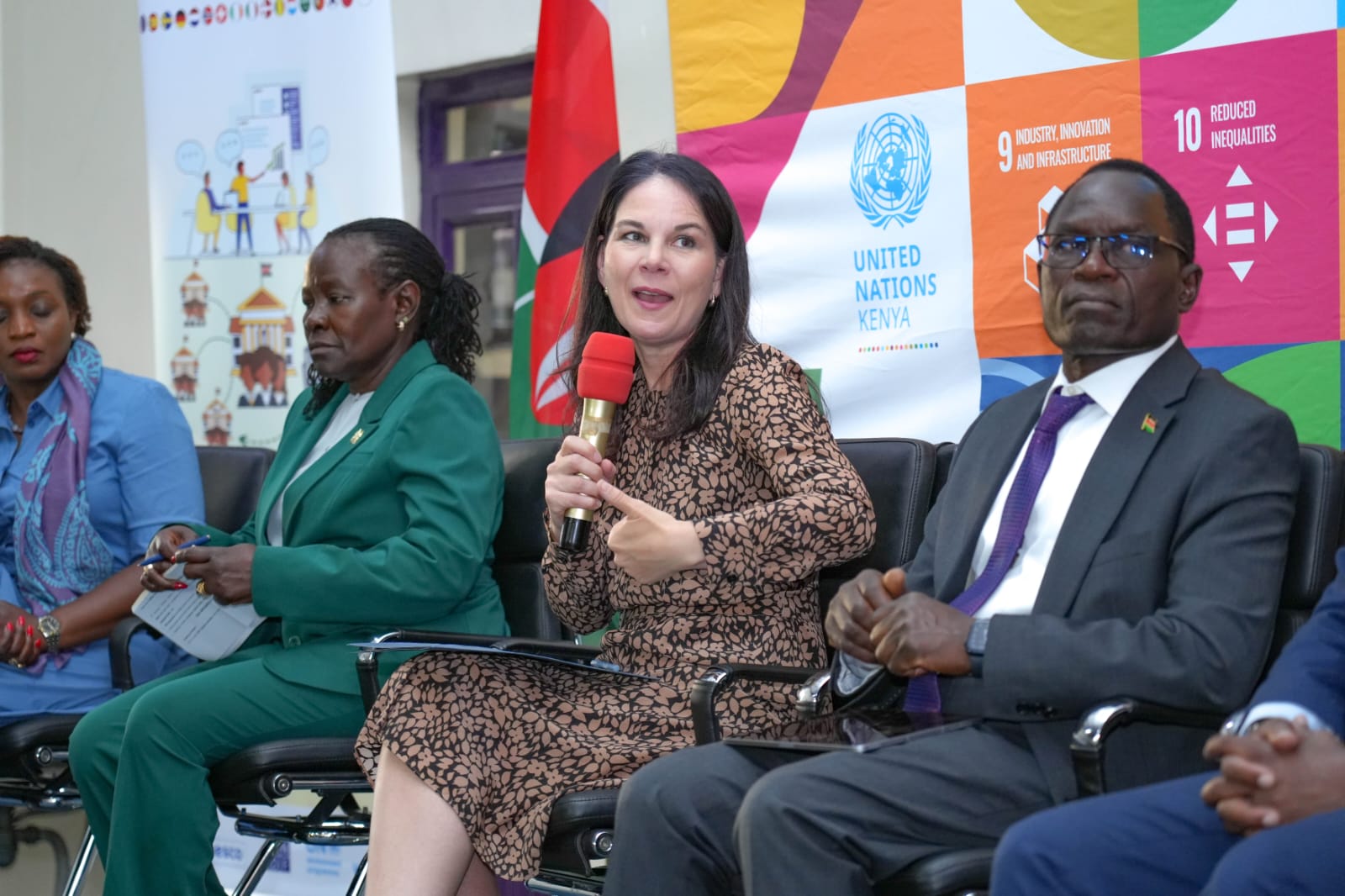
Amani’s story is a single thread in a massive tapestry of economic transformation sweeping across Kenya. This week, that transformation took centre stage during an official visit to Kenya by the President of the United Nations General Assembly, H.E. Ms. Annalena Baerbock, who was hosted at PCKTTI for a high-level review of inclusive digital transformation on the ground.
The high-profile event brought together key leaders across government and international diplomacy, including Broadcasting and Telecommunications Principal Secretary Stephen Isaboke; TVET Principal Secretary Dr. Esther Muoria; Hon. John Kiarie, MP for Dagoretti South; and Kenya’s Permanent Representative to UN-Habitat, Susan Nakhumicha Wafula. They were joined by a robust delegation of global dignitaries, including the UN Resident Coordinator and representatives from UNESCO, UN Women, UNCDF, and UNEP.
At the heart of the tour was the DigiKen (Digital Platforms Kenya) initiative, an ambitious, $4.26 million 36-month UN Joint Programme funded by the UN Joint SDG Fund. Spearheaded by UNESCO in partnership with Kenya’s Ministry of ICT and Digital Economy, the project aims to train 20,000 government officials, support 150 MSMEs, and ultimately unlock over 24,500 direct and indirect jobs by 2027.
The high-level meeting
Welcoming the international delegation, Dr. Esther Muoria lauded the strategic intersection of technical training and the modern digital economy.
“This partnership bridges the gap between traditional technical training and the digital frontier,” noted TVET PS Dr. Esther Muoria during the tour. “By turning our TVET institutions into vibrant innovation hubs, we are ensuring that Kenyan youth are not just consumers of technology but the creators, innovators, and leaders of tomorrow’s global digital economy.”
Echoing her remarks, PS Stephen Isaboke emphasised the national government’s unyielding stance on digital inclusion and regional ecosystem building.
“The Government of Kenya remains committed to ensuring that no one is left behind in the digital age,” stated PS Stephen Isaboke. “Through the Digital Superhighway agenda and partnerships such as DigiKen, we are expanding digital opportunities for youth, women, and persons with disabilities, while strengthening innovation ecosystems across the country.”
PS Isaboke further highlighted the exceptional performance of the host institution, noting, “We are particularly proud of the PC Kinyanjui Jitume Hub, which is a model for TVET-led digital innovation. Through training in areas such as coding, artificial intelligence, cybersecurity, data analytics, and digital entrepreneurship, the Hub is equipping young people with skills required for the jobs of the future.”
The high-level discussions firmly aligned with local impact, centering heavily on skills development, digital transformation, and inclusive economic participation under Kenya’s Bottom-Up Economic Transformation Agenda (BETA). PCKTTI served as a live blueprint, illustrating how collaboration between the Government of Kenya and the United Nations is expanding access to digital skills, innovation pathways, and enterprise opportunities for everyday trainees.
Among the beneficiaries changing the local economic landscape is Winnie Achieng, a clinical officer who travelled from Kilifi to demonstrate how the hub network breathes life into grassroots commerce. Standing by her display of value-added local food products, Achieng credits the digital ecosystem with giving her the technical edge needed to scale her enterprise.
“Through DigiKen and the Kilifi Innovation Hub, I have gained the knowledge and confidence to turn my local resource innovations into a growing business,” Achieng shares.
The program’s unique architecture relies on a “cascade” model, where public sector leaders and trainers are equipped with advanced technical knowledge to train communities at scale. On a projection screen inside the hub, Vera Obonyo, Deputy Director at the Kenya School of Government’s eLearning & IT Institute, highlighted this public-sector synergy.
“As the implementing partner for the government, the Kenya School of Government is empowering 20,000 public servants at scale to lead digital transformation and AI governance,” said Obonyo.
For local trainers like Philip Omondi Ochola, the Jitume hub center manager, completing this curriculum means having the tools to directly uplift hundreds of learners annually.
“It empowers us to cascade AI, platform governance, digital ethics, and transformation leadership across the hub network, drastically strengthening learner-centered services,” Ochola notes.
The grass-roots impact of this joint delivery model visibly impressed the visiting global dignitary. During her remarks, H.E. Ms. Baerbock noted that the visit played an important role in allowing the UN to experience first-hand the real-world impact of General Assembly decisions and their actual implementation in beneficiary Member States.
“The UN was established for the people and has always been standing together with the people,” said H.E. Ms. Baerbock. “Today in Kenya, I visited a material recovery facility supported by UN-Habitat, along with a digital innovation hub that combines the work of four different UN entities. These projects show the power of joint delivery and the UN’s work on the ground towards the 2030 Agenda and the New Urban Agenda.”
As the high-level delegation concluded its tour, the engagement reaffirmed a collective commitment to digital competence, inclusion, and equitable access to emerging opportunities. Armed with 100 high-speed computers, reliable internet, backup power, and a certified curriculum, PCKTTI is geared to train over 530 learners annually, ensuring that for youth, women, and persons with disabilities, the digital superhighway remains a tangible, life-changing reality.
A South Korean court has sentenced former President Yoon Suk Yeol to 30 years in jail for sending drones into North Korea.
Prosecutors argued that Yoon ordered the operation in October 2024 to provoke Pyongyang and create a pretext for his failed martial law bid later that year.
When Yoon declared martial law on 3 December, he had claimed he was protecting the country from “anti-state” forces that sympathised with North Korea. But it soon became clear he was driven by domestic troubles and he rolled back the order in the face of mass protests.
Yoon was impeached and is now serving time in prison after he was sentenced to life for insurrection over his botched martial law attempt.
On Friday, the Seoul District Court found Yoon, as well as his former defense minister Kim Yong-hyun, former head of the Defense Counterintelligence Command Yeo In-hyung and former head of Drone Operations Commands Kim Yong-dae guilty of treason and abuse of power.
Kim was sentenced to 30 years in jail, while Yeo received 15 years and Kim Yong-dae received three years in prison with a five-year suspended sentence.
“The defendants used the guise of a military operation to induce provocations from North Korea with the aim of creating a state of emergency,” the court said.
It added that all three officials had “provoked North Korea”, thus “increasing the risk of a military conflict”, but concluded that Yoon bore the “greatest responsibility” in this event.
Yoon’s lawyers had argued that his actions were a “legitimate” response to North Korea’s “provocations with rubbish balloons”.
This was a reference to North Korea dropping hundreds of balloons in 2024, which were later found to contain “filthy waste and trash”, across the border in the South.
The two countries have used such “propaganda balloons” in their campaigns since the Korean War, where messages are put inside the balloons.
But tensions shot up in 2024 when North Korea accused the South of flying drones into its capital. These drones allegedly scattered propaganda leaflets all over Pyongyang, in what the North described as a provocation that could lead to war.
It was Yoon who sent these drones into the North expecting it to strike back, said a judge in Friday’s ruling.
Apart from insurrection, Yoon has was also sentenced to five years in jail for abuse of power and obstructing his own arrest.
Yoon’s martial law attempt and the protests that followed created months of chaos in the country, ending in an election which saw the opposition Democratic Party’s Lee Jae-myung win a decisive mandate.
The education sector has received the largest allocation in the National Government’s Budget Estimates for the 2026/27 Financial Year, underscoring the government’s commitment to strengthening quality learning, training and research.
Presenting the budget estimates in Parliament on Thursday, Treasury Cabinet Secretary John Mbadi announced that the sector has been allocated Ksh784.5B, representing 26.6 pc of the total budget. This marks an increase from the Ksh701.1 B allocated in the previous financial year.
The funding will support schools, teachers, universities and Technical and Vocational Education and Training (TVET) institutions.
The CS dismissed claims that the government was defunding education. “It is not correct that this government, this administration, is defunding education. In fact, we are funding it more. From Ksh526M in 2022, it has increased now by 49pc”, he said.
A total of Ksh424B has been allocated to the Teachers Service Commission (TSC) to cater for teachers’ salaries, while basic education will receive Ksh136.6B.
Under capitation programmes, Ksh7B has been earmarked for free primary education, Ksh54.6B for free day secondary education, and Ksh30.7B for Junior Secondary School (JSS) learners.
The budget also provides Ksh4.9B for the conversion of 20,000 intern teachers to permanent and pensionable terms beginning January 2027, with a further 24,000 expected to be absorbed in July 2027.
“In this respect, I propose an allocation of KSh 8.2 billion for intern teachers to address staffing gaps and improving learning outcomes”, he stated.
Additionally, Ksh 9.9B will be used for administering National Examinations, and Ksh 3.0B for the School Feeding Programme.
Infrastructure
To improve learning environments and skills training, Ksh4.1B has been proposed for primary and secondary school infrastructure, and Ksh 2.1B for the construction and equipping of TVET Centres, Ksh 7.1B for the Kenya Primary Education Equity in Learning Program, and Ksh 4.7B for Kenya Secondary Education Improvement Project.
“This comprehensive allocation safeguards service delivery and expands opportunities across the learning continuum”, he said.
To enhance access to higher education, the budget provides Ksh 56.3B to the Higher Education Loans Board (HELB) for student loans, Ksh 30.9B for university scholarships, and Ksh 9.2B for TVET scholarships.
The government has also allocated Ksh 6.7 B to settle Collective Bargaining Agreement (CBA) arrears for universities and implement the 2021–2025 CBA, alongside Ksh 5.9B for ongoing university development projects nationwide.
Mbadi assured that the government will continue promoting equity and inclusivity, increasing investment in education, and strengthening the sector’s capacity to respond to emerging technological trends and evolving labour market demands.
“The government will continue to promote equity and inclusivity, scale up investment in education and fortify the system against emerging technological and labour market shifts, as well as fortify education-to-industry linkages, thus ensuring skills match demand”, he said.
Detectives from Imenti North have arrested three individuals implicated in a fraud scheme that allegedly siphoned more than Ksh22.4 million from a savings and credit cooperative society (SACCO).
According to the Directorate of Criminal Investigations (DCI), investigations uncovered a sophisticated fraud network in which suspects manipulated the SACCO’s computerised financial systems to illegally access and transfer funds.
At the center of the scheme is Allan Karani, the SACCO’s ICT Assistant Officer, who is alleged to have masterminded the operation.
Further investigations revealed that accounts associated with Tony Mwenda, Sharon Kendi, Brivin Dentel, and Mawingu Plus Ltd were used to receive and withdraw the stolen funds.
The first breakthrough in the case came on June 4, 2026, when Tony Mwenda was arrested. Authorities subsequently obtained custodial orders to facilitate further investigations.
On June 10, 2026, detectives conducted a coordinated operation that led to the arrest of Allan Karani, Betty Kanana, and Sharon Kendi.
During the operation, officers recovered several mobile phones and a company laptop, which have been seized for forensic analysis as investigators seek to establish the full extent of the fraud.
“What was supposed to be a haven for savings has turned into a nightmare for many, with evidence indicating that a conspiracy involving multiple suspects was at play, utilising the SACCO’s electronic systems to orchestrate their fraud,” the DCI said in a statement.
The three suspects remain in police custody and are awaiting arraignment.
The Energy and Petroleum Regulatory Authority (EPRA) has called on global investors to explore opportunities in Kenya’s geothermal sector, citing the country’s vast resource potential and ongoing efforts to strengthen regulatory frameworks that support sustainable energy development.
Speaking at the World Geothermal Congress currently underway in Calgary, Canada, EPRA Acting Director General Joseph Oketch said Kenya remains one of the world’s leading geothermal destinations, backed by robust planning tools and policy frameworks that ensure sustainable growth of the energy sector.
Oketch noted that the authority is overseeing the implementation of the Integrated National Energy Plan Regulations 2025, which seek to harmonise county and national energy planning.
“We are currently overseeing the implementation of the INEP Regulations 2025, which seek to align county energy plans with national plans, ensuring coherence across levels of government and ensuring all actors follow a common framework and that energy planning is economically efficient and technically sound,” he said.
Reliable and affordable power
According to EPRA, the Kenya electricity sector is guided by key planning instruments, including the Least Cost Power Development Plan, the National Energy Policy, and the Integrated National Energy Plan.
The Authority said the frameworks are designed to ensure coordinated and sustainable development across all energy subsectors while identifying the most cost-effective pathways for electricity generation and transmission expansion.
Oketch said geothermal energy continues to play a central role in Kenya’s energy mix due to its ability to provide reliable baseload power at comparatively low production costs.
The country is recognised globally as one of Africa’s leading geothermal producers, with the resource contributing significantly to national electricity generation and supporting the government’s transition to clean energy.
New regulations
The EPRA Acting Director General said the authority is finalising the Draft Geothermal Resources Regulations 2026, which are expected to streamline permitting and licensing procedures in the sector while strengthening environmental, health and safety compliance.
“We are making significant strides in establishing frameworks that enhance the operational environment for geothermal energy investments,” Oketch said.
He added that once enacted, the regulations will create a more predictable investment environment while ensuring the responsible development of geothermal resources.
“By establishing clear protocols for permitting and licensing, we are not only attracting investment into the sector but also ensuring that environmental and safety standards are met comprehensively. This creates a win-win for both the industry and the communities where these resources are developed,” he said.
Industry stakeholders have identified regulatory certainty as one of the key factors in unlocking additional geothermal investments, particularly in exploration and resource development.
Geothermal development
He underscored the importance of collaboration between governments, regulators, investors, and development partners in advancing geothermal energy.
He said EPRA remains committed to engaging both local and international stakeholders to develop inclusive regulations that encourage innovation while promoting sustainable energy practices.
“As we advance our regulatory frameworks, we are committed to engaging with both local and international partners to shape an inclusive regulatory environment that supports innovation and sustainable practices in geothermal energy,” he said.
The official added that Kenya aims to strengthen its position as a global leader in geothermal development by creating an enabling environment for investment and ensuring responsible resource utilisation.
EPRA said its participation at the World Geothermal Congress aligns with its mandate of promoting and regulating the sustainable development of geothermal resources while safeguarding environmental and community interests.
Thousands of public officers and their dependents are set to access comprehensive healthcare services following the signing of Public Officers Medical Scheme Fund (POMSF) contracts.
The signing was led by Health Cabinet Secretary Aden Duale alongside Cabinet Secretary for Public Service, Human Capital Development and Special Programmes Geoffrey Ruku, marking a key milestone in strengthening healthcare access for public servants under the government’s Universal Health Coverage agenda.
The exercise also saw the launch of the Social Health Authority (SHA) biometric registration exercise for dependents aged 7 to 17 years.
The contracts, signed between SHA and healthcare providers, including private and faith-based facilities from Level 3 to Level 6, establish a framework for service delivery, reimbursement and accountability to support efficient access to healthcare services for beneficiaries.
Under the enhanced scheme, public officers and their dependents will access a wide range of healthcare services, including outpatient and inpatient care, specialised surgeries, cancer treatment, dialysis, dental and optical services, overseas referrals and reproductive health services, including In Vitro Fertilization (IVF).
Duale stated that the agreed tariffs eliminate unauthorised co-payments for services covered under the scheme and cautioned healthcare facilities against imposing unlawful charges on beneficiaries.
The Cabinet Secretary also launched SHA biometric registration for dependents aged 7–17 years, describing it as a key step towards strengthening patient identification, improving access to health records, enhancing data security and supporting efficient service delivery across healthcare facilities.
The exercise forms part of the Digital Health Agency’s efforts to strengthen digital health systems and improve transparency, accountability and efficiency in healthcare delivery.
The event culminated in the signing of the POMSF Implementation Charter and adoption of the negotiated tariffs, paving the way for full implementation of the scheme.
Among those present were Principal Secretary for Medical Services Dr. Ouma Oluga, Principal Secretary for Public Health and Professional Standards Ms. Mary Muthoni, Principal Secretary for Public Service Dr. Jane Imbunya, Director-General for Health Dr. Patrick Amoth, Vice Chairperson of the Council of Governors and Governor of Tharaka Nithi County Muthomi Njuki, SHA Chief Executive Officer Mercy Mwangangi, representatives of public servants’ unions, KUPPET officials, chief executive officers of public referral hospitals and other health sector stakeholders.
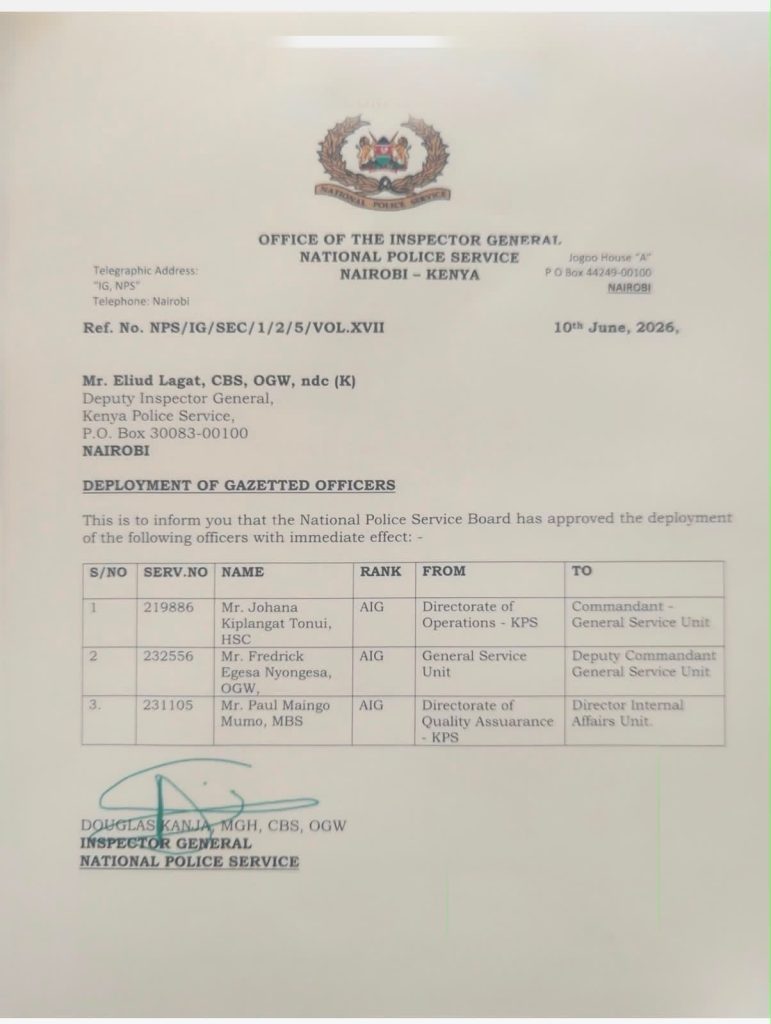
Assistant Inspector General (AIG) Johana Kiplangat Tonui has been appointed the new Commandant of the General Service Unit (GSU) following a reshuffle within the top ranks of the National Police Service (NPS).
Tonui, who previously served at the Directorate of Operations, takes over leadership of the elite paramilitary unit from Ranson Lolmodooni as part of a reshuffle affecting three senior officers in key departments within the National Police Service.
Inspector General Douglas Kanja has also appointed AIG Fredrick Egesa Nyongesa as the Deputy Commandant of the GSU. He served within the unit.
Meanwhile, the Internal Affairs Unit (IAU), which investigates complaints against police officers, will now be headed by AIG Paul Maingo Mumo. Mumo moves to the position of Director from the Directorate of Quality Assurance.
In a notice dated June 10, Inspector General Kanja said the National Police Service Board had approved the deployments, which take effect immediately.
The official communication announcing the changes was addressed to Deputy Inspector General Eliud Lagat.
The latest changes come barely weeks after another reshuffle affecting the Presidential Escort Unit. On May 24, Noah Kirwa Maiyo was transferred from his position as Commandant of the Presidential Escort Unit to the Vigilance Department at Kenya Police Headquarters.
The transfer followed a security breach during President William Ruto‘s public address in Ganze, Kilifi County.
Juda Mathews Gwiyo, who was serving as Deputy Commandant of the PEU, was asked to proceed on leave pending retirement.
The changes also saw William Sawe moved from his role as Commanding Officer of the Recce Sub Unit to take over as the new Commandant of the Presidential Escort Unit (PEU).
George Kirera was transferred from the position of Staffing Officer Personnel at the PEU to serve as Deputy Commandant of the same unit.
In the Recce Sub Unit, Josphat Sirma was elevated from Deputy Commanding Officer to Commanding Officer.
Meanwhile, Rere Kipkoech was transferred from the position of Deputy SOB1 to the Kenya Police Headquarters under the Vigilance Department.
Explainer: The General Service Unit (GSU) Commandant is the senior operational and administrative commander of Kenya’s elite paramilitary police force.
Tasked with leading a highly trained reserve and rapid-response force, the Commandant oversees the enforcement of the Unit’s constitutional mandate and ensures internal security across the country.
The Ministry of Education has revealed that 204 senior schools countrywide have been affected by a wave of unrest in recent weeks, with boarding schools bearing the brunt of the disturbances.
Speaking Wednesday during a media briefing, Education Cabinet Secretary Julius Ogamba ruled out any plans for an early closure of schools, noting that 59 of the affected institutions have already resumed normal operations after learners returned to class. He said efforts are ongoing to restore stability in the remaining schools and ensure learning continues uninterrupted.
Ogamba noted that more than 98 per cent of the country’s senior schools remain stable and are operating normally. Learners in Grades 1 to 9 have not experienced significant disruptions, while learning in day senior schools has largely continued without interruption.
” As a Ministry, we have undertaken preliminary reviews of most of the cases. From our analysis of reports across the country, less than 2% of the country’s senior schools have been affected by unrest, meaning that over 98% of schools remain stable and continue normal operations. Most of the schools affected are boarding senior schools. Day senior schools are largely not affected”, he told journalists.
The briefing comes amid growing concern over rising cases of student unrest and follows the deadly fire at Utumishi Girls Academy in Gilgil, Nakuru County, which claimed the lives of 16 students. Investigations established that the fire was an act of arson allegedly orchestrated by some learners. Nine suspects have since been arraigned in court and remanded in custody pending investigations.
The Cabinet Secretary said the government is treating the unrest and cases of indiscipline in schools with utmost seriousness, stressing that grievances should be addressed through established channels rather than through violence or destruction of property.
“Whatever grievances learners may have, there can never be justification for causing death and destroying property. Any grievances must only be addressed through appropriate channels without resorting to unlawful actions or violence. All perpetrators will be dealt with firmly in accordance with the law”, he warned.
Multi-stakeholder team
To address the recurring challenge, the Government announced the formation of a multi-stakeholder team that will investigate the root causes of school unrest and recommend long-term solutions.
“To establish and address underlying causes of this perennial challenge of student unrest, we shall be forming a multistakeholder team to review the causes of unrest and make recommendations on strategies for stemming the challenge”, he said.
The Ministry also confirmed that the second-term mid-term break will proceed as scheduled from June 24 to June 28, 2026. Parents and guardians have been urged to use the break to engage with their children, provide guidance and raise any concerns through appropriate channels.
Schools have been directed to urgently convene Parents Association meetings to discuss learner welfare and the current situation in their institutions. They have also been instructed to strengthen safety measures, improve grievance-handling mechanisms and intensify guidance and counselling programmes.
Additionally, County and Sub-County Education Offices will conduct targeted safety assessments and monitor schools considered at risk of unrest.
Additionally, Migos announced plans to rationalise the school calendar from the next academic year to ensure balanced school terms.
“Starting next academic year, the Ministry shall rationalise the school calendar to ensure balanced terms across the school year”, he noted.
The Ministry commended the majority of learners, teachers, school heads and parents for maintaining discipline and ensuring continuity of learning despite the recent challenges, calling on all stakeholders to work together to safeguard the education sector and the well-being of learners.