Author: Jared Ombui

  • From cattle tracks to coffee farms in Baringo County

    From cattle tracks to coffee farms in Baringo County

    For generations, the hills and valleys of Baringo County have echoed with a story written in dust and conflict the story of cattle rustling, of communities locked in cycles of retaliatory violence, of land scorched not by drought alone but by the persistent embers of insecurity. It is a story that has cost lives, derailed schools, chased away investment, and consigned one of Kenya’s most naturally endowed counties to a reputation it has long deserved to shed. But something is shifting. Along the fertile ridges of Eldama Ravine, in the villages of Sirwa and Mogotio, a new story is being planted literally one seedling at a time.

    The commissioning of the Koibatek ATC Water Dam and the launch of distilling projects in Eldama Ravine, accompanied by the distribution of cash-crop seedlings to local farmers, marked a decisive turning point in the government’s strategy for Baringo. Principal Secretary for Agriculture Dr. Kipronoh Ronoh delivered a message that was as much a challenge as it was a commitment: diversify, plant, and prosper. The era of depending on pastoralism alone in a landscape that can sustain so much more is over.

    The weapon they never expected: A seedling
    Poverty and insecurity are rarely separate problems. In Baringo, cattle rustling has long been both a symptom and a sustainer of economic desperation. When a young man has no viable income, no crop to tend, no harvest to anticipate, the cattle raid becomes in a cruel but comprehensible logic an economic act. The government’s intervention is therefore not merely agricultural. It is a peace strategy dressed in green leaves.

    By introducing high-value cash crops into communities that have historically relied on livestock, the Ministry of Agriculture is disrupting the economic incentive structure that makes rustling attractive. A farmer tending a coffee plantation worth Kshs. 150,000 per season has a stake in stability. He does not leave his crop to mount a raid. He does not welcome the chaos that burns neighbours’ farms and closes the roads his produce must travel to reach the market. Prosperity, quietly and powerfully, is one of the most effective peacekeeping tools ever invented.

    “The government remains committed to tapping the huge potential of coffee and tea in Baringo County ensuring more land is brought under irrigation and propagating over 3 million coffee and 5 million tea seedlings for distribution to farmers.” PS Agriculture Dr. Kipronoh Ronoh, Eldama Ravine

    Three crops, one county, unlimited potential
    Baringo’s agro-ecological zones are far more diverse than its semi-arid reputation suggests. The highlands around Eldama Ravine receive reliable rainfall and enjoy fertile soils entirely capable of sustaining premium cash crops. The government’s focus on three specific commodities is both deliberate and shrewd:

    Coffee — A high-value global commodity with growing demand; KALRO’s 3 million seedling propagation programme positions Baringo to become a significant contributor to Kenya’s premium coffee export story.

    Avocado — Kenya is already Africa’s largest avocado exporter. Baringo farmers entering this market now join a value chain with proven, rapidly expanding European and Asian demand and strong farm-gate prices.

    Macadamia — One of the world’s most lucrative tree nuts, macadamia thrives in Kenya’s highlands and offers Baringo farmers a long-term, low-maintenance income stream that grows more valuable each year.

    Water is the game-changer
    No crop strategy survives without water. The commissioning of the Koibatek ATC Water Dam is therefore not a backdrop to this story it is its enabling chapter. Irrigation is the single most transformative lever available to semi-arid and sub-humid counties like Baringo. It converts rain-dependent, one-season farming into a year-round productive enterprise, decouples farmers from the volatility of rainfall patterns worsened by climate change, and dramatically increases the land area that can sustain commercial-grade crop production.

    Combined with the establishment of a KALRO centre in Baringo to propagate over 3 million coffee and 5 million tea seedlings, and the active support of PS ICT Dr.Eng. John Kipchumba Tanui and Eldama Ravine MP Musa Sirima, the infrastructure for a genuine agricultural transformation is no longer a promise it is being physically installed. What Baringo now needs from its farmers is the courage to plant, the patience to tend, and the collective will to build a county whose wealth grows from the ground up not from the barrel of a gun or the theft of a neighbour’s herd. The seedlings have been distributed. The dam is full. The future is ready to be farmed.

  • What Ruto’s Nordic mission means for Kenya’s future

    What Ruto’s Nordic mission means for Kenya’s future

    It was a pointed headline that forced a presidential rebuttal. “William Ruto is travelling again,” the Kenyan media declared and this time, the President of Kenya chose not to let it pass unanswered.

    Standing before a gathering of Kenyans living in Helsinki, Finland, on the evening of June 11, 2026, President William Ruto delivered what may be the most candid and consequential defence of executive diplomacy heard from a Kenyan leader in a generation. “I have not come here as a tourist,” he said, his voice carrying the unmistakable weight of a man who had spent five days in Brussels, Oslo, and Helsinki closing deals that most critics had not bothered to look up.

    The speech was short. It was direct. And buried in its matter-of-fact delivery was a vision of Kenya that is rarely articulated with such specificity from the highest office: a nation actively repositioning itself not as a recipient of global goodwill, but as a deliberate, strategic actor on the world stage. “I am the chief diplomat of our country,” Ruto told the diaspora audience. “People want to know what Kenya stands for.”

    The Deals Behind the Departure
    Critics of presidential travel often focus on cost and optics. What they miss is the opportunity cost of absence. In Brussels, Ruto negotiated the stability of Kenya’s Economic Partnership Agreement with the European Union a framework that governs billions of shillings in trade while simultaneously laying groundwork to onboard East African Community partners ahead of the critical 2031 scaling deadline. A missed conversation at that level is not a saved flight allowance; it is a potentially disrupted trade architecture that takes years to repair.

    But it was the EU data adequacy agreement secured in Brussels and set for formal framework adoption by August or September 2026 that deserves particular attention. In a world where data flows are the new oil pipelines, Kenya gaining EU data adequacy status means Kenyan businesses and tech firms can exchange data with European partners under the same legal protections as EU member states. For a country positioning itself as Africa’s premier technology and business process hub, this is not a bureaucratic footnote it is a competitive advantage of historic proportions.

    “I have not come here as a tourist. I have come here pointedly to make sure that we achieve certain things. Just for the record, I am the chief diplomat of our country.” — President William Ruto, Helsinki, 11th June, 2026

    Nokia, Data Centres, and the Digital Frontier
    In Finland, Ruto held what he described as a “most consequential meeting” with Nokia the global telecommunications and network infrastructure giant on deploying data centres in Kenya. This is not a marginal technology announcement. Data centres are the foundational infrastructure of the digital economy: they host cloud services, enable AI workloads, attract multinational technology investment, and create high-skill employment. Nokia’s commitment signals that Kenya is being considered not merely as a market, but as a regional digital infrastructure hub for Sub-Saharan Africa.

    Key Deliverables from the Nordic & Brussels Mission:
    Brussels, Belgium — EU–Kenya Economic Partnership Agreement stability secured; EAC partners recruitment for 2031 scale-up initiated
    Brussels, Belgium — EU data adequacy agreement framework agreed; formal adoption expected by August–September 2026
    Oslo, Norway — Bilateral agreements on key sectors advanced with Norway; specific instruments to be formalised
    Helsinki, Finland — Nokia data centre deployment in Kenya agreed; Kultaranta Talks foreign policy forum — first African head of state to participate

    Diplomacy Is Not a Departure — It Is a Delivery
    The deeper argument Ruto was making in Helsinki was not a personal defense. It was a structural one. In the 21st century, no economy however well-governed domestically — can afford to operate in diplomatic isolation. Trade agreements, technology partnerships, investment frameworks, and global governance influence are all negotiated face to face, at bilateral meetings, multilateral forums, and yes at town halls with diaspora communities who carry Kenya’s name and reputation with them every day.

    Kenya’s diaspora remittances exceeded Kshs. 700 billion in 2025, making them one of the country’s largest inflows of foreign exchange. The Kenyans sitting in that Helsinki hall were not bystanders to their country’s economic story they were, in many cases, funding it. A president who travels to meet them, brief them, and hear their concerns is not wasting time. He is doing exactly what a chief diplomat should do.

    Dr. Yusuf Muchelule is a Senior Lecturer & a Consultant.

  • Rethinking success in academic careers

    Rethinking success in academic careers

    The end of an academic contract used to feel like a clear chapter break: you finished, you left, you moved on. Today, for many early- and mid-career academics, it feels more like being stuck in a long, blurry middle teaching on short contracts, applying endlessly, and wondering when “real stability” will finally show up. This uncertain middle is not a personal failure; it is the new normal in a higher education ecosystem defined by precarity, competition, and constant change.

    In this uncertainty, one quiet but radical move is to stop waiting for clarity and start designing it. Instead of asking “Will I get a permanent post?”, the more powerful question becomes “What kind of academic life do I want to build, and what experiments can I run this year to move toward it?”. That shift from prediction to design releases you from the fantasy of a single “correct” path and opens space for multiple, parallel futures. You might pursue a tenure-track role, cultivate industry collaborations, and pilot a community-based project, all as legitimate strands of your professional identity.

    To design that future with intention, think in three portfolios rather than one job title: a portfolio of skills, a portfolio of relationships, and a portfolio of impact. Your skills portfolio goes beyond formal qualifications to include habits like facilitation, grant writing, public speaking, coding, mentoring, data storytelling, or digital pedagogy. Naming and curating these capabilities makes it easier to see how they travel across institutions, sectors, and even countries. Your relationships portfolio centres the people you learn with and from colleagues, students, alumni, and partners treated not as “contacts” but as a learning community you actively tend over time.

    The impact portfolio asks a different kind of question: “If my current role disappeared tomorrow, what remains of my contribution?” Impact can live in an open educational resource, a policy brief, a community workshop series, or a student-led innovation you helped nurture. By deliberately creating artefacts that outlive your contract, you anchor your value in more than a job description. This also makes your next application, pitch, or promotion case far more compelling, because you are not just listing duties; you are demonstrating legacies.

    Thriving in the uncertain middle does not mean suppressing anxiety or pretending the system is fair. It means holding three practices together: honest naming of constraints, imaginative design of alternative futures, and disciplined, small-scale experimentation in the present. Each semester, you might choose one skill to deepen, one relationship network to strengthen, and one visible contribution to produce, regardless of what HR decides. Over time, these accumulative choices transform waiting into building. The middle stops being a holding pattern and becomes a workshop a place where you quietly craft the next version of your academic life long before any contract can fully define it.

    Dr. Yusuf Muchelule is a Senior Lecturer & a Consultant.

  • Kenya to complete Kshs 2.4B Maritime Survival Training Center by December

    Kenya to complete Kshs 2.4B Maritime Survival Training Center by December

    Bandari Maritime Academy (BMA) is on track to complete a Ksh 2.4 billion Maritime Survival Training and Certification Center by December 2026, a facility officials say will cement Kenya’s position as East Africa’s premier hub for maritime education.

    The center will offer internationally accredited training in maritime safety, survival techniques, firefighting, emergency response and rescue operations competencies required under the International Maritime Organization’s Standards of Training, Certification and Watchkeeping Convention.

    “The Maritime Survival Training and Certification Center is not just an infrastructure project; it is an investment in Kenya’s future,” said BMA Chief Executive Officer Dr. Erick Katana. “It will empower thousands of young Kenyans with globally competitive maritime skills and create pathways to employment across the international shipping industry.”

    The facility will feature survival-at-sea training pools, firefighting simulation units, emergency evacuation facilities and rescue boat operation areas. Equipment will be designed to replicate real-life maritime emergencies, officials said.

    Katana said the center would reduce the need for Kenyan trainees to travel abroad for specialised safety training, lowering costs and increasing access for aspiring seafarers seeking certification for international deployment.

    Beyond Kenya, the academy expects the facility to attract students from across East and Central Africa, positioning the country as a regional center of excellence for maritime professional certification.

    “Kenya possesses immense human capital potential,” Katana said. “By providing internationally accredited maritime training locally, we are opening doors for our youth to access rewarding careers in the global maritime labour market.”

    The project will also strengthen maritime safety standards, improve emergency preparedness and support growth across Blue Economy sectors including shipping, fisheries, tourism, logistics and offshore energy.

    “The Blue Economy cannot thrive without competent and safety-conscious professionals,” Katana said. “This center will play a pivotal role in developing the workforce needed to drive sustainable growth across maritime industries.”

    The construction of the center began on 1st July, 2024.

  • The Day the Library Went Silent

    The Day the Library Went Silent

    I recently found myself standing in front of my home library, staring at shelves lined with books accumulated over decades. Some had been carefully selected, others gifted, and a few purchased during moments of intellectual curiosity or professional necessity. As I scanned the collection, a simple but unsettling question came to mind: When was the last time I picked up a physical book and read it from cover to cover?

    The answer surprised me. In my case, it was probably close to ten years ago.It is not that I stopped reading. Far from it. In fact, I probably consume more information today than at any other time in my life. What has changed is not the desire to learn, but the way knowledge is accessed, filtered, consumed, and applied.

    We are living through one of the most profound shifts in human history. For centuries, books were the primary gateway to knowledge. They were repositories of wisdom, records of events, and vehicles through which ideas travelled across generations. To be well-read meant spending countless hours in libraries, bookshops, and personal studies. The printed page was king.

    Today, that kingdom is being challenged. Modern readers are increasingly selective. Time has become our scarcest resource. Before committing hours to a publication, many of us instinctively ask a simple question: What value will this add to the problem I am trying to solve? If the answer is unclear, we move on.

    When undertaking research, I often find myself asking why I should limit my search to a handful of books on a shelf when I can access thousands of sources online within minutes. Search engines, digital archives, academic databases, and now artificial intelligence have transformed the way information is discovered and synthesized. What once required weeks of effort can now be accomplished in hours, sometimes minutes.

    This reality raises an uncomfortable question for authors, publishers, and scholars: Who are we writing for, and how will they find us?

    Across the world, book launches continue to be celebrated with enthusiasm. Authors gather friends, relatives, colleagues, and admirers to unveil years of hard work. Speeches are made, photographs taken, and copies purchased in support of the occasion. Yet, one cannot help but wonder how many of those physical books are actually read. How many become living sources of knowledge rather than decorative ornaments gathering dust on bookshelves?

    The challenge facing authors today is no longer simply writing a book. The challenge is ensuring that the knowledge contained within it remains discoverable, relevant, accessible, and useful in an increasingly digital world.

    The digital age has fundamentally changed the economics of attention. Readers are no longer competing for access to information; they are overwhelmed by it. Every day, millions of articles, reports, videos, podcasts, and social media posts compete for a limited number of human hours. In such an environment, publication alone is no longer enough. Visibility, credibility, and utility matter just as much as authorship. Perhaps even more significant is the challenge technology poses to the concept of authority itself.

    For generations, published works enjoyed an almost sacred status. Once printed, a book was often accepted as a definitive record. Today, technology allows readers to cross-reference claims instantly, compare perspectives globally, and verify facts against multiple sources. Artificial intelligence can analyse vast bodies of information and expose inconsistencies that might once have remained hidden for decades. This development should not be feared. It should be welcomed.

    The age of unquestioned authority is giving way to the age of transparent accountability. Authors, researchers, journalists, policymakers, and institutions are increasingly required to support their claims with evidence that can withstand scrutiny. In many ways, this strengthens knowledge rather than weakens it.

    The real question, therefore, is not whether books are dying. Books will survive, just as radio survived television and television survived the internet. The deeper question is whether we are adapting our understanding of publishing to a world where access to information is instant, verification is continuous, and audiences are more discerning than ever before.

    The library has not disappeared. It has simply expanded beyond its walls. Today it exists in our phones, our laptops, our cloud storage, our search engines, and increasingly within intelligent systems capable of helping us navigate oceans of information. The role of the modern author is no longer merely to publish. It is to create knowledge that remains valuable in a world where information is abundant but wisdom remains scarce.

    As I stood before my shelves that day, I realised the books had not become less important. What had changed was the reader. And perhaps that is the real story of our time.

    Edward Mwasi is a Media Strategy and Innovation Consultant

  • Kenya – Norway deal to employ 1,000 seafarers by 2030

    Kenya – Norway deal to employ 1,000 seafarers by 2030

    Bandari Maritime Academy (BMA) Chief Executive Officer Dr. Eric Katana has welcomed the agreement signed by President William Ruto and Norwegian shipping firms, which will see at least 1,000 Kenyan seafarers employed by 2030.

    The deal, announced following a series of meetings in Oslo, Norway, includes commitments from leading maritime employers and industry stakeholders to recruit Kenyan maritime professionals. An initial target of 120 Kenyan seafarers is expected to be achieved by the end of this year.

    Speaking on the development, Dr. Katana said the agreement is a wake-up call to Kenyan youth on the numerous opportunities available in the global maritime industry.

    “This agreement sends a strong message to Kenyan youth about the vast employment opportunities that exist within the international maritime sector. It is an opportunity for many young people to pursue careers that can transform their lives and contribute to the country’s economic growth,” said Dr. Katana.

    The BMA CEO noted that the agreement is expected to increase demand for maritime training and certification, urging more Kenyans to enroll in maritime courses at the academy.

    “As a regional Centre for maritime training, we are ready to train the seafarers required by Norwegian shipping firms and other maritime employers across the world,” he said.

    Dr. Katana further highlighted the academy’s world-class training infrastructure, which equips students with practical skills required in the maritime sector. The facilities include a Full Mission Bridge Simulator, Gantry Crane Cargo Simulator, Engine Room Simulator, and an Aquatic Centre.

    He said these state-of-the-art facilities enable the academy to provide comprehensive training across various maritime disciplines, ensuring graduates meet international standards and are ready for employment in the global shipping industry.

    The Kenya-Norway partnership is expected to strengthen bilateral cooperation in the maritime sector while opening up employment opportunities for Kenyan seafarers in international waters.

  • Why our marriages break faster than our parents

    Why our marriages break faster than our parents

    The divorce stories are getting younger, sharper and more sophisticated. People who speak fluent psychology, quote attachment styles and can diagnose “narcissists” from three reels on Instagram are walking out of marriages at a rate that terrifies even themselves. We are educated, exposed and empowered yet our unions are fragile, short-lived and often emotionally exhausted long before the legal dissolution.

    Our grandparents knew almost nothing about “red flags” and “boundaries,” yet their marriages somehow survived decades of poverty, droughts, in laws, polygamy and cultural shifts. They did not post hugs online, never staged proposal videos, rarely used pet names, and had no “date nights” sponsored by airlines. Still, their marriages endured the slow grind of life in a way many modern Christian unions do not. The question nags: were they better, or just quieter in their suffering?

    Today, a spouse is dismissed in a sentence: “He’s a narcissist, I left that morning.” “I don’t like the imposter syndrome she carries, I’m out.” Labels that took psychologists years to define now become exit buttons. Narcissism as a personality trait is not new, but our vocabulary for it is. Our parents endured difficult personalities too, but they described them with different words: “mwenye kichwa ngumu,” “too proud,” “has a temper.” The difference may not be the existence of hard people, but the threshold of what we are willing to endure and the number of doors we perceive as open when things get tough.

    Endurance, however, is a dangerous word if we do not interrogate it. “Until death do us part” sounds noble during the vows, but what is dying, exactly? Is it the physical body of the spouse, or the death of love, trust and safety? Enduring a partner’s humanity their flaws, moods, growth pains – is part of covenant. Enduring violence, humiliation or the slow murder of one’s soul is something else entirely. The older generation’s endurance gave stability, yes, but it also buried a lot of silent pain that erupted in their children’s emotional lives.

    Then there is submission, that word that can start a war in a room full of women. Our grandmothers often submitted because there was no alternative script; survival depended on compliance. Today, a woman with her own income, education and social capital hears “submit” and sees a threat to her identity. If submission is taught as erasing your voice, talents and personhood, of course it will feel like slavery. If, however, it is framed as mutual yielding a dance where both partners bend so neither breaks – it starts to resemble teamwork more than chains.

    On the other side, some men have exploited old ideas of submission to avoid adulthood. Why carry responsibility if culture excuses your laziness and infidelity? When a man never grows emotionally, spiritually or financially, the empowered woman beside him does not interpret submission as virtue; she experiences it as self-betrayal. It is easier to preach about “modern women who don’t submit” than to confront growing male irresponsibility and emotional absenteeism. Leadership without sacrifice will always feel like oppression to the one being led.

    Beneath all the noise lies a simpler truth: our structures for handling conflict are weak. We either romanticize marriage into a heaven with no fights, or endure in silence until resentment calcifies into contempt. Very few couples are taught how to argue without destroying each other, how to seek mediation early, how to confess and repair. Instead, issues are swept under carpets until those carpets become volcanoes. When eruption finally comes, everyone is shocked yet the signs were there, ignored, belittled or spiritualized away.

    Ignorance was not a blessing; it was a form of survival. Enlightenment is not a curse; it is a tool that can heal or harm depending on how we use it. The real crisis may not be knowledge but the lack of wisdom to balance endurance with dignity, submission with mutual respect, empowerment with humility, and exit with genuine attempts at repair. The question haunting our generation is no longer, “How did they stay so long?” but “Do we still know how to stay at all and when, wisely, not to?”

    Dr. Yusuf Muchelule is a Senior Lecturer & a Consultant.

  • Xi, Kim hold talks in Pyongyang, pledge to advance China-DPRK ties

    Xi, Kim hold talks in Pyongyang, pledge to advance China-DPRK ties

    Xi Jinping, general secretary of the Communist Party of China Central Committee and Chinese president, said on Monday that China and the Democratic People’s Republic of Korea (DPRK) should consolidate the foundation of political mutual trust and enhance the level of practical cooperation.

    Xi made the remarks during his talks with Kim Jong Un, general secretary of the Workers’ Party of Korea and president of the State Affairs of the DPRK. Xi arrived in Pyongyang on Monday for a two-day state visit to the DPRK. Xi noted that after seven years, he is very pleased to once again visit the beautiful city of Pyongyang, and feels especially warm and familiar. He expressed his readiness to work with Kim to take this visit as an opportunity to strengthen top-level planning and strategic guidance for China-DPRK relations in the new era, keep bilateral relations advancing with the times and achieve greater progress in bilateral ties, so as to better benefit the two countries and peoples, and make positive contributions to peace, stability, development and prosperity in the region and the world. Stressing that China and the DPRK are both socialist countries led by communist parties, Xi said that the traditional friendship between the two countries is rooted in their shared ideals and beliefs as well as their common goals, and is backed by a profound historical foundation, a solid political basis and strong emotional bonds.

    Xi noted that friendship passed down from generation to generation, a shared future and mutual support have always been the defining features of China-DPRK relations. No matter how the international situation changes, the Chinese party and government’s firm stance on highly valuing China-DPRK traditional friendship will not change, the firm support for General Secretary Kim in leading the DPRK’s socialist cause will not change, and the firm commitment to safeguarding the shared interests of the two countries and preserving a favorable strategic environment will not change, Xi said. Xi pointed out that, in the face of the profound changes unseen in a century that are accelerating across the world, the two sides should take a broad and long-term view, build on past achievements and open up a new future, draw wisdom from the development process of the relations between the two parties and the two countries, seize opportunities in the prevailing trend of human history, inject new contemporary connotations and strong impetus into the traditional friendship between China and the DPRK, and open up a brighter prospect for the socialist cause of the two countries as well as regional peace and development.

    During the meeting, Xi put forward four proposals on developing China-DPRK relations. The two sides should stay guided by the high-level exchanges and consolidate the foundation of political mutual trust, Xi said. The strategic guidance by the top leaders of both nations is the greatest strength of China-DPRK relations, he added, noting that he stands ready to maintain close strategic communication with Kim and guide China-DPRK relations to continuously reach new heights. Noting that this year marks the 65th anniversary of the China-DPRK Treaty of Friendship, Cooperation and Mutual Assistance, Xi said that both sides will hold grand commemorative events. The relations between the two parties play an important guiding role in the development of China-DPRK relations, Xi said, calling for further expansion and invigoration of friendly exchanges at various levels and in various fields between the two parties, as well as the deepening of exchanges of experience and mutual learning on party and state governance.Both sides should enhance exchanges in diplomacy, law enforcement, military affairs and others, implement the important consensus reached between the two leaders, and pool wisdom and strength for the development of China-DPRK relations, Xi said.

    The two sides should stay committed to the goal of delivering benefits to the people and elevate the level of practical cooperation, Xi said. China stands ready to work with the DPRK to strengthen the alignment of development strategies, and expand practical cooperation in such areas as economy and trade, agriculture, construction, science and technology, as well as health care, to bring greater benefits to the two peoples, he said. Xi called on both sides to leverage the opportunity of the full reopening of border crossings and the resumption of civil aviation flights and international passenger trains to increase people-to-people exchanges and foster mutual interaction. The two sides should uphold the inheritance of friendship as a driving force and strengthen the bonds between their peoples, Xi said, noting that the traditional friendship between China and the DPRK, forged in blood, is a valuable shared asset of the two peoples.

    China stands ready to work with the DPRK to preserve and properly manage the memorial facilities dedicated to the Chinese People’s Volunteers martyrs in the DPRK, carry out distinctive programs on revolutionary traditions and youth education, and pass on the red legacy and traditional friendship between the two countries, Xi said. China is also ready to work with the DPRK to make full use of each side’s strengths and resources, enhance exchanges and cooperation in education, culture and the arts, tourism, sports, media, youth affairs, subnational engagement and sister-city relations, and ensure that the traditional friendship between China and the DPRK takes deeper root in the hearts of the two peoples, Xi said.

    The Chinese president also called for upholding fairness and justice as a guiding principle to enrich the substance of strategic coordination. Xi said that, in response to the major question of where humanity is headed, he has proposed the vision of building a community with a shared future for humanity and the four global initiatives, which aim to steer global governance toward greater fairness and justice and have won broad support and positive responses from the international community, including the DPRK.Noting that Asia is the common home where regional countries, including China and the DPRK, live and thrive, Xi said that the two countries should strengthen strategic coordination, firmly safeguard their respective sovereignty, security and development interests, and jointly uphold regional peace and development. Calling Xi the most respected guest of the DPRK people, Kim said that his country extended the warmest and most cordial welcome to Xi, who visited the DPRK after a seven-year interval.

    Xi’s choice of Pyongyang for his first overseas trip this year fully reflects the great importance he attaches to DPRK-China relations and the profound friendship between the two countries, which is a tremendous encouragement to the DPRK side, Kim said. This visit once again clearly demonstrates that the DPRK-China relationship is unbreakable, Kim said. Calling the bilateral ties time-tested, Kim said that the bilateral ties have always stood on the right side of history and championed autonomy and justice. The special nature of the bilateral relations lies not only in the fact that the two countries are close neighbors, but also in the deep traditional friendship and shared ideals and convictions, which both sides cherish and are committed to carrying forward from generation to generation, Kim said.

    Kim also recalled his meeting with Xi in Beijing last September, noting that since then the bilateral relations have achieved positive progress in various fields, bringing tangible benefits to the two peoples. He voiced sincere appreciation for the important proposals put forward by Xi on advancing DPRK-China relations in the new era, adding that relevant departments of the DPRK side will work closely with their Chinese counterparts and make every effort to fully implement the proposals, promote new progress in bilateral exchanges and cooperation in such areas as economy and trade, infrastructure, science and technology, education, as well as people-to-people and cultural exchanges, and strengthen exchanges of experience and mutual learning through inter-party channels to provide valuable support for the development of the DPRK’s socialist cause, so as to help the DPRK people advance toward modernization together with the Chinese people.
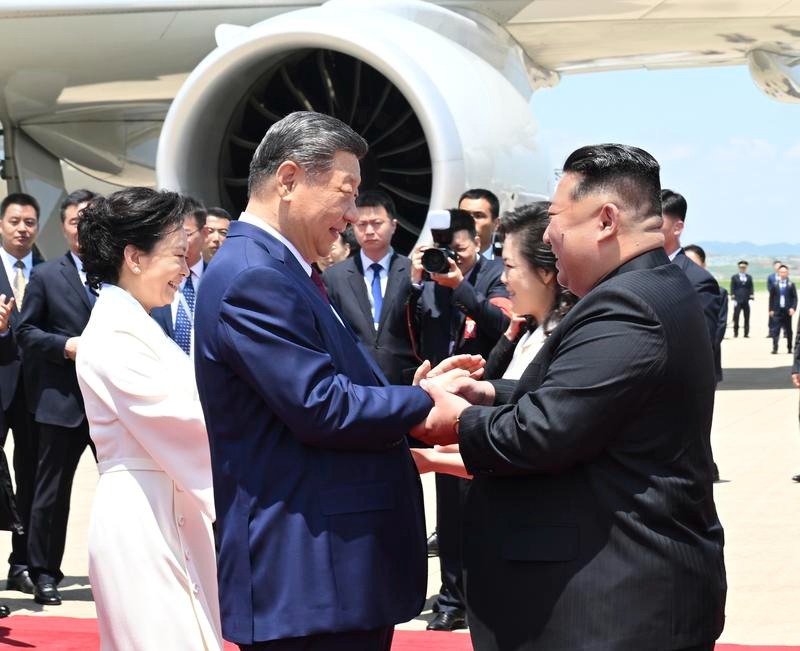
    Kim said that the DPRK is pleased to see that, under the leadership of General Secretary Xi, China has achieved development accomplishments that have amazed the world and significantly enhanced its international status. He noted that the concept of a community with a shared future for humanity and the four major global initiatives proposed by Xi carry profound significance for promoting world peace and development, and have won the support and appreciation of people around the world. Kim said that the international community is undergoing unprecedented and profound changes in recent years, stating that the DPRK will unwaveringly uphold the one-China principle and firmly support China’s policies and positions on safeguarding its core interests. He stressed that consolidating and developing the DPRK-China friendship in the new era is the choice of the peoples of the two countries and a necessity of the times, and remains the DPRK’s consistent strategic choice and steadfast strategic resolve. He said the DPRK will, as always, regard the development of DPRK-China relations as the foremost strategic undertaking of the state, spare no effort to build bilateral relations into a model of interstate relations, and work together with China to contribute to peace and prosperity in the region and the world.

    Before the meeting, Kim held a grand welcome ceremony for Xi at Kim Il Sung Square in Pyongyang. The top leaders of the two parties and the two countries jointly ascended the review stand. Amid a 21-gun salute, the military band played the national anthems of China and the DPRK. Accompanied by Kim, Xi inspected the honor guard of the three services of the Korean People’s Army. After that, Xi watched a march-past with Kim. Also on Monday, Xi attended a welcome banquet hosted by Kim, during which Xi said that the relationship between China and the DPRK stands at a new historical starting point and that he reached important consensus with Kim during the visit. From the strategic perspective of the future and destiny of socialism, both leaders have agreed to seize the general trend of the times, respond to the shared aspirations of the two peoples, strengthen high-level exchanges, deepen strategic communication, expand practical cooperation, enhance people-to-people bonds, promote the high-level development of China-DPRK relations, jointly open up brighter prospects for the socialist cause of both countries, and contribute to the continuous progress of human society, Xi said.

  • Bandari Maritime Academy to recognise prior learning

    Bandari Maritime Academy to recognise prior learning

    Bandari Maritime Academy (BMA) is expanding maritime training opportunities through its Recognition of Prior Learning (RPL) programme.

    Speaking on the initiative, BMA’s Chief Executive Officer Dr. Eric Katana said the programme is designed to help individuals with existing skills and experience gain formal certification for sea and offshore operations. He noted that the move is aimed at increasing the pool of qualified personnel required to support Kenya’s growing Blue Economy.

    “The Recognition of Prior Learning programme provides an avenue for experienced workers to have their knowledge, skills and competencies assessed and certified, enabling them to access more opportunities within the maritime sector,” said Dr. Katana.

    The programme targets individuals who have acquired practical skills through work experience but may lack formal qualifications. By recognizing and certifying these competencies, BMA is helping bridge the skills gap in the maritime industry while enhancing employability.

    Some of the courses currently offered under the Recognition of Prior Learning programme include Forklift Operations, Coxswain Grade III, Clearing and Forwarding, Terminal Tractor Operations, Cargo Documentation, Lifeguard Training, Gantry Crane Operations, Firefighting and First Aid, Warehouse and Stores Management, as well as Rescue Boat and Survival Techniques.

    Dr. Katana emphasized that the initiative is aligned with national efforts to develop a skilled workforce capable of driving growth in Kenya’s maritime and blue economy sectors.

  • The 5 Lecturers who quietly shape the future

    The 5 Lecturers who quietly shape the future

    Walk into any university lecture hall and you might think the magic lives in PowerPoint slides and course outlines. In reality, the true magic lies in the mix of lecturers a higher institution chooses to employ. Some open doors to industry, some walk beside students through personal storms, others quietly redesign assessments or transform learning through technology. When these different strengths come together, the institution becomes more than a place of instruction; it becomes an engine of transformation.

    First is the career‑shaping lecturer: the bridge between the classroom and the world of work. This is the lecturer who brings industry guests, uses live case studies, and designs assignments that look suspiciously like real consultancy briefs. Students leave their classes with more than grades; they leave with direction, networks and a vocabulary that employers recognize. Over time, this kind of lecturer turns a department into a talent pipeline that industry trusts.

    Then there is the student‑success lecturer, the quiet guardian of retention and wellbeing. They know students by name, notice when someone has gone silent at the back row, and ask the simple but powerful question: “Are you okay?” They mentor, nudge, and support students to navigate family pressure, financial strain and self‑doubt. Their office becomes a sanctuary where academic advice blends with life coaching, and their impact shows up in completion rates and stories of “I almost dropped out, but…”

    The assessment strategist is less visible but absolutely critical. This is the architect who ensures that what we test truly reflects what we claim to teach. They design assessments that are fair, transparent and aligned to clear learning outcomes. They experiment with portfolios, projects, peer review and real‑world challenges instead of recycling the same exam every year. When they do their work well, cheating decreases, feedback improves, and students start to feel that assessment is part of learning, not a punishment.

    In our digital age, every institution needs the digital lecturer: the one who sees technology as a canvas, not a complication. They flip classrooms, use learning management systems intelligently, integrate short videos, simulations and online discussions, and make learning accessible beyond the four walls of the lecture hall. For working students, parents, and those commuting from faraway neighborhoods, this flexibility can be the difference between dropping out and finally graduating.

    Finally, there is the adaptive lecturer—the eternal learner. They constantly reflect on what worked, what failed, and what tomorrow’s students will need. They attend workshops, read new research, embrace feedback (even the painful kind) and reinvent their teaching year after year. Their humility sends a powerful message: in a fast‑changing world, even the teacher must remain a student.

    When these five lecturer types coexist in one institution, something powerful happens. Students don’t just pass exams; they build careers, confidence, character and creativity. Institutions don’t just issue transcripts; they earn reputations, attract partnerships and become laboratories of innovation. In a century defined by uncertainty, the greatest competitive advantage a university can have is not a shiny building or a fancy slogan—it is a deliberately balanced ecosystem of lecturers who together shape futures, not just timetables.