Author: Claire Wanja

  • Fire razes Malindi villas, owners count millions in losses

    Fire razes Malindi villas, owners count millions in losses

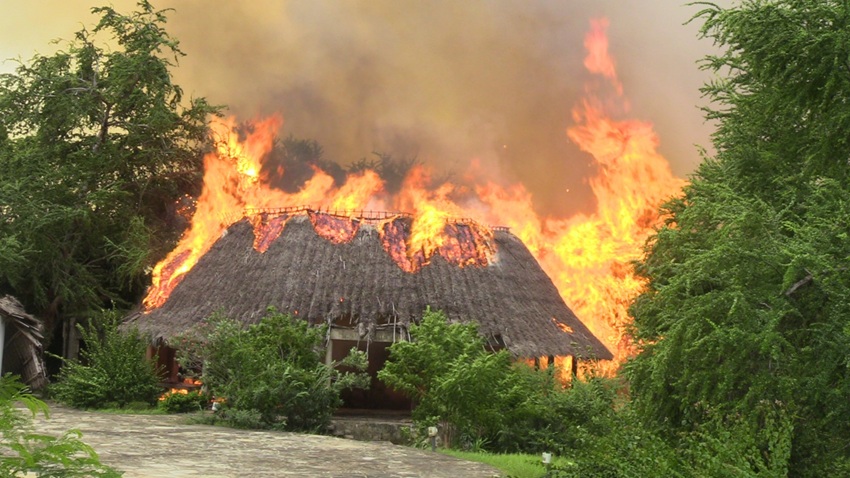
    Villa owners in Malindi, Kilifi County are counting millions of shillings in losses after fire gutted at least 12 executive properties along the Casino beachline.

    The residents are blaming the Malindi Municipality for slow response to the incident, noting that the fire spread very fast, bringing down the villas.

    According to Samuel Kaduka, an employee at one of the villas, the fire broke out around 3 am after flames from burning garbage on an alleged grabbed neighboring beach plot spread due to strong winds blowing from the Indian Ocean.

    “I take care of a plot around the beach and there were some people who grabbed a nearby plot and they were burning garbage at around 3 am in the morning but they failed to control the fire due to strong winds from the ocean that made the fire spread to other properties,” he said.

    “We demand action from the Malindi fire brigade and also, the land grabbers, and action should be taken against those who started the fire,” he added.

    Kaduka said firefighters from the Malindi municipality arrived with their engine when the fire had not spread much, but they did nothing.

    According to Samuel Kaduka, an employee at one of the villas, the fire broke out around 3 am after flames from burning garbage on an alleged grabbed neighboring beach plot spread due to strong winds blowing from the Indian Ocean.

    Brenda Kombe, another employee, said she is now jobless after her employer’s villa burned to ashes.

    “I was away when I received a call from an employee of another villa, and when I rushed here I found the house had just started burning and firefighters were just there watching with their engine,” she said.

    She blamed firefighters for their slow response, saying they waited until all the villas were down before they started spraying water on the ashes and debris.

    “Many a times houses burn in Malindi but the firefighters drag themselves to respond. I am now jobless because the house I take care of has been reduced to ashes,” she said.

  • Government declares Wednesday public holiday to mark Eid-ul-Adha

    Government declares Wednesday public holiday to mark Eid-ul-Adha

    The Government has declared Wednesday, May 27, 2026, a public holiday in celebration of Eid-ul-Adha.

    In a Gazette Notice dated Monday, Interior and National Administration Cabinet Secretary Kipchumba Murkomen announced the holiday pursuant to Section 3(1) of the Public Holidays Act.

    Eid-ul-Adha, also known as the “Festival of Sacrifice,” is one of the most important Islamic holidays celebrated by Muslims worldwide.

    The declaration allows Muslim faithful across the country to observe the day with prayers, feasting, and acts of charity.

    Background on Eid-ul-Adha

    Eid-ul-Adha commemorates the willingness of Prophet Ibrahim (Abraham) to sacrifice his son as an act of obedience to God. According to Islamic tradition, God provided a ram to sacrifice instead. The holiday marks the completion of the annual Hajj pilgrimage to Mecca.

    Key aspects of Eid-ul-Adha include:

    • Prayers: Special congregational prayers are held at mosques and open grounds.
    • Sacrifice: Muslims who can afford it slaughter a livestock animal (sheep, goat, cow, or camel), sharing the meat among family, friends, and the needy.
    • Charity: Emphasis is placed on giving to the less fortunate.
    • Feasting and family gatherings: The day is spent visiting relatives, exchanging gifts, and enjoying festive meals.

    The date of Eid-ul-Adha changes annually in the Gregorian calendar as it follows the Islamic lunar calendar. It falls on the 10th day of Dhu al-Hijjah, the 12th month of the Islamic calendar.

  • Ruto: We’re cushioning Kenyans from high fuel prices

    Ruto: We’re cushioning Kenyans from high fuel prices

    The government is taking decisive measures to cushion Kenyans from high fuel prices caused by the conflict in the Middle East, President William Ruto has said.

    Speaking after a consultative meeting with transport stakeholders at State House Mombasa on Friday, the President directed that diesel prices be reduced by KSh10 in the June-July pricing cycle.

    He explained that the Government has been using the Petroleum Development Fund and the 50 per cent reduction of Value Added Tax (VAT) – from 16 to 8 per cent – to stabilise fuel prices.

    In the April-May and May-June 2026 pricing cycles, President Ruto pointed out, the Government has committed KSh28.19 billion in fuel price support through stabilisation measures and tax relief interventions to cushion Kenyans.

    During the May-June 2026 pricing cycle alone, he said, the Government utilised KSh7.7 billion to stabilise prices and also had to forego KSh8 billion in VAT revenue, bringing the total support to KSh15.7 billion.

    As a result, the President noted that Super Petrol prices reduced by KSh15.87 a litre, diesel by KSh44.89, and kerosene KSh78.62.

    He pointed out that without the Government intervention, Super Petrol would today be retailing at KSh230.12 a litre instead of the current KSh214.25, diesel at KSh277.75 instead of KSh232.86, and kerosene at KSh270 instead of KSh191.38.

    “These interventions have protected millions of Kenyans from even more severe economic hardship,” he said.

    He told Kenyans that the Government fully understands the burden rising fuel prices have placed on families, businesses, farmers, and transport operators across the country.

    The President noted that global fuel prices have risen sharply within weeks, with Super Petrol increasing by 54.4 per cent, diesel by 118.5 per cent, and kerosene by 126.4 per cent.

    “These increases directly affected the landed cost of fuel imported into Kenya and ultimately impacted pump prices across the country,” he said.

    He told Kenyans that no country can completely escape a global oil shock of this magnitude, noting that even advanced economies are facing similar challenges.

    The President said the Government has also ensured stable and uninterrupted fuel supply under the Government-to-Government fuel framework.

    “This arrangement has also stabilised fuel pricing compared to the old spot-market system, where prices fluctuated sharply every month,” he said.

    On those calling for the scrapping of all taxes and levies on fuel, President Ruto warned that doing so would immediately affect the delivery of public services.

    “Do we go back to the spectacle of stalled road projects that had become a hallmark across the country?” he asked.

    He reminded those suggesting the removal of all taxes that leadership requires responsible decisions that protect both current needs and the country’s long-term economic stability.

    The President said the Government is engaging stakeholders in the transport, agriculture, and business sectors to develop practical interventions aimed at reducing pressure on livelihoods and economic activity.

    He said the East African Partner States and the private sector are working towards establishing a regional refinery to strengthen energy security, while Kenya is developing oil resources in Turkana County.

    President Ruto said the global fuel crisis is a reminder that Kenya must reduce its vulnerability to external oil shocks.

    He therefore pointed out that the Government is accelerating investments in renewable energy, electric mobility, modern public transport, and energy infrastructure to reduce dependence on fossil fuels.

    The President announced that the Government is in the process of buying 3,000 electric vehicles through the Ministry of Interior for use by security and administration officers.

    “I am also making a declaration that the first 100,000 electric vehicles to be imported to Kenya, whether for public service or private use, will be duty-free,” he said.

    Following consultations with transport stakeholders, the Government also announced several measures to support the sector.

    The President said the Ministry of Transport will engage financial institutions and explore temporary relief measures for transport operators facing financial challenges.

    Additionally, the ministry will work with the Insurance Regulatory Authority to address concerns relating to insurance claims affecting public transport operators.

    The President further directed that the Insurance Act and the Auctioneers Act be reviewed within the next three months to create a fairer framework for sector players.

    He also said the Ministry of Transport, through the National Transport and Safety Authority (NTSA), will convene a meeting between digital taxi platforms and drivers to address disputes in the ride-hailing sector, including the introduction of minimum fare regulations.

    The President further directed NTSA to support matatu operators in continuing to use artwork and graffiti on their vehicles while maintaining safety standards.

    “The Government will continue engaging stakeholders across the transport sector to develop practical and sustainable solutions that protect livelihoods and support economic activity,” he said.

    President Ruto called on Kenyans to remain calm, patient, and united as the country navigates the global fuel crisis.

    He urged Kenyans not to allow political opportunists to exploit the crisis for selfish gain, saying the country would overcome the challenge through unity.

    “While every citizen has a right to express their concerns, collectively we must reject hooliganism and all forms of violence that lead to loss of lives, disrupt livelihoods and undermine our economy,” he said.

  • Kindiki urges Kenyans to back environmental conservation

    Kindiki urges Kenyans to back environmental conservation

    Deputy President Kithure Kindiki has called on Kenyans to support government efforts in environmental conservation, saying it is a constitutional responsibility and moral obligation.

    The DP said environmental conservation is enshrined in the Constitution and is also emphasised in scripture, urging citizens to actively participate in protecting the environment for future generations.

    “We have a constitutional duty as a nation, both collectively and individually, to conserve the environment,” he said.

    Prof. Kindiki was speaking in Kapyego, Elgeyo-Marakwet County, during the official launch of the Cherangany Hills Ecosystem Restoration for Livelihood Improvement, Sustainability and Harmony (CHERISH) programme and the commemoration of the International Day for Biological Diversity.

    While applauding the initiative, the Deputy President said the programme supports the Government’s agenda of planting 15 billion trees by 2032 to combat climate change and restore degraded ecosystems.

    “Initiatives like this will help us achieve the target of planting 15 billion trees by 2032,” he said.

    The programme, spearheaded by Interior and National Administration Cabinet Secretary Kipchumba Murkomen under the OKM Foundation, is a 10-year environmental and peace initiative aimed at restoring the Cherangany Forest ecosystem, promoting climate resilience, community empowerment and sustainable livelihoods, as well as supporting education, sports and culture.

    Murkomen said the initiative will play a key role in sustaining peace and stability in the Kerio Valley region, noting that environmental degradation and climate change are among the root causes of banditry and insecurity challenges in the area.

    “There is a close relationship between security and climate change due to climate-related conflicts,” he said.

    Spanning 414,928 hectares across Trans-Nzoia, Elgeyo-Marakwet, West Pokot, and Uasin Gishu counties, the Cherangany ecosystem comprises 22 gazetted forests covering nearly 100,000 hectares.

    The ecosystem feeds more than 22 major rivers flowing into Lake Victoria and Lake Turkana, making it one of Kenya’s critical water towers.

    “Our goal is to restore and replace trees in 40,000 hectares across the four counties,” Murkomen said.

    Some of the dignitaries present included Dr. Deborah Barasa (CS- Environment, Climate Change and Forestry), Governors Wisley Rotich, Jonathan Chelilim, and Simon Kachapin, Deputy Governor Prof. Grace Cheserek, MPs William Kisang (Senator), Caroline Ng’elechei (County MP), Kangogo Bowen (Marakwet East), Timothy Kipchumba (Marakwet West), Adams Kipsanai (Keiyo North), and Dr. Gideon Kimaiyo (Keiyo South).

    Also present were PSs Dr. Eng. Festus Ng’eno (Environment and Climate Change), Gitonga Mugambi (Forestry), Dr. Chris Kiptoo (National Treasury), Dr. Belio Kipsang (Immigration and Citizens Services), Dr. Salome Beacco (Correctional Services), Joel Arumonyang (Public Works), Harry Kimtai (Mining), Aurelia Rono (Parliamentary Affairs), Chair of OKM Foundation Gladys Kipchumba, Elgeyo-Marakwet County Commissioner David Kosgei, and MCAs led by Speaker Lawi Kibire, among other leaders and government officials.


  • Full Speech: Ruto speaks on the global and national fuel crisis

    Full Speech: Ruto speaks on the global and national fuel crisis

    Remarks by his Excellency Hon. William Samoei Ruto, PHD, C.G.H., president of the republic of Kenya and Commander-in-Chief of the defence forces, on the global and national fuel crisis and its impact on Kenya, following a meeting with transport sector stakeholders

    Fellow Citizens,

    Over the past few weeks, many families, businesses, farmers, and transport operators have felt the pain of rising fuel prices. I fully understand the frustration and the burden this has placed on households and on the cost of living across our country.

    As your President, I want to speak to you honestly and directly about why this is happening, what the Government is doing, and why we must face this challenge together as one nation. The truth is this: Kenya is facing the effects of a global fuel crisis caused by the ongoing conflict in the Middle East. This is not a crisis affecting Kenya alone. Countries across Africa, Europe, Asia, and the Americas are all struggling with rising fuel prices, fuel shortages, and disruptions in supply.

    Since the conflict involving Iran escalated on 28th February 2026, the Strait of Hormuz, one of the world’s most important oil supply routes, through which nearly one-fifth of global oil passes every day, has experienced major disruption. This has created one of the largest global oil supply shocks in modern history.

    Within just weeks, global fuel prices rose sharply, with prices increasing by 54.4 per cent for Super Petrol, 118.5 per cent for Diesel, and 126.4 per cent for Kerosene.

    These increases directly affected the landed cost of fuel imported into Kenya and ultimately impacted pump prices across the country.

    The World Bank now projects that global energy prices will rise by 24 per cent in 2026 alone, while the International Energy Agency has warned that the global market may remain undersupplied until late 2026 or beyond.

    This is not a Kenyan problem alone. Around the world,  governments are introducing emergency measures to manage rising fuel costs, supply disruptions, and pressure on the cost of living. Some countries are now experiencing actual fuel shortages and rationing. Others have encouraged citizens to work from home in order to reduce fuel consumption, while some have reduced working days.

    Our priority as a government has therefore been twofold: first, to ensure that Kenya continues receiving stable fuel supplies across the country; and second, to cushion Kenyans as much as possible from the full impact of this global crisis.

    Kenya imports nearly all its fuel from the Gulf region. Therefore, when global oil prices rise, the impact inevitably reaches us here at home.

    The current fuel prices reflect that global reality. We recognise that these increases are painful and carry serious consequences for transport costs, food production, business operations, and the overall cost of living.

    I know that for many Kenyans, rising fuel prices are not just numbers at the pump; they affect everyday life. They mean higher matatu fares, a farmer paying more to transport produce to market, a boda boda rider worried about earnings, a parent struggling to stretch the family budget, and a business fighting to remain afloat while protecting jobs.

    The Government of Kenya has not stood by. We have undertaken several consequential interventions.

    First, through forward planning using the Petroleum Development Fund, we have built strategic financial reserves to help stabilise the market during times such as these, without disrupting the broader economy as happened in the past.

    To cushion consumers from the sharp rise in global oil prices, the Government has used the Petroleum Development Fund to stabilise fuel prices.

    In the last two pricing cycles alone, April–May and May–June 2026, the Government utilised Ksh 13.74 billion to cushion consumers.

    Secondly, working with Parliament, we have reduced VAT on petroleum products from 16 per cent to 8 per cent, foregoing Ksh 14.43 billion in tax revenue in order to reduce pressure on Kenyan families and businesses.

    In the April–May 2026 pricing cycle, the Government utilised Ksh 6.04B in fuel stabilisation and also forewent Ksh 6.41B in VAT revenue. In total, the Government spent Ksh 12.45B on stabilisation during that cycle.

    Because of this intervention, Super Petrol prices were reduced by Ksh 19.67 per litre, Diesel by Ksh 40.25 per litre, and Kerosene by Ksh 115.03 per litre.

    Similarly, during the May–June 2026 pricing cycle, the Government utilised another Ksh 7.7B for stabilisation and forewent Ksh 8.02B in VAT revenue. In total, during the current cycle, the Government has spent Ksh 15.72B on stabilisation.

    As a result, Super Petrol prices were reduced by Ksh 15.87 per litre, Diesel by Ksh 44.89 per litre, and Kerosene by Ksh 78.62 per litre.

    Without Government intervention during this cycle, Super Petrol would today have retailed at Ksh 230.12 per litre instead of Ksh 214.25; Diesel would have retailed at KSh 277.75 instead of Ksh 232.86; and Kerosene would have retailed at KSh 270.00 instead of Ksh 191.38.

    Taken together, across the April–May and May–June 2026 pricing cycles, the Government has committed a total of Ksh 28.19B in fuel price support through direct stabilisation measures and tax relief interventions.

    These interventions have protected millions of Kenyans from even more severe economic hardship.

    I have directed that the cost of diesel be further reduced by Ksh 10 in the June–July cycle to help stabilise pump prices and provide additional relief to consumers.

    Thirdly, through the Government-to-Government (G-to-G) fuel framework, we have secured guaranteed fuel supplies despite global supply chain disruptions, ensuring uninterrupted fuel availability across the country. The arrangement has also stabilised fuel pricing compared to the old spot-market system, where prices fluctuated sharply every month.

    Before the arrangement was introduced in 2023, oil importers faced intense pressure to secure US dollars within short timelines, driving rapid depreciation of the Kenya Shilling and threatening fuel supply stability. By easing pressure on foreign exchange demand and ensuring predictable supply terms, the framework has protected the economy during the crisis; without it, the country’s situation would be far worse today.

    I know there are those trying to turn this global crisis into politics; people seeking to exploit public pain for political gain, making reckless claims, and pretending there are easy solutions. But leadership requires honesty, not political opportunism or playing populist politics.

    The reality is that no country can completely escape a global oil shock of this magnitude.

    Even advanced economies with far greater financial resources than Kenya are facing similar challenges.

    There are those asking the government to remove all taxes and levies on fuel immediately. But we must ask ourselves honestly: if we stop collecting this revenue entirely, what public services shall we stop funding?

    Do we go back to the spectacle of stalled road projects that had become a hallmark across the country?

    Do we stop the fertiliser subsidy programme that is enhancing food security? Do we cut the security budget that helps us secure our borders, combat criminal gangs, and protect citizens, including women and children? Surely our hospitals and schools must continue to function and be funded. These are not simple decisions.

    Leadership requires us to make responsible decisions not only for today, but also for the long-term stability of our country. Because we do not know how long this crisis will continue, or whether prices may rise even further in the months ahead, we must act with care, responsibility, and sustainability in mind.

    Fellow Citizens,

    Every nation facing this crisis is being forced to make sacrifices. Kenya, too, is making sacrifices, but they must be fair, responsible, and sustainable.

    Our responsibility as Government is to solve today’s problems without creating a bigger crisis tomorrow. Our duty is to protect Kenyan families today, while ensuring the long-term stability of our economy.

    That is why Government continues to review every possible measure to reduce pressure on citizens while safeguarding economic stability.

    We are engaging stakeholders across the transport sector, agriculture, industry, and the business community to develop practical interventions aimed at reducing the impact on livelihoods and economic activity.

    This crisis is also a reminder that Kenya must never remain permanently vulnerable to external oil shocks and conflicts happening thousands of kilometres away from our borders. Therefore, the Government of Kenya, working together with our East African partner states and the private sector, is determined to bring into production our oil resources in Turkana and across the region, alongside the development of a regional refinery to reduce our vulnerability to disruptions beyond our control.

    Equally, we are accelerating investments in renewable energy, electric mobility, modern public transport, and energy security infrastructure so that future generations of Kenyans are less exposed to global fuel instability. We must embrace electric vehicles, and as a first step, the Government has already ordered 3,000 electric vehicles through the Ministry of Interior for use by our security and administration officials.

    I am also making a declaration that the first 100,000 electric vehicles to be imported into Kenya, whether for public service or private use, will be duty-free, even as we continue to court investments from electric vehicle manufacturing companies to establish production facilities in Kenya.

    This is not only about overcoming the current crisis, but also about building a more self-reliant, resilient, and economically secure Kenya for generations to come.

    I, however, wish to assure the country that there is no fuel shortage in Kenya. Through the Government-to-Government framework, under which international oil suppliers are contractually obligated to maintain consistent supply, the Government is taking all necessary measures to ensure continued, uninterrupted supply and stability in the market.

    Fellow Citizens,

    This situation is not permanent. We have overcome many challenges before, including droughts, floods, terrorism, the COVID-19 pandemic, and global economic shocks. Each time, we prevailed because we stood together as one people.

    I, therefore, ask all Kenyans to remain calm, patient, and united.  To every mother worried about tomorrow’s food prices, every worker wondering how they will afford transport to work, every trader struggling to keep a small business alive, and every young person anxious about the future, I want you to know that your Government sees your struggle and stands with you.

    To our transport operators, drivers, and logistics workers, we hear your concerns, we respect the important role you play in keeping our economy moving, and we will continue engaging you to find practical solutions. No Kenyan should feel abandoned in this moment.

    And so, after extensive consultations with stakeholders across the transport sector, a number of critical concerns and proposals were raised regarding livelihoods, operations, and the sustainability of the industry. Consequently, the Government has agreed on the following measures:

    a. The Ministry of Transport will engage financial institutions and banking partners to provide a platform for transport operators to address the financial challenges arising from the current crisis, including the possibility of temporary relief on lending terms within the sector.

    b. The Ministry of Transport will work together with the Insurance Regulatory Authority to engage stakeholders and address concerns relating to insurance claims affecting public transport operators.

    c. I have further directed that an immediate review of both the Insurance Act and the Auctioneers Act be undertaken and concluded within the next three months in order to establish a more responsive and fairer framework for players within the sector.

    d. The Ministry of Transport, through the National Transport and Safety Authority (NTSA), will engage transport network companies and drivers operating under digital taxi platforms with a view to implementing regulations on a minimum taxi fare and resolving the long-running disputes affecting the ride-hailing sector.

    e. Recognising the important role of creativity and self-expression within our transport culture, I have directed NTSA to facilitate an enabling environment for matatu operators to continue utilising artwork and graffiti on their vehicles in a manner that upholds safety and respect for other road users.

    f. The Government will continue engaging stakeholders across the transport sector to develop practical and sustainable solutions that protect livelihoods and support economic activity.

    I, therefore, ask all Kenyans to remain calm, patient, and united. Let us reject division, fear, and misinformation. While every citizen has a right to express their concerns, collectively, we must reject hooliganism and all forms of violence that lead to the loss of lives, disrupt livelihoods, and undermine our economy. Let us use fuel responsibly, support one another and protect our economy during this period.

    We will continue keeping the nation informed and doing everything possible to protect Kenyan families, businesses, and jobs. We must confront this challenge in the same spirit of unity, resilience and national resolve that has carried Kenya through difficult moments before.

    This crisis was not created by Kenya, but together, we shall overcome it.

    May God bless you, and may God bless the Republic of Kenya.

  • Ruto announces Ksh10 diesel cut, reveals billions spent on fuel stabilisation

    Ruto announces Ksh10 diesel cut, reveals billions spent on fuel stabilisation

    President William Ruto has directed a further Ksh 10 reduction in the price of diesel for the June–July 2026 pricing cycle, as part of ongoing government interventions to cushion Kenyans from the global fuel crisis.

    Speaking at State House, Mombasa Friday, following a meeting with transport sector stakeholders, the President detailed the government’s extensive fuel price stabilisation efforts over the past two pricing cycles.

    “The Government has used the Petroleum Development Fund to stabilise fuel prices,” President Ruto stated. He revealed that in the April–May 2026 cycle, the government utilised Ksh 6.04 B for fuel stabilisation and forewent Ksh 6.41 B in VAT revenue. “In total, the Government spent Ksh 12.45 B on stabilisation during that cycle,” he said.

    As a result of these interventions, “Super Petrol prices were reduced by Ksh 19.67 per litre, Diesel by Ksh 40.25 per litre, and Kerosene by Ksh 115.03 per litre.” He added.

    In the current May–June 2026 pricing cycle, the President explained that “the Government utilised another Ksh 7.7B for stabilisation and forewent Ksh 8.02B in VAT revenue.” He added, “In total, during the current cycle the Government has spent Ksh 15.72B on stabilisation.”

    Without government action, the President warned, “Super Petrol would today have retailed at Ksh 230.12 per litre instead of Ksh 214.25; Diesel would have retailed at KSh 277.75 instead of Ksh 232.86; and Kerosene would have retailed at KSh 270.00 instead of Ksh 191.38.”

    Across both cycles, “the Government has committed a total of Ksh 28.19B in fuel price support through direct stabilisation measures and tax relief interventions.”

    President Ruto further directed that the cost of diesel be further reduced by Ksh 10 in the June–July cycle to help stabilise pump prices and provide additional relief to consumers.

    He attributed the crisis to global factors, noting that ” Since the conflict involving Iran escalated on 28th February 2026, the Strait of Hormuz, one of the world’s most important oil supply routes, through which nearly one-fifth of global oil passes every day, has experienced major disruption. This has created one of the largest global oil supply shocks in modern history.” This has led to “global fuel prices rising sharply, with prices increasing by 54.4 per cent for Super Petrol, 118.5 per cent for Diesel, and 126.4 percent for Kerosene.”

    The President assured Kenyans that “there is no fuel shortage in Kenya,” crediting the Government-to-Government fuel framework introduced in 2023. “Through the Government-to-Government framework, under which international oil suppliers are contractually obligated to maintain consistent supply, the Government is taking all necessary measures to ensure continued, uninterrupted supply and stability in the market.”

  • President Ruto: First 100,000 electric vehicles duty-free

    President Ruto: First 100,000 electric vehicles duty-free

    President William Ruto has announced that the first 100,000 Electric Vehicles (EVs) imported into Kenya will be exempt from import duties, as part of a broader strategy to reduce the nation’s vulnerability to global fuel shocks.

    Speaking at State House, Mombasa Friday, following a meeting with transport sector stakeholders, the President said the duty-free waiver applies to both public service and private-use EVs adding that the move aims to accelerate Kenya’s transition to electric mobility amid a global fuel crisis triggered by ongoing conflict in the Middle East.

    “We must embrace electric vehicles,” Ruto said. “This is not only about overcoming the current crisis, but also about building a more self-reliant, resilient, and economically secure Kenya for generations to come.”

    The President added that the government is courting EV manufacturers to establish local production facilities. As an initial step, he noted that 3,000 electric vehicles have already been procured through the Ministry of Interior for use by security and administration officials.

    The announcement came as Kenya grapples with sharp increases in fuel prices, with diesel and kerosene having risen by over 118 per cent since February 2026. The government has so far committed Ksh 28.19 billion in fuel price stabilisation and VAT relief measures.

    Ruto assured Kenyans that the country has no fuel shortage, urging calm and unity as the nation navigates the global energy crisis.

  • Kenya Power earns Ksh. 382M from e-mobility in 34 months

    Kenya Power earns Ksh. 382M from e-mobility in 34 months

    Kenya Power has announced a record growth in income from the e-mobility sector with electricity sales surging by over 113% in three years and cumulatively earning Ksh. 382M in revenue.
    The monthly revenue from EVs charging increased from Ksh. 873,907 in July 2023 to a peak of Ksh.35 million in February 2026, underscoring the accelerated adoption of EVs in the country.
    Nairobi region is leading the uptake of EVs accounting for 71% of the cumulative revenue, followed by other regions such as Coast, North Eastern and Western Kenya which have demonstrated steady uptake of EVs.
    “Our E-mobility Sales Growth Analysis Report (July 2023April 2026) shows that electricity sales to the e mobility sector have grown 113-fold in just under three years, from 13,500 kWh (units) in July 2023 to over 1.5 million kWh in April 2026. This is clear evidence that EVs adoption is no longer a pilot, but a mainstream reality,” said Kenya Power’s Managing Director and CEO, Dr. (Eng.) Joseph Siror.
    He added, “This growth tells us the opportunity is truly national, and our focus must be on diversifying beyond the capital. This is why we are launching the EV parades today and having the E-mobility Conference and Expo in June.”
    More than one thousand stakeholders in the fast-growing electric mobility industry in East Africa region are set to convene in Nairobi from 4th to 5th June 2026 for the 4th Annual Kenya Power E-mobility Stakeholders’ Conference and Expo.
    The event will provide a platform to advance dialogues around electric mobility policy and supporting infrastructure under the theme Aligning Policy, Infrastructure Development and Partnerships to Scale E-mobility in Kenya. It will also offer an opportunity to showcase innovations and developments that have been made to support electric mobility in Kenya.
    Kenya Power attained a historic milestone in November 2025 when it crossed the one million kWh (units) sold to the e-mobility sector in a single month, with volumes staying consistently above this level since then.
    The adoption of E-mobility in Kenya is fast gaining momentum with official data indicating an increase in the number of registered EVs as well as electricity consumption. Data from the Electric Mobility Association of Kenya (EMAK) indicates that Kenya had registered over 35,000 EVs by the end of 2025, comprising mostly two-wheelers, up from a total of 796 EVs that had been registered three years ago.
    “We expect that EV uptake in Kenya will scale significantly by 2030 when we envision attaining universal access to electricity. Kenya Power will continue to ride on the goodwill of sustained policy support and enabling tax incentives, such as zero-rating of VAT on EVs and lithium-ion batteries, as well as the reduction of excise duty on electric bicycles, electric motorcycles and lithium-ion batteries to drive the uptake of electric mobility,” said Dr. (Eng.) Siror.
    To further create awareness of EVs, as part of this year’s E-mobility Conference, Kenya Power, GIZ Kenya, Electric Mobility Association of Kenya (EMAK) and Kühne Foundation have flagged off EV parades from Nairobi to Mombasa, and Nairobi to Kisumu and back.
    The parades will take place this week, starting today, and will also provide an opportunity to examine the readiness of the charging infrastructure along these routes and address range anxiety.
    During these parades, Kenya Power will also launch its newly established charging stations located at the Company’s offices in Voi and Nyali, Mombasa. The Company will also flag off ebikes for use by meter readers in Nakuru and Mombasa Island as part of entrenching sustainable transport in the country.
  • Kakuzi doubles dividend to Ksh 16 as profits surge

    Kakuzi doubles dividend to Ksh 16 as profits surge

    Kakuzi has acknowledged the growing international market risks facing the firm and Kenyan export agriculture, necessitating strategic diversification of products and markets.

    Speaking at the Nairobi Securities Exchange (NSE) listed firm’s 98th Annual General Meeting (AGM), Kakuzi Plc Chairman, Nicholas Ng’ang’a, said agribusiness firms globally are facing contemporary operating risks, further compounded by unrest in the Middle East.

    To mitigate risks, he noted that the firm is pursuing further diversification across products and markets, as well as actively exploring income streams from non-agricultural enterprises.

    Ng’ang’a said that the blueberry expansion is well underway, marking the transition from an experimental crop to a key contributor to the Company’s long-term growth, expanding our revenue streams, strengthening resilience, and positioning Kakuzi to lead East Africa in superfood production.

    As part of its product diversification strategy, Kakuzi is also exploring export opportunities for avocado products, including long‑life avocado, frozen avocado pulp and crude avocado oil, to extend shelf life and capture new value streams.

    While dismissing concerns that avocado exports are not sustainable, Kakuzi Plc Managing Director Chris Flowers explained that the firm had maintained a growth trajectory with production rising by 23%, and 525 containers exported last year, up from 446 the previous year.

    “The fact is, the business is challenging, but exporting fresh avocados remains viable as long as we produce quality fruit,” Flowers said. He added, “We believe growth must be deliberate, purposeful, prudent and asset‑preserving.  We are not just farmers; we are builders of our economic development.”

    During the AGM, Kakuzi shareholders approved the payment of a first and final dividend of KSh 16.00 per ordinary share for the Financial Year ended 31 December 2025, up from the KSh. 8.00 payout the previous year.

    Last year, Kakuzi’s avocado profit nearly doubled to KSh 709 million in 2025, up from KSh 361 million in 2024.

    Kakuzi Macadamia business posted better profits, closing at KSh 365 million, up from KSh 69 million the previous year. Demand for macadamia, Flowers said, continues to recover, with increased sales volumes and improved prices. “However, to maintain sustainable demand, the product needs to expand the opportunities for how consumers can experience quality macadamia kernels,” he said.

    The Kakuzi Blueberry operation recovered to a Ksh 5 million profit, up from a Ksh 19 million loss the previous year.  Production volumes also increased to 90 tons, up from 53 tons.

    To preserve shareholder value, the Kakuzi Board of Directors assured investors that the firm intends to maximise the potential of its land holdings and would resist efforts by unscrupulous persons to acquire its land irregularly.

    “Kakuzi’s land is not for sale, and neither are we giving it away. It is the bedrock of our future, the source of our strength, and an investment inheritance we are safeguarding for generations to come,” the listed firm’s officials assured.


  • BlockCoop launches historic blockchain SACCO in Kenya

    BlockCoop launches historic blockchain SACCO in Kenya

    BlockCoop SACCO has launched Kenya’s first blockchain-powered SACCO, marking a historic milestone in the evolution of cooperative finance and reinforcing the country’s position as a leader in financial innovation across Africa.

    The initiative introduces a new model for SACCOs, leveraging blockchain technology to address long-standing challenges in the sector, including illiquid shares, restrictive loan requirements, limited member participation, and lack of transparency.

    Speaking during the launch, the Director, Gideon Gitonga emphasized the significance of the innovation in strengthening the cooperative sector.

    “As we advance cooperative finance, our focus is on leveraging innovation to address structural challenges while expanding access and trust. Blockchain technology enables us to build a more transparent, inclusive, and efficient SACCO model, he said.

    Through its digital share token, BLOCKS, BlockCoop SACCO has transformed traditional SACCO shares into tradable assets, enabling liquidity and opening up participation to a global market. The model also replaces conventional guarantor requirements with guarantor pools and trust-based scoring, providing a more inclusive approach to credit access.

    Since launching its share trading on 1st October 2025, the sacco has experienced significant growth, reaching an estimated market capitalization of Ksh 1.3 billion.

    Building on this momentum, BlockCoop SACCO has launched the “Lipa na BLOCKS” loyalty campaign, where participants can acquire BLOCKS from the secondary market and enjoy discounts when making payments. The program is open to the public and accessible through lipanablocks.com.

    In a major boost to its ecosystem, BlockCoop SACCO also announced strategic partnerships with Nomachain and HF, aimed at accelerating the digitization and scalability of SACCOs across the region.

    HF will provide compliant SACCO infrastructure, ensuring that cooperative systems meet regulatory standards. Nomachain on the other hand, will power the tokenization of SACCO assets and shares, enabling cooperatives to unlock the value of traditionally illiquid assets such as land and buildings.