As record Kenyan Premier League champions Gor Mahia intensifies preparations for the CAF Champions League return, fans have the opportunity to financially support the club trough a first-of-its-kind initiative dubbed Wallcover K’Ogalo Edition unveiled by sponsors Kansai Plascon Kenya.
Gor, who reclaimed the Football Kenya Federation Premier League title will represent the country in the continent’s top club football 2026/27 season when the preliminary round kicks-off in September.
Kansai Plascon Kenya will dedicate a percentage of the proceeds from every sale of the Wallcover K’Ogalo Edition to support Gor Mahia FC’s continental campaign.
Every purchase made by fans will directly contribute towards the club’s participation in the upcoming CAF Championship, enabling supporters to play an active role in Gor Mahia’s journey on the continental stage.
The initiative marks a new chapter in sports sponsorship by extending corporate support beyond traditional partnerships and inviting supporters to play a tangible role in the club’s journey on the continental stage.
The limited-edition Plascon Trade Wall Cover Emulsion – K’Ogalo Edition has been created to celebrate K’Ogalo’s triumphant 2025–2026 FKF Premier League title-winning season while reaffirming Kansai Plascon Kenya’s long-term commitment to the growth of Kenyan football.
Speaking during the unveiling, Enami Kota, Managing Director, Kansai Plascon Kenya, said:
“Our partnership with Gor Mahia has always been about more than sponsorship. It is about investing in a legacy that inspires millions of Kenyans. This initiative allows supporters to celebrate the club’s achievements while directly contributing towards its future as the team prepares to fly the Kenyan flag in the CAF Championship. We believe corporate partnerships should create meaningful impact beyond branding.”
Gor Mahia chairman Ambrose Rachier, welcomed the initiative, saying:
“This partnership reflects what modern football requires—long-term collaboration built on shared ambition. Kansai Plascon has stood with us as partners, and this latest initiative demonstrates a genuine commitment to supporting the club beyond the football pitch. Every supporter who purchases the K’Ogalo Edition becomes part of our journey as we prepare to compete on the continental stage.”
Rather than simply commemorating the club’s latest success, the campaign transforms everyday purchases into an opportunity for Kenyans to contribute towards one of the country’s most successful football clubs as it prepares to represent Kenya in continental competition.
Designed as a collector’s edition, the commemorative packaging incorporates Gor Mahia’s iconic identity, championship-inspired graphics, and visual elements celebrating one of Kenya’s most decorated football clubs.
The campaign is anchored on the theme “Champions on the Pitch. Champions in Every Home.” It celebrates not only sporting excellence but also the power of partnerships, community pride and the role football continue to play in uniting millions of Kenyans.
The National Biosafety Authority (NBA) which regulates GMOs in the Country has released a list of commercially approved GM Plants, animals, microorganisms and veterinary vaccines, and their derived products.
In a letter to government agencies operating at the entry and exit ports, dated 29th June 2026, NBA acting Chief Executive Officer Dr. Ann Karimi said importation of any product from these plants, animals, microorganisms or veterinary vaccines would require clearance by the Authority in line with provisions of the Biosafety Act.
The letter was addressed to Kenya Ports Authority (KPA), Department of Public Health at the Ministry of Health, Kenya Revenue Authority (KRA), Kenya Wildlife Service (KWS), Kenya Plant Health Inspectorate Service (KEPHIS), National Environment Management Authority (NEMA), Kenya Bureau of Standards (KEBS), Pest Control Products Board((PCPB), Directorate of Veterinary Services and Kenya Industrial Property Institute (KIPI).
“These products are traded globally between and among countries. The Authority has already profiled the relevant Harmonized System (HS) codes of these products, and we request the cooperation and assistance of your Officers at various entry and exit points to ensure that these products are cleared by NBA before their release,” said Dr. Karimi.
She added that NBA officers are present at the points of entry/exit and will be able to advise accordingly on the steps to be taken in case of non-compliance.
Among the approved GM products for cultivation are Bt Cotton in Kenya, Sudan, South Africa, Ethiopia, Eswatini, Nigeria and Malawi. Bt Cotton is also cultivated in Argentina, Australia, Brazil, China, Colombia, Costa Rica, India, Mexico, Myanmar, Pakistan, Paraguay, USA, Bangladesh, Philippines, Indonesia, Uruguay.
Countries where it’s Bt Cotton is approved for Food, Feed, ornamental, and/or Processing and other uses; Australia, Costa Rica, Myanmar, Pakistan, USA, Bangladesh, Uruguay, European Union, Japan, Malaysia, New Zealand, South Korea, Taiwan, Colombia, Paraguay, Philippines, Singapore, Canada, India, China, Indonesia, South Africa, Switzerland, UK, Turkey, Vietnam, USA, Argentina, Mexico, Brazil, Kenya, Sudan, Ethiopia, Eswatini, Nigeria and Malawi.
GM maize/corn has been approved for cultivation South Africa, Nigeria and Ethiopia
Click here—>Commercialized GMOs to view the list of Globally Commercialized Genetically Modified Organisms (GMOs) (Plants, animals, microorganisms, and veterinary vaccines), and their derived products as of June 2025.
The Directorate of Criminal Investigations (DCI) is set to rollout a new digital platform that will revolutionize the processing of Police Clearance Certificates, commonly known as Certificates of Good Conduct.
According to the DCI, the launch of the Multi-Biometric Identification System (MBIS)-ABIS Version 5, is designed to accelerate application processing through enhanced biometric identification technology.
The investigative agency says the upgrade marks a significant step in modernising its services, promising shorter waiting periods and more reliable processing for Kenyans seeking the document.
The Certificate of Good Conduct is one of the most sought-after government documents in Kenya. Currently, applicants apply through the eCitizen platform, pay a fee of Ksh1,050, and visit a Huduma Centre or designated DCI office for fingerprint capture with the processing taking between two to four weeks.
The new system set to launch next week on Monday is expected to significantly reduce these processing times, improving efficiency and delivering a faster, smarter service experience.
The upgrade comes amid growing demand for the clearance certificates and follows the government’s broader push to digitise public services under the Digital Superhighway initiative
Mombasa Governor Abdullswamad Sheriff Nassir has pushed back against claims suggesting that public health facilities in the county are struggling with severe shortages of medicines, saying County Government facilities currently record a prescription fill rate of 92 per cent.
Speaking during the commissioning of the Coast General Teaching and Referral Hospital Frontage Redevelopment Project, Nassir said the figures recently cited by Health Cabinet Secretary Aden Duale covered 239 health facilities in Mombasa, including both government and private facilities.
The Governor clarified that only 52 of the facilities captured in the data are operated by the County Government of Mombasa, arguing that it was therefore misleading to use the overall county-wide figures to assess the performance of the devolved government’s health facilities.
“Out of the 239 facilities being referred to, only 52 are County Government facilities. Our prescription fill rate in those facilities stands at 92 per cent,” Nassir said.
The Governor said his administration was prepared to be held accountable for the performance of facilities under its management but insisted that public debate must be based on accurate and properly disaggregated data.
Nassir maintained that the County Government has continued to invest in medicines, healthcare infrastructure and service delivery, with the 92 per cent prescription fill rate demonstrating progress in ensuring patients receive prescribed medicines at public health facilities.
His remarks came as he commissioned the redeveloped frontage of Coast General Teaching and Referral Hospital, a project undertaken through a partnership between the County Government of Mombasa, Jaffer Foundation and Bulkstream Ltd.
The Governor said his administration would continue working with development partners and the private sector to modernise healthcare infrastructure, improve patient experience and strengthen the quality of healthcare services available to Mombasa residents.
Nassir welcomed scrutiny of his administration’s healthcare record but cautioned against the use of aggregated statistics that fail to distinguish between County Government facilities and privately operated healthcare providers.
Conflict is an inevitable feature of complex organisations, particularly in high-pressure, high-expectation working environments. Rather than defaulting to litigation, which may have long-term negative consequences, Kenyan law allows companies to opt for Alternative Dispute Resolution (ADR) mechanisms.
Further to this, forward-thinking organisations are moving beyond reactive dispute resolution towards embedding ADR into governance structures to prevent escalation, restore trust and drive cultural change in what is described as a Dispute System Design (DSD).
Internal conflicts carry serious reputational, financial and governance risks. High-stakes issues such as sexual harassment, major disagreements between directors or unfair labour practices can carry devastating consequences, especially when that conflict escalates or goes public.
In today’s increasingly litigious business environment, allowing internal conflicts to go unchecked or relying solely on knee-jerk legal reactions, can carry a high price tag. What starts as a relatively minor internal dispute can escalate quickly into a public relations crisis. When organisational disputes reveal deeper structural or cultural weaknesses, isolated interventions such as one-off town hall meetings are rarely sufficient.
ADR offers a range of solutions, including systematic negotiation, mediation, and conciliation processes. DSD turns these principles into practical action by embedding ADR into a company’s governance, decision-making and accountability structures. The result is an intentional, system-wide approach that is designed to resolve disputes at the lowest, fastest and least adversarial level first.
Given the role that DSD can play in avoiding lengthy court proceedings, and preventing long-term reputational damage and financial liability, it is as much a strategic imperative as it is a legal one.
Effective DSD is about preventing, managing and containing disputes, not only as a way of resolving internal conflict but as a matter of good organisational design.
Consider an example from Kenya’s ride hailing services, where disputes frequently arise from disagreements around factors like pricing and driver earnings. In this particular sector, payment disputes therefore represent a significant structural risk. Failure to resolve an escalating conflict fairly and timeously could lead to strikes and loss of business.
Above and beyond sound risk management, DSD can go a long way in helping companies to improve, strengthen and stabilise their governance structures. Disagreements among directors – when prolonged and poorly managed, can lead directly to internal instability, a lack of confidence in leadership teams and operational disruption. ADR processes can play a role in strengthening governance and preserving organisational cohesion.
For example, empowered with a solid DSD structure, an organisation can use mediation techniques as a proactive management resource, helping directors to use constructive debate as a way of embracing diversity, opening channels of communication and achieving balanced outcomes.
Taking a DSD approach to corporate governance could also involve proactively appointing facilitators as objective, neutral third parties who can encourage collaborative decision-making and maintain focus on shared organisational objectives.
DSD also has its place in employee relations by providing a framework for building trust, addressing grievances constructively and fostering a positive, welcoming workplace culture.
Disputes between team members could lead to reduced morale, breakdowns in teamwork and decreased productivity. In the long term, this could in turn increase staff turnover, undermine organisational performance and ultimately have a negative impact on the bottom-line.
Incorporating mechanisms like in-house or external Ombudspersons or peer-review panels could ensure power balance and impartiality, while encouraging the buy-in and cooperation of the affected parties.
In support of this, Chief Justice Martha Koome has highlighted the value of a multi-door approach to resolution of disputes, particularly through court-annexed mediation programmes, in resolving labour disputes efficiently and effectively.
This success is reflected in a Judiciary report released in April 2024, which shows that 16,770 of the 18,162 cases referred to Court-Annexed Mediation were resolved, representing a settlement rate of 92.3%. These results make a compelling case for the important role of ADR and DSD in fostering working relationships that can survive – and even thrive, in times of conflict.
Desmond Odhiambo is a Partner in the Dispute Resolution practice at Cliffe Dekker Hofmeyr (CDH) Kenya
Healthcare is no longer merely a social service. It is a matter of economic resilience, strategic sovereignty, and survival. Africa understands this better than most because we have paid the price for a global health architecture that has long treated our problems as commodities and our people as passive recipients of decisions made elsewhere.
When a continent carries approximately a quarter of the world’s disease burden yet produces only a fraction of its own vaccines and medical supplies, it is not facing a logistics problem. It is facing a justice problem. And when the next pandemic arrives, as we know it will, that injustice becomes existential.
This is precisely why the World Health Summit Regional Meeting 2026 convened in Nairobi this April. Hosted by the Aga Khan University together with the World Health Organization, the Kenya Ministry of Health, and the Africa CDC, the meeting carried a theme that was itself a declaration of intent: Re-imagining Africa’s Health Systems: Innovation, Integration, and Interdependence. More than 3,000 policymakers and change agents gathered, including 16 African health ministers, not to draft just another communiqué, but to forge a practical roadmap, one that treats health as a strategic asset and establishes concrete commitments to fund, manufacture, and secure Africa’s health future.
The COVID-19 pandemic did not create Africa’s vulnerabilities. It exposed them. Vaccine nationalism, fragmented donor funding, weakened country ownership, and decision-making concentrated in a handful of distant capitals- these were not accidents. They were the predictable outcomes of a broken system. From Ebola to Mpox, the pattern repeats: Africa bears the burden, while others hold the levers.
What Nairobi made clear is that the old model is finished. A new global health framework must respect regional sovereignty, demand accountability from leaders, and be grounded in genuine equity, and not of the performative kind, but the structural kind.
The Regional Meeting crystallized five pillars that must anchor this transformation.
The first is country ownership. For too long, the story of African health has been written in rooms far from the people it affects. That must end. African institutions, researchers, and policymakers are not supplicants seeking inclusion. We are co-authors of global health policy, and we must assert that role without apology.
The second is sustainable financing. Africa cannot build resilient health systems while remaining dependent on unpredictable external funding. The path forward requires stronger domestic resource mobilization, genuine accountability, closer alignment between Finance and Health ministries, and innovative mechanisms such as blended finance and debt swaps. Ultimately, it requires trust between citizens and the institutions meant to serve them.
The third is manufacturing and supply chain security. COVID-19 delivered a brutal lesson about the dangers of concentrating production in a few global hubs. Building a fairer system means investing in regional manufacturing, transferring technology on equitable terms, harmonizing regulations, and pooling demand across the continent. This is not idealism, but a strategic necessity.
The fourth is data sovereignty. In the modern health system, data is infrastructure. African nations must have the right to own, govern, and benefit from their own health data, even as we contribute to global knowledge. We cannot accept a future in which our data enriches others while our systems remain underserved.
The fifth is a fundamental shift in how we define partnerships. For decades, the measure of a good global health partnership was whether African voices were present in the room. That standard is no longer sufficient. True partnership is measured by whether power is shared, whether local institutions are strengthened, and whether every partner has equal standing to shape priorities and demand accountability. Representation without power is not partnership. It is mere optics.
Among the most consequential outcomes of the Nairobi meeting was the launch of the African High-Level Ministerial Committee on the Reform of the Global Health Architecture. This Committee is a declaration that Africa is done waiting for a seat at the table. We are building our own, and we are inviting the world to join us on our terms.
The question is no longer whether reform is necessary. That debate is settled. The question is whether reform will be ambitious enough, and structural enough, to dismantle the inequities that have accumulated over decades. Nairobi showed that Africa is prepared not just to participate in that conversation, but to lead it.
Global health architecture should not simply be built for Africa. It must be built with Africa, and with the involvement of Africans.
Prof Lukoye Atwoli is the Dean of the Medical College East Africa at Aga Khan University and International President of the World Health Summit Regional Meeting 2026
Smartphone users in Kenya are about to get a new option that promises to tackle three of the most persistent frustrations with modern devices: battery anxiety, outdoor visibility, and data privacy.
The vivo Y500, set to arrive in the country later this month, brings what the company describes as its largest battery ever, a premium display, and a renewed emphasis on keeping personal information secure. The device will be available for pre-order starting 13 July through a World Cup-inspired campaign that offers early adopters guaranteed rewards and a shot at football-themed prizes.
At the heart of the Y500 is an 8100mAh BlueVolt Battery, a capacity that vivo says is the biggest ever fitted to any of its smartphones. The company is positioning the device for users who spend long hours away from power outlets, whether they are working, streaming matches, or simply staying connected throughout the day.
Alongside the battery, the Y500 features a 1.5K AMOLED display designed to maintain clarity and colour accuracy even in bright outdoor conditions, addressing a common pain point for users who struggle to read their screens under direct sunlight. But vivo is also betting that battery life and screen quality are no longer enough to win over discerning buyers.
The company points to a broader shift in how people use their phones, noting that users now store vast amounts of their personal lives on these devices, from financial records to private conversations. In response, the Y500 introduces a new privacy layer that gives users greater control over their data.
While vivo has not yet disclosed the full details, it says the feature is designed to offer peace of mind in everyday use and that more information will be shared during the official launch. Durability is another key pillar of the device.
The Y500 carries both IP68 and IP69 ratings, meaning it is resistant to dust and can withstand immersion in water as well as high-pressure water jets. That level of protection is relatively rare in this segment and suggests vivo is targeting users who need a phone that can handle the unpredictability of daily life, whether that means sudden rain showers or dusty work environments.
The timing of the launch is no accident. With football fever gripping the globe, vivo Kenya is tapping into the excitement with a pre-order campaign that opens on 13 July.
The vivo Y500 is expected to hit Kenyan stores before the end of the month, combining a record-setting battery, a vibrant display, robust durability, and a fresh approach to privacy in a single package.
Community leaders, legal advocates and grassroots organisations meeting in Harare at the ongoing African Ecofeminism Convening have renewed calls for governments, mining companies and international financiers to respect community land rights as mining and large-scale development projects continue to displace families and threaten livelihoods.
Participants at the meeting shared first-hand experiences from Kenya, Zambia, Zimbabwe, South Africa and other African countries, highlighting how communities are losing ancestral land, facing forced relocations, and suffering from pollution, inadequate compensation and limited participation in decisions that directly affect their lives.
They stressed that communities should not be treated as obstacles to development but as rightful custodians of their land whose voices must be heard before any mining or infrastructure project is approved.
“We cannot continue to see communities paying the price for development while receiving little or no benefit,” Dr Melania Chiponda, Executive Director, Shine Collab, a global feminist movement of CSOs, community groups and Faith groups said during the discussions. “Development must respect people’s rights, culture and dignity. We are demanding that land compensation must in kind and not cash; land for land,” added Dr Chiponda.
Tricia Abwooli, a lawyer working for GreenFaith Africa in Uganda raised several urgent concerns, including forced displacement of families without meaningful consultation, loss of ancestral land, cultural heritage and traditional livelihoods and environmental pollution affecting community health, particularly women and children.
Abwooli noted the compensation packages that fail to account for long-term social, cultural and economic losses, weak enforcement of legal protections and limited access to justice and [lack of transparency around mining licences, geological information and development agreements.
The meeting highlighted examples of the Hanyanya community resistance and successful advocacy. Participants from Hanyanya Community in Bikita, Zimbabwe shared experiences where organised communities used research, documentation, legal action and peaceful mobilisation to delay harmful projects, negotiate improved compensation and secure commitments for schools, clinics and other essential services.
Tapiwa Gorejena,a movement legal advisor in Zimbabwe called for stronger legal action where governments and corporations fail to meet their obligations. Strategic litigation, class actions, administrative justice processes and international legal mechanisms were identified as important tools for protecting community rights.
A key message from the meeting was that affected communities must document evidence of land loss, environmental damage and human rights violations to strengthen future legal cases and advocacy efforts.
The discussions further emphasised the importance of cross-border solidarity among African communities facing similar challenges. Participants agreed that communities can learn from one another by sharing legal strategies, advocacy experiences and successful models for defending land rights.
Concerns were also raised about international investment agreements and development initiatives that often prioritise foreign commercial interests while excluding local communities from decision-making. Participants called for greater transparency, stronger accountability and legally binding commitments that protect African communities.
The meeting concluded with several immediate priorities, including strengthening community awareness of land and environmental rights, expanding access to legal support for affected communities and building stronger networks among grassroots organisations across Africa.
They also called for investigation of legal options for challenging harmful mining and development projects and exploring the establishment of community-led tribunals to ensure the voices of affected people are heard in national and international decision-making.
Community organisations reaffirmed that lasting development can only be achieved when local people are fully consulted, fairly compensated and empowered to participate in decisions affecting their land and future.
President William Ruto has called for accelerated investment and stronger partnerships to ensure universal access to clean cooking across Africa.
The President said nearly one billion Africans still rely on traditional fuels that threaten public health, education, and the environment.
Speaking during a high-level virtual event on keeping clean cooking high on Africa’s development agenda, President Ruto said the continent cannot afford to slow down with less than five years remaining to achieve Sustainable Development Goals targets.
“Nearly one billion Africans still rely on traditional and polluting cooking fuels, with profound consequences for public health, education, environmental sustainability and climate action,” the President said.
The event was initially intended to be the Second Africa Clean Cooking Summit to be hosted in Nairobi.
The forum was also addressed by International Energy Agency Executive Director Fatih Birol, Norway Prime Minister Jonas Gahr Støre, and United States Secretary of Energy Chris Wright.
The President said the clean cooking challenge extends beyond households, noting that thousands of schools, hospitals, prisons and other institutions across Africa still depend on firewood, increasing pressure on forests and exposing millions of people to harmful air pollution.
He reaffirmed Kenya’s commitment to clean energy, saying the country has made clean cooking a national development priority through the Kenya National Cooking Transition Strategy, which aims to achieve universal access to clean cooking by 2028.
However, he acknowledged that the ambition will require substantial financing. Kenya, he noted, needs about $435 million (kSh56.5 billion) to achieve universal household access to clean cooking and an additional $590 million (KSh76.7 billion) to transition institutions to cleaner energy solutions.
“The financing challenge extends across Africa. Closing the continent’s clean cooking access gap will require investment at an unprecedented scale,” he said.
President Ruto welcomed the announcement of $900 million (KSh117 billion) in new commitments towards the clean cooking agenda. He commended the launch of the Clean Cooking Security Programme, describing the initiatives as critical steps toward accelerating the transition.
He also announced that Kenya will become an inaugural member of the newly integrated Clean Cooking Alliance under the International Energy Agency, saying the move demonstrates the country’s commitment to advancing clean cooking both domestically and across the continent.
The President noted that Kenya’s partnership with the alliance has already facilitated the establishment of Africa’s first Clean Cooking Delivery Unit, which is helping speed up the adoption of clean cooking solutions in institutions.
“As host of the rescheduled summit, Kenya remains fully committed to sustaining this momentum. We look forward to welcoming leaders once again in Nairobi and to advancing this shared agenda together,” he said.
President Ruto urged African leaders and development partners to translate the pledges made during the meeting into tangible outcomes that improve the lives of millions of people across the continent.
“Together, let us turn today’s commitments into lasting impact for the people of Africa,” the President said.
Dr Birol said there has been strong commitment to clean cooking in the past two decades, noting that many African countries have made clean energy transition a national priority.
He commended President Ruto for taking leadership in ensuring increased access to clean energy in Kenya and in Africa.
Dr Birol said sponsors and development partners have pledged $2.2 billion to be released in tranches between 2024 and 2030. So far, he disclosed, $750 million has been disbursed to African countries.
He pointed to positive gains in Africa, stating that there has been an increase in the uptake of clean energy.
Although the numbers are encouraging, he added, there is still a long way to go considering that four out of five people in Africa still use poor cooking practices.
“This causes 850,000 premature deaths due to pollution and respiratory diseases,” Dr Birol pointed out.
Prime Minister Støre said clean cooking is the most underfunded in global development and climate policy. He called for urgent action, saying the right policies have been established and strong partnerships formed.
Access to clean energy, Mr Støre explained, will lead to multiple gains, including improved health, empowerment of women, protection of biodiversity, accelerated economic growth and climate justice.
“It is encouraging to see that African countries are making progress and showing that affordability barriers to clean energy can be overcome,” Mr Støre said.
Secretary Wright also commended President Ruto for robustly pushing the clean cooking agenda.
“You have been delivering leadership and setting targets for clean energy access,” Mr Wright said.
Noting that access to clean energy remains a universal challenge, he however termed the issue as the “largest solvable problem”.
Mr Wright said the solution, which the United States had adopted, is the provision of abundant energy.
He regretted that about a quarter of the global population still use traditional cooking methods that were in place ages ago.
These practices, he added, are behind poor health, limited lifespan and widespread poverty.
Access to clean cooking, he explained, is a major liberating step for women who spend hours looking for traditional fuel and cooking in smoky rooms.
Kenya has officially launched the Strengthening Policy Frameworks for Women’s Participation in Peace and Security Governance in Arid and Semi-Arid Lands (ASAL) and Informal Settlements Programme (2026–2028).
The initiative by Act Change Transform (Act!), with the support of the Embassy of Denmark in Kenya and in partnership with the Government of Kenya through the State Department for Gender and Affirmative Action is set to be piloted across ten ASAL counties of Garissa, Samburu, Laikipia, Uasin Gishu, Elgeyo Marakwet, West Pokot, Mombasa, Kilifi, Kwale and Nairobi.
It seeks to strengthen policy frameworks and enhance the meaningful participation and leadership of women in peace and security governance across Kenya’s ASALs and informal settlements.
The programme comes at a pivotal moment for Kenya. With the 2027 General Elections approaching, communities in many ASAL counties continue to face insecurity driven by resource-based conflicts, climate change, and violent extremism. Women also continue to encounter barriers to participation in political and peace processes, despite their critical role in community mediation, conflict prevention, and social cohesion.
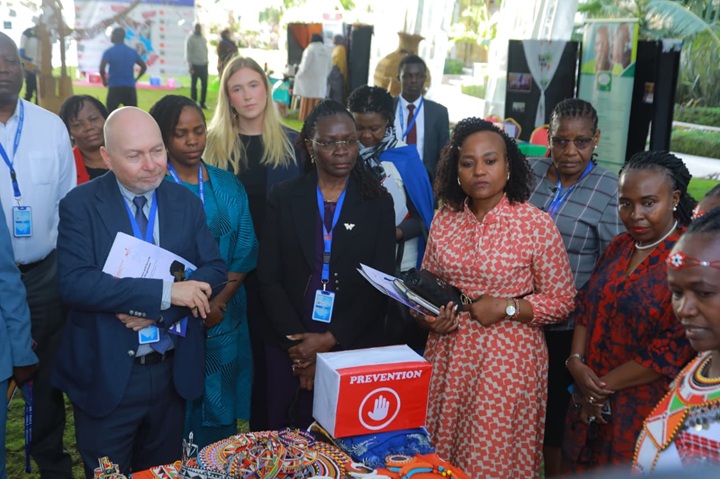
The launch convened representatives from the Government of Kenya, the Embassy of Denmark in Kenya, constitutional commissions, county governments, development partners, civil society organisations, women peacebuilders, academia, the media, and community leaders. Together, they reaffirmed their shared commitment to advancing the Women, Peace and Security (WPS) Agenda and ensuring that women are recognised not only as beneficiaries of peacebuilding efforts but also as leaders and architects of sustainable peace.
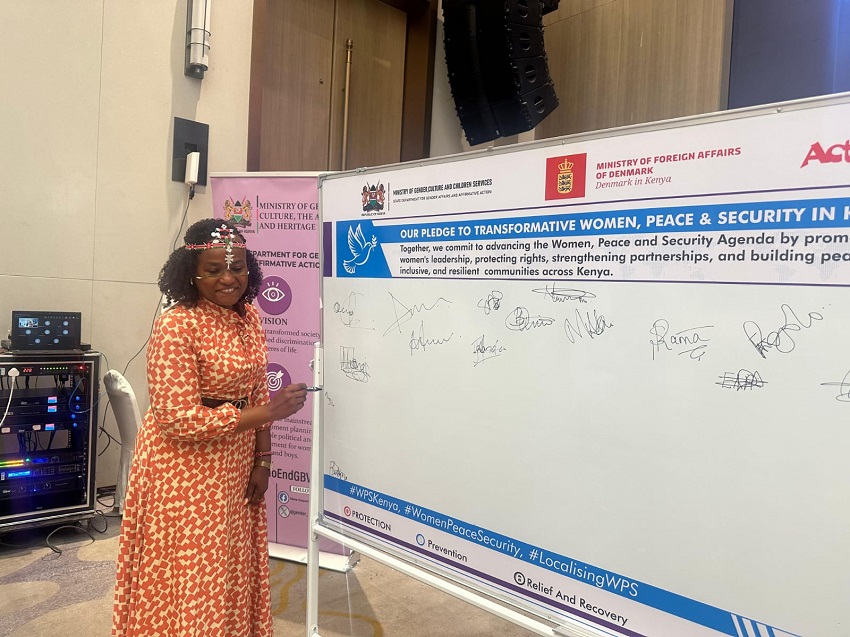
Dr. Ruth Dama Masha, Kilifi County official representative signing the pledge. Picture by KECOSCE
A key highlight of the event was the adoption of the Pledge for Transformative Women, Peace and Security Partnership, through which stakeholders committed to moving beyond symbolic representation towards measurable action.
The pledge calls for stronger localisation of the WPS Agenda, increased accountability, enhanced protection of women peacebuilders, and greater investment in women’s leadership and influence in peace and security decision-making processes.
The event also marked the dissemination of findings from the Baseline Survey and Contextual and Institutional Analysis, which provide an evidence base for the programme’s implementation. The studies established benchmark indicators on the status of Women, Peace and Security implementation, identified institutional and structural barriers limiting women’s participation, and generated recommendations to strengthen policy engagement, accountability mechanisms, County Action Plan implementation, and localisation of the WPS Agenda.
Four of the ten project counties (Garissa, Elgeyo-Marakwet, Mombasa and Uasin Gishu) have adopted County Action Plans, all of which were developed under the now-lapsed KNAP II and require rapid review and realignment to KNAP III as a priority early activity; the remaining six counties have no functioning CAP.
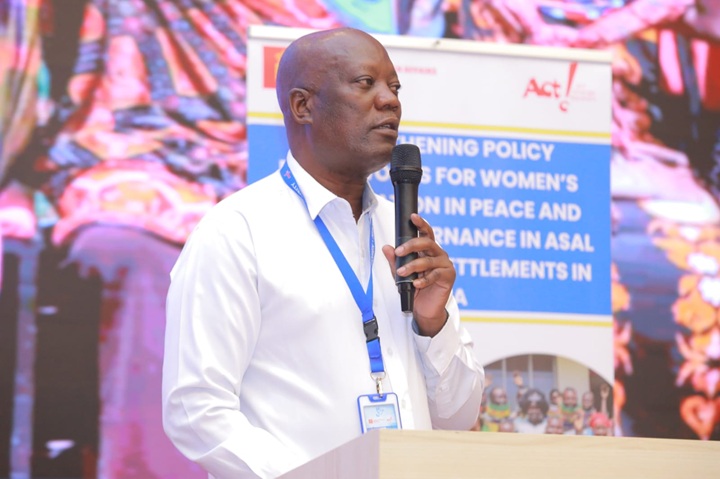
CEO ACT! Tom Were described the programme as an important investment in inclusive governance and long-term peace.
” Since our establishment, we have been working on peace-building and conflict transformation in Kenya. We’ve been working across many types of conflicts: resource conflicts, political conflicts, preventing and countering violence, extremism, but also community conflicts on different issues. And because of that focus of our work, we started having a discussion a few years back with the embassy of Denmark on how to strengthen the inclusion and involvement of women on matters of peace. And we find this a useful strategy because women get impacted by conflicts; women are the ones who receive those who are involved in conflicts back at home, and women are the ones who take care of those who are affected by conflicts.”
‘The burden on women is really significant in the situation of conflict. And so we’ve thought this is a useful program to design and implement in Kenya. And in the design, we are partnering with the Ministry of Gender; we are also partnering with other stakeholders who are keen on matters of peace and security, not just women, but also matters of peace and security,” he added.
‘The programme is dear to us, and we think that, particularly the timing right now when a lot of women are being affected by violence and many conflicts across the country, it’s a moment to advocate for women to get involved more, sit around the table as members of community, but also as individuals who have a right to speak for themselves on matters of peace and security, so that their voices can be represented and they can be heard, because their burden is actually very big when we are in a conflict situation.” Tom Were, CEO ACT! Picture by Dickson Wekesa
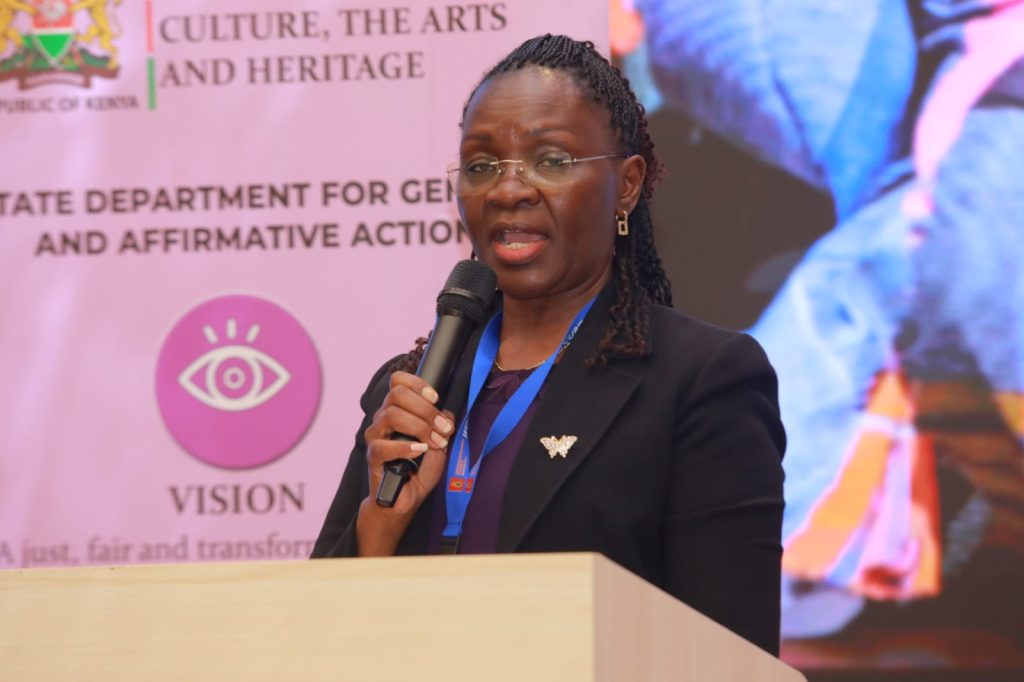
Speaking during the launch, Dr. Josephine Obonyo, Secretary Gender at the State Department for Gender and Affirmative in the Ministry of Gender, Culture, the Arts and Heritage.noted that strengthening women’s participation is essential to achieving lasting peace.
” The most concerning for us is the women participation in the peace and security committees in particular and for us there is mitigation for that. And this is through the implementation of the two thirds gender principle that cuts across and therefore we are working with other stakeholders to ensure that is achieved that is achieved, because once that is achieved then it’s able to cut across in all aspects of leadership, including in Women Peace and Security.”
“Issues of sustainability are not an issue for us because it’s something we’ve been doing, we continue doing, and also there are resources set aside through the Exchequer to ensure that it continues.” Dr. Josephine Obonyo, Secretary Gender at the State Department for Gender and Affirmative. Picture by Dickson Wekesa
Speaking on sustainability, the Secretary noted that the government has resources set aside through the Exchequer to ensure that it continues.
” This particular program may have been supported by a development partner, but what I can assure you is that issues around women, peace and security is something that as government we’ve been doing for a very long time and we continue doing. And therefore, in terms of sustainability, funds are set aside. There’s a whole directorate, a specific directorate, that works around issues of women peace and security, and therefore as government this only comes in to complement what we’re already doing.”
Throughout the discussions, participants highlighted the increasingly complex intersection between climate change, conflict, displacement, and gender inequality. Communities in ASAL regions continue to experience recurring droughts, competition over natural resources, and insecurity, all of which disproportionately affect women and girls while also reinforcing the importance of women’s leadership in community resilience and peacebuilding.
The programme is strategically aligned with key national, regional, and global commitments, including the United Nations Security Council Resolution 1325 and subsequent Women, Peace and Security resolutions, Kenya’s National Action Plan on Women, Peace and Security (KNAP III), Denmark’s National Action Plan on Women, Peace and Security (2025–2029), the African Union Continental Results Framework on Women, Peace and Security, and the Sustainable Development Goals—particularly SDGs 5 (Gender Equality), 13 (Climate Action), 16 (Peace, Justice and Strong Institutions), and 17 (Partnerships for the Goals).
Over the next three years, the programme will support stronger policy frameworks, promote women’s meaningful leadership in peace and security governance, strengthen institutional accountability, and foster partnerships that contribute to peaceful, inclusive, and resilient communities across Kenya’s ASALs and informal settlements.
Head of Cooperation, Embassy of Denmark in Kenya Henrik Larsen, reaffirmed Denmark’s commitment to supporting gender-responsive peacebuilding initiatives.
” One of the main issues is, of course, to have a political commitment, to have this as a priority in your general, you know, in your general politics. And I think this is something that Denmark has had for a long time. It’s gender issues is something that we have been prioritizing for many, many years, and therefore the Women Peace and Security agenda has been a natural priority for us. Then, of course, also to have the institutions that can actually work on this, and also be able to do whole-of-government approaches to the implementation. But I think, you know, as with so many other things, it all starts with a political commitment. And I think that has really has been the thing that has been there, from the formulation of policies until implementation.”
He added that the role of the stakeholders should be—of course should be complementary—but they also each have their own role.
” I think it’s the role of the state to ensure that there is protection of the population and that there are the policies and the laws in place. Then, of course, we have the civil society—that really builds bridges from governments and builds trust between governments and the population, but also between the security agencies and the population. I think this is incredibly important. And then they are the ones that we also really want to see build up and empower the women of the local communities.”
“While this specific program is about KSh300 million—making it a medium-sized effort—it does not stand alone. It works in tandem with our broader engagements under the general program for Kenya, which is very large and will remain a priority for years ahead.” Henrik Larsen, Head of Cooperation, Embassy of Denmark in Kenya. Picture by Dickson Wekesa
As Kenya continues to navigate evolving peace and security challenges, the programme represents a renewed commitment to ensuring that women are at the centre of building peaceful, resilient, and inclusive communities. By strengthening partnerships and translating policy commitments into action, the initiative seeks to create lasting impact for women, communities, and future generations.