Author: Claire Wanja

  • Actress Kate Walsh calls for global action to protect the oceans

    Actress Kate Walsh calls for global action to protect the oceans

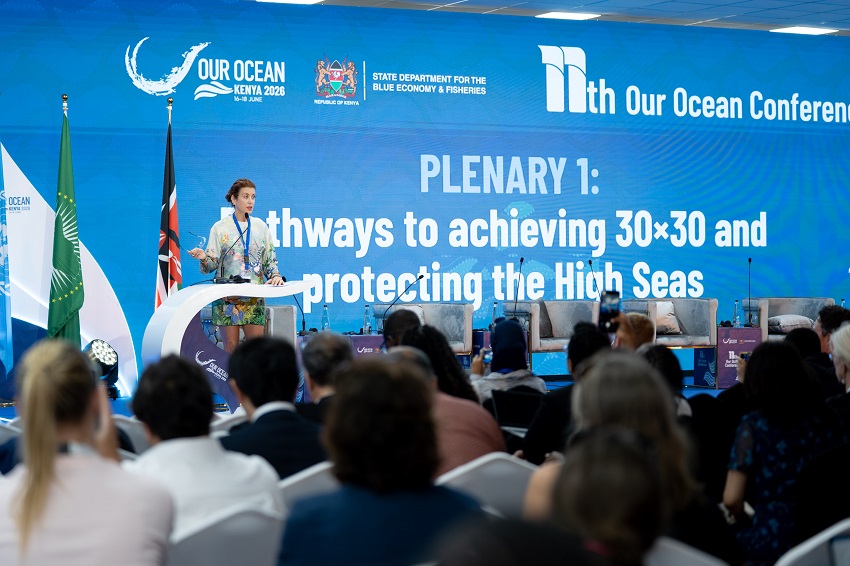
    Actress, advocate, and Oceana ambassador Kate Walsh has called for urgent action to protect marine ecosystems, strengthen coastal livelihoods, and accelerate progress toward protecting at least 30% of the world’s oceans by 2030.

    Speaking during a keynote address at the 11th Our Ocean Conference (OOC11) in Mombasa, Walsh noted that the gap between ambition and action remains significant.

    “A few years ago, world leaders came together around an extraordinary commitment to protect at least 30% of the ocean by 2030,” said Walsh. “But the deadline nears and we have fallen behind. Today, just 10% of the ocean is protected, and only about 3% is strongly protected. The gap between ambition and action remains significant,” she said.

    The session focused on accelerating progress toward the global 30×30 target, strengthening marine protected areas (MPAs), and advancing international cooperation to safeguard biodiversity beyond national waters through the High Seas Treaty.

    Kate Walsh addresses the Plenary Room at Our Ocean Conference: Photo Credit Franz Mahr Oceana

    In her remarks, Walsh emphasized the importance of community-led conservation and inclusive ocean governance.

    On Tuesday, she participated in a special conversation titled “Women’s Voices Are Key to the Future of Kenya’s Ocean,” where women leaders from Kenya’s coastal communities gathered to discuss marine conservation, sustainable livelihoods, and locally led solutions.

    The event featured Amina Komora, a fisher from the Sanye Community in Lamu County; Zulfa Haasan, widely known as “Mama Mikoko,” a pioneering mangrove conservation leader from Pate Island; and Raabia Hawa, founder and director of Ulinzi Africa Foundation. Moderated by Dr. Christina Chemtai Hicks, Professor at Lancaster University, Pew Marine Fellow, and Oceana Board Member, the discussion explored the indispensable role women play across fisheries, conservation, entrepreneurship, and community leadership.

    Walsh also visited the Jomvu Kuu Beach Management Unit and Jomvu Kuu Women in Fisheries alongside representatives from the Government of Kenya. These experiences informed her remarks on the mainstage.

    “We’ve seen time and again that conservation is at its strongest and most successful when local communities help lead,” Walsh said. “And lasting protections require partnership.

    Indigenous Peoples, coastal communities, artisanal fishers, and local leaders must have a meaningful seat at the table.”

    With momentum building at OOC11, Walsh emphasized that the window for action is narrowing.

    “The ocean has always been there for us,” Walsh concluded. “It has fed us, protected us, connected us, and inspired us. Now it is our turn to be there for the ocean.”

  • Plastic pollution poisoning marine ecosystems and entering the food chain, coalition warns

    Plastic pollution poisoning marine ecosystems and entering the food chain, coalition warns

    As the 11th Our Ocean Conference concludes in Mombasa, the Kenya Coalition to End Plastic Pollution has raised alarm over escalating plastic contamination in marine ecosystems, food systems, and coastal communities, calling for urgent and coordinated global action.

    The coalition says plastic pollution is increasingly infiltrating oceans and food chains, with serious implications for both environmental and human health.

    Plastic waste is estimated to account for around 80% of marine litter globally. Once in the ocean, marine animals often become entangled or mistake plastics for food, leading to injury or death. Experts also warn that microplastics and toxic chemicals associated with plastics are entering human food systems through seafood consumption, raising long-term health concerns.

    Studies by CEJAD and partners have confirmed that many recycled and everyday consumer plastics currently on the Kenyan market contain toxic chemicals, capable of leaching into the environment. Beyond this chemical threat, plastics fragment into microplastics that can be ingested by marine life and enter the food chain as seafood, posing serious health risks when consumed,” Griffins Ochieng’, Executive Director at the Centre for Environment Justice and Development (CEJAD).

    The coalition emphasized that oceans and coastal livelihoods cannot withstand unchecked plastic leakage.

    “Around 80% of marine plastic pollution originates on land, largely from mismanaged waste that is carried through rivers, waterways and drainage systems into the ocean. This underscores the urgent need to strengthen waste management systems if we are to tackle plastic pollution before it reaches our coastlines and oceans,” Frederick Njau, Programme Coordinator, Sustainable Development, Heinrich Böll Foundation.

    Coastal communities, they say, are bearing the brunt of the crisis.

    “Coastal communities are on the frontline of the plastic pollution crisis. They are the first to witness polluted beaches, declining fish catches impacting their earnings, marine creatures harmed by plastic waste, and contaminated food systems. Yet they are also at the heart of the solutions. Empowering and supporting these communities is essential to protecting both human and ocean health,” Hellen Dena, Pan-African Plastic Project Lead, at Greenpeace Africa.

    As Africa hosts the conference for the first time, civil society groups are urging governments and industry to move beyond commitments and focus on implementation.

    “As Africa hosts the Our Ocean Conference for the first time, we call on governments, industry, development partners, and the international community to move beyond declarations and deliver measurable action. The future of our ocean depends not on promises, but on implementation,” Stephen Kariuki, Executive Director at Mt. Kenya Network Forum.

    The coalition is calling for urgent interventions, including increased investment in environmental education, public awareness, youth leadership, and community-led conservation, alongside sustainable livelihood opportunities for coastal populations; stronger protection and restoration of mangroves, coral reefs, beaches, and other critical marine ecosystems; full implementation and enforcement of Kenya’s Sustainable Waste Management Act and Extended Producer Responsibility (EPR) regulations to ensure producer accountability and improved waste systems and formal recognition and integration of waste pickers and frontline waste workers into national waste management systems.

    The coalition also called for upstream action to reduce plastic pollution at its source, including reducing plastic production, eliminating hazardous chemicals in plastics, phasing out problematic single-use plastics, and scaling up reuse and refill systems.

    “The ocean cannot be protected if the flow of plastic pollution across its life cycle continues unchecked,” the coalition warned, urging governments and businesses to accelerate the transition toward a toxics-free circular economy.

    It added that protecting ocean health is inseparable from protecting human health and the future of coastal communities, urging governments to ensure commitments made during the conference are translated into concrete action.

  • Africa urged to tackle infrastructure gaps to tap AI investments

    Africa urged to tackle infrastructure gaps to tap AI investments

    African countries have been challenged to address existing infrastructure gaps as the continent emerges as the next Artificial Intelligence (AI) frontier.

    According to Schneider Electric Vice President for Secure Power Sub-Saharan Africa Steven Santini, the continent’s AI ambitions will ultimately depend on its ability by the continent to solve one critical challenge, infrastructure readiness.

    Speaking at this year’s IDC CIO Summit 2026, a premier gathering for technology decision makers in South Africa, Santini said global AI players are already looking toward Africa as a strategic investment destination.

    “The question becomes: is Africa ready? Global AI players increasingly view Africa as the next frontier, the new gold rush, in many respects. We have the land, the resources, and the growth potential. As many have already seen, data centres are being developed across Kenya, Nigeria, South Africa, and other regions where investment is welcomed,” said Santini.

    However, while momentum around AI infrastructure is rapidly building, Santini cautioned that the continent faces significant barriers that could slow adoption if not addressed strategically.

    “Power remains the number one challenge for AI, particularly AI data centres. To put this into perspective, some of the projects we are involved with in the Middle East have power requirements comparable to entire cities.”

    Santini further added that Africa’s infrastructure conversation cannot focus solely on hyperscale facilities. Instead, organisations should rethink how AI is deployed and where it delivers the greatest operational value.

    “When people hear ‘AI’, they often picture massive hyperscale data centres. But AI exists in many different forms. Your laptop can run AI workloads. A small ten-node server cluster deployed at an industrial site can support AI applications. AI does not always require enormous, high-density centralised environments,” he noted

    Santini believes this shift is particularly relevant for Africa, where industries such as mining, agriculture, financial services, and government are increasingly adopting AI to improve operational efficiencies, automation, predictive maintenance, and decision-making closer to the edge.

    “We are seeing many African organisations deploying smaller AI environments through prefabricated systems, containerised data centres, or even single racks within existing facilities. This allows them to leverage existing cooling and power infrastructure while simplifying deployment.”

    He adds that connectivity remains just as important as power in enabling AI success across the continent.

    “A data centre without reliable network infrastructure is effectively just an expensive paperweight. If data cannot move efficiently in and out, the infrastructure cannot deliver value.”

    Beyond physical infrastructure, Santini highlighted the growing importance of software intelligence in helping organisations maximise energy efficiency and optimise cooling performance in increasingly power-constrained environments.

  • Mombasa Governor vows ocean protection through waste action

    Mombasa Governor vows ocean protection through waste action

    Mombasa Governor Abdulswamad Sharif Nassir has reaffirmed the county’s commitment to strengthening solid waste management, improving sewer infrastructure, and advancing environmental sustainability as key pillars in protecting the ocean and coastal ecosystems .

    Speaking at the 11th Our Ocean Conference, hosted in Mombasa, the Governor highlighted ongoing efforts to modernize waste management systems, enhance waste collection and recycling, and promote responsible waste disposal. He noted that the county is making significant strides toward investing in an integrated waste management project aimed at reducing environmental pollutio.

    The initiative is expected to strengthen environmental protection efforts and contribute to a cleaner, more sustainable Mombasa.

    Governor Nassir emphasized that effective waste management requires ownership, innovation, and collaboration among government, communities, and the private sector. He underscored the importance of improving sewer management systems to prevent pollution of marine ecosystems and safeguard public health .

    “As a coastal city whose economy and identity are closely tied to the ocean, Mombasa continues to champion marine conservation efforts, including reducing marine pollution, protecting coastal habitats, and promoting sustainable environmental practices,” the Governor said

    The commitment comes amid growing concern over the city’s sewage management crisis. In previous remarks, Governor Nassir revealed that 95 per cent of Mombasa’s liquid waste goes unaccounted for, with most exhausters dumping effluent directly into the ocean or stormwater drainage pipes

    “This is the same ocean I swam in when I was young and would like my grandchildren to swim in and see fish. Wouldn’t you want that too?” Nassir posed during a meeting with built environment stakeholders.

    The proliferation of high-rise buildings has worsened the situation, with many developers bypassing biodigester requirements and connecting sewer lines to stormwater drains. The Governor noted that the Kizingo Sewer Treatment plant has been defunct for 33 years, while the Kipevu plant has been non-operational for 13 years—reviving them would cost billions of shilling.

    The county has already procured 41 modified garbage-collection tuk-tuks and four garbage compactor trucks worth KSh95 million to bolster collection. The new machinery has significantly improved efficiency, with each compactor capable of handling 10 to 12 tonnes of waste.

    The port city generates over 1,200 tonnes of solid waste daily, but only 52 per cent is currently collected. To address this, youth-led Community-Based Organisations are being contracted to collect waste within designated zones across the county .

    “This is more than a clean-up campaign. It is a jobs and dignity programme,” Nassir said

    The Our Ocean Conference also featured a vibrant cultural and water sports exhibition, including traditional dhow races and swimming competitions, aimed at introducing international delegates to the region’s maritime heritage.

    “I was delighted to host ministers responsible for the Blue Economy from across the world… celebrating the deep connection between our people, our culture and the ocean that sustains us,” Nassir said .

    The governor noted that the county remains committed to implementing long-term solutions that support a cleaner environment, healthier communities, and a sustainable blue economy for future generation.

  • Toy Story 5 targets $275M record-breaking global debut

    Toy Story 5 targets $275M record-breaking global debut

    Pixar’s beloved franchise is poised for its biggest opening ever as ‘Toy Story 5’ heads into theaters this week with a projected $275 million worldwide debut.

    Industry trackers expect the film to pull in $140 million domestically across 4,425 theaters—making it the strongest domestic opening of 2026 and a franchise best. International markets are projected to contribute $135 million, with the film launching across approximately 87% of overseas territories, including China. Two major markets are opening later: Japan on July 3 and Germany on July 23.

    The projected numbers would comfortably surpass the franchise’s previous record, set by 2019’s Toy Story 4, which opened to $120.9 million domestically and $249 million worldwide. Inside Out 2 still holds Pixar’s overall global record with $384 million, while Incredibles 2 leads domestic Pixar openings at $182.6 million.

    Pre-sales have reached $25 million, placing the film ahead of The Super Mario Galaxy Movie and Zootopia 2 at the same stage, though trailing Moana. The Juneteenth holiday this Friday is expected to boost opening day turnout, though its effect on Saturday holds remains uncertain.

    The fifth installment sees Jessie stepping into the lead role. Woody—now sporting a “dad paunch and bald spot”—returns to help after Jessie calls him for backup, as Bonnie is losing interest in her toys to a frog-shaped smart tablet called Lilypad (voiced by Greta Lee). Directed by Andrew Stanton (Finding Nemo, WALL-E), the film pits the toys against the threat of electronics taking over playtime.

    The film has earned a 93% “Certified Fresh” rating on Rotten Tomatoes—strong, though the lowest in the franchise’s history following Toy Story 3 (98%) and Toy Story 4 (97%).

    Toy Story 5 opens in theaters on June 19 in the US and UK. Japan follows on July 3, while Germany will have to wait until July 23.

  • Kagwe launches $11.4B Agriconnect Compact for 2.4M jobs

    Kagwe launches $11.4B Agriconnect Compact for 2.4M jobs

    Agriculture and Livestock Cabinet Secretary Mutahi Kagwe has officially unveiled the Kenya AgriConnect Compact (2025–2030), a bold national agricultural transformation initiative engineered to shift the sector from subsistence farming into a modern, high-tech, and commercially viable economic powerhouse.

    Speaking during the launch, the CS stated that the Agriconnect Compact positions agriculture not as a subsistence sector, but as a modern, technology-enabled, climate-smart, and investment-ready engine for inclusive economic transformation.

    The CS noted that at the core of this ambitious strategy is a heavy emphasis on digitalization and technology, which will see the deployment of digital extension services, agritech platforms for market traceability, and advanced processing technologies designed to eliminate crippling post-harvest losses.

    Kagwe said the government is committing USD 3.8 billion in catalytic public funds, strategically structured to de-risk the sector and crowd in a massive USD 7.6 billion in private sector investment.

    ‘The Agriconnect Compact is a deliberate, strategic, and urgent framework to align public investment with private sector ambition where public investment finances foundational systems and public goods, reducing risks and creating an enabling environment that attracts large-scale private capital,” CS Kagwe noted.

    He added that by leveraging public-private partnerships, blended finance, and credit guarantees, the framework fundamentally changes the risk profile of agricultural lending, turning local value chains, such as dairy, edible oils, and horticulture, into highly attractive, lucrative targets for private capital.

    ‘Beyond production, this comprehensive framework prioritizes market systems transformation by upgrading infrastructure, rolling out digital marketplaces, and developing structured trading systems to ensure farmers are no longer exploited by fragmented value chains,”he added.

    “These market reforms are aggressively targeted at slashing costly imports of food staples like rice and maize by 50 percent, while driving a 60 percent surge in high-value exports to global markets. Most importantly, this market-driven growth is directly tied to solving the nation’s employment crisis,” he emphasized.

    According to Kagwe, the Agriconnect Compact is uniquely engineered to create 2.482 million new and upgraded better jobs by 2030, absorbing the youth into dignified roles across agro-processing, logistics, digital supply chains, and agribusiness management.

    Highlighting the human impact of this shift, CS Kagwe emphasized, “The jobs to be created will be real jobs with dignity. The food security we achieve will mean that no Kenyan goes to bed hungry.”

    The technical groundwork is set to be complete.

    “We have the strategy. We have the investment framework. We have the political will. What we need now is private sector action.” Kenya is officially moving from strategy to collective action to secure total food sustainability and widespread economic prosperity” the CS concluded.

    Present were PS Livestock Development Jonathan Mueke, PS Agriculture Dr.Kipronoh Ronoh, Governor Mutahi Kahiga (Nyeri), Governor Nathif Jama Adam (Garissa), Governor Joseph Ole Lenku (Kajiado), Deputy Governor Dr. Mathew Ochieng among other key partners: Key development partners: World Bank Group, IFAD, African Development Bank (AfDB), Gates Foundation, AGRA, US Embassy, Embassy of the Netherlands, Embassy of the Netherlands, German Embassy, GiZ, American Chamber of Commerce, British Chamber of Commerce & Industry, KEPSA, KAM and ASNET

  • Stars unite for Obama Presidential Center grand opening

    Stars unite for Obama Presidential Center grand opening

    Music royalty will this Thursday descend on Chicago’s historic Jackson Park for the Obama Presidential Center grand opening.

    The former U.S. president will unveil the library and museum built to commemorate his presidency. The 64-year-old served as America’s leader from 2009 to 2017. Designed to inspire, empower, and connect people to change their world, the campus features a diverse array of public spaces.

    Among the performers linedup include Stevie Wonder, Bruce Springsteen, John Legend, Jennifer Hudson, Christina Aguilera, and U2’s Bono with The Edge.

    Other performers set to take part in the spectacle include The Roots, Common, Eddie Vedder, Marc Anthony, Nigerian Afrobeats sensation Tems, and young actress-singer Marsai Martin.

    “This Grand Opening ceremony will be unlike any other – filled with music, performances, and hope,” praised Valerie Jarrett, chief executive of The Obama Foundation. “The Grand Opening Ceremony will reflect a spirit of inspiration and joy, with a big boost from the performers who are sharing their talent with us. We hope to inspire people everywhere to believe in their power to bring change home.”

    The invitation-only ceremony kicks off at 11 a.m. CT at John Lewis Plaza, with a global livestream on Obama.org and the Foundation’s YouTube and social channels.

    The 19.3-acre campus, featuring the nation’s first fully digital presidential museum, opens to the general public on June 19—Juneteenth—with free admission (timed tickets required). 

    The Obama Presidential Center is designed to inspire, empower, and connect people to change their world, the campus features a diverse array of public spaces. Photo credit: Angie McMongical

    “Visitors of all ages will be invited to explore the open campus, engage with immersive exhibits and public programs, and discover how they can make a difference in their own communities,” a spokesperson added. “Celebratory events will continue through the weekend, offering a preview of programming that will bring the entire campus to life throughout the year and beyond.”

    Construction on the centre began in 2021.

  • Kenya ranks 6th in Africa’s digital rights and inclusion index

    Kenya ranks 6th in Africa’s digital rights and inclusion index

    Kenya has been ranked sixth in the latest report on the state of digital rights and inclusion across the continent.

    According to the Digital Rights and Inclusion in Africa Report-Londa, which is the most comprehensive continental assessment, covering 29 countries across Central, East, North, South, and West Africa, the latest report indicate the country has jumped three places, up from 9th place in 2024.

    In the 2025 report, South Africa has retained its top position as Africa’s leading digital rights-respecting country for the second time in a row. It is followed by Ghana, Namibia, Senegal, Egypt, Zambia, Kenya, Rwanda, Malawi and Nigeria in that order.

    In addition, the research draws on desk-based legal and policy analysis, secondary data review, key informant interviews with regulators and sector stakeholders, and media monitoring to assess trends, developments, and emerging challenges.

    From the report, Kenya and Rwanda are the only countries featured among the top ten in East Africa. The country’s score is 37 out of 60, which is a three-point improvement on last year’s performance, placing it as moderately compliant with international digital rights standards, well below South Africa’s benchmark score of 47 out of 60.

    “Kenya’s media landscape is among the most vibrant on the continent, though journalists face harassment and intimidation, and press-freedom restricting laws remain on the books,”said the report.

    Rwanda scored 36 out of 60, retaining its 2024 score. The country performed well in infrastructure and e-government, but continued to record low scores in freedom of expression and in arbitrary arrests. Kenya marginally outperforms Rwanda overall, more so in judicial independence and emerging technology strategy.

    Here is the report->Kenya-LONDA-2025-REPORT-EN-1

    The Londa 2025 report calls on the Kenyan government to halt internet throttling and disruptions during protests, repeal overbroad provisions of the Computer Misuse and Cybercrimes Amendment Act 2024, ensure the Office of the Data Protection Commissioner has adequate enforcement resources, build a comprehensive Artificial Intelligence (AI)https://www.kbc.co.ke/wp-content/uploads/2026/06/Kenya-LONDA-2025-REPORT regulatory framework, and close the urban-rural digital inclusion gap.

    It further urges the government to establish harmonised rules on cross-border data transfers, data localisation and cloud contracts to ensure that Kenyan public data and sensitive information are protected under the Kenyan law. Additionally, it calls on the government to expand affordable connectivity by prioritising infrastructure in rural, informal and marginalised communities.

    The report is compiled by Paradigm Initiative, a leading pan-African organisation advocating for digital rights and inclusion.

    Kenya and 28 other African countries were evaluated using the Score Index, a 12-point indicator that ranks countries by performance. Key indicators include access to information, freedom of expression, privacy protections, and digital inclusion, among others. The index highlights areas for improvement and persistent structural challenges across the region.

    The most improved countries in the ranking are Botswana and Egypt, which moved up by more than nine places. This was in stark contrast to countries like Nigeria and Cameroon, which dropped by five and ten places, respectively. On the other hand, Mozambique, the Democratic Republic of Congo, and Sudan all dropped in rank, placing them among the bottom five in the list.

    The report provides a comprehensive, data-driven assessment of internet freedoms, policy environments, and emerging digital rights risks across the continent. It provides an annual benchmark of progress and setbacks in digital rights protection, drawing on extensive country-level research and stakeholder engagement.

    Londa is named after a Zulu word meaning “to protect or defend” and serves as a call to action for safeguarding digital rights on the continent.

  • Rhino Ark demands halt of forest airstrip construction

    Rhino Ark demands halt of forest airstrip construction

    Rhino Ark Kenya Charitable Trust has objected to the ongoing construction of an airstrip within the Upper Imenti Forest Reserve and called upon the National Environment Management Authority (NEMA) to immediately suspend all works until all environmental and public participation requirements are fully met.

    In a statement, Christian Lambrechts, Executive Director of Rhino Ark Kenya Charitable Trust says as a long-standing conservation partner in the Mt. Kenya ecosystem, they have invested over KSh 1 billion during the past fourteen years in conservation infrastructure, including 320 kilometres of electric fencing around the Mt. Kenya forests, of which 54 kilometres protect the Upper and Lower Imenti Forest Reserves. Notes that the investments have significantly reduced human–wildlife conflict, protected communities and strengthened conservation efforts in one of Kenya’s most important ecosystems.

    ‘Rhino Ark respectfully urges NEMA and all relevant government agencies to immediately halt construction activities and ensure that all legal, environmental and public participation requirements are fully met before any further action is taken. Protecting the Mt. Kenya ecosystem is not only a legal obligation but a national responsibility, and the long-term value of safeguarding one of Kenya’s most important water towers, wildlife habitats and biodiversity hotspots far outweighs the short-term benefits of constructing an airstrip within a protected forest reserve,” he said.

    Lambrechts added that the airstrip is being constructed within a protected forest landscape that forms part of the Mt. Kenya forest ecosystem, which was further gazetted as a National Reserve to ensure maximum protection of its ecological, biodiversity and water catchment values.

    ‘Rhino Ark is deeply concerned that no public participation has been undertaken as required by the Constitution of Kenya, no Environmental and Social Impact Assessment (ESIA) has been conducted as required under the Environment Management and Coordination Act of 1999, and no licence authorising the project has been issued by the National Environment Management Authority. The absence of these legal requirements raises serious concerns regarding the legality and environmental oversight of the project,’ he added.

    The Executive Director stated that Mt. Kenya is one of Kenya’s five principal water towers and provides water that supports millions of Kenyans, major irrigation schemes, hydropower generation, agriculture and livelihoods across the country and that the Upper Imenti Forest Reserve lies on the hydrological divide between the Tana and Ewaso Nyiro river catchments, and any degradation of this sensitive forest ecosystem risks undermining water security and the ecological integrity of two of Kenya’s most important river systems.

    ‘The Mt. Kenya ecosystem is internationally recognised for its exceptional biodiversity, hosting more than 880 documented plant species, including 81 endemic species found nowhere else in the world; globally important populations of threatened species such as elephant, bongo, leopard, and one of Kenya’s most significant forest bird habitats, supporting more than 50 African highland biome bird species. The Upper Imenti Forest Reserve is one of the most ecologically important sections of the Mt. Kenya ecosystem and plays a vital role in maintaining this biodiversity,” he said.

    “We cannot trade one of Kenya’s water towers for short-term convenience. Upper Imenti is protected for a reason: it feeds the Tana and Ewaso Nyiro rivers, shelters elephants, and holds many plant species found nowhere else on Earth. No ESIA, no public participation, no licence means no construction. NEMA must halt works now,” he noted.

    Lambrechts noted that Scientific elephant surveys undertaken by the Wildlife Conservation Society, Kenya Wildlife Service, Rhino Ark, Mount Kenya Trust and the Bongo Surveillance Project established that Mt. Kenya supports between 1,900 and 2,600 elephants.These studies further confirmed that the Upper Imenti Forest has the highest concentration of elephants during the dry season, and the airstrip is being constructed in this critical elephant habitat and near a known elephant maternity area. The Upper and Lower Imenti Forest Reserves also form the central section of a key wildlife corridor linking Mt. Kenya to conservation landscapes in northern Kenya, and the fragmentation of this corridor threatens elephant movement, habitat connectivity and long-term conservation objectives.

    ‘Rhino Ark notes that Gaitu Airstrip, located approximately 14 kilometres from Meru Town and accessible via a paved road, already exists. Rather than constructing a new airstrip inside a protected forest ecosystem, Rhino Ark proposes that resources be directed toward upgrading the existing Gaitu Airstrip, an option that would be more cost-effective and avoid the significant environmental risks associated with developing infrastructure inside a protected forest reserve.” He suggested.

    ‘The proposed airstrip is inconsistent with Kenya’s commitments under the Sustainable Development Goals – particularly SDG 6 (Clean Water), SDG 13 (Climate Action) and SDG 15 (Life on Land) – Kenya’s climate commitments under the Paris Agreement and Nationally Determined Contributions (NDCs), the Convention on Biological Diversity, the UN Decade on Ecosystem Restoration and the Global 30×30 biodiversity Target. The project also conflicts with key national policy frameworks, including Vision 2030, the National Spatial Plan 2015–2045, the National Climate Change Action Plan, the Upper Imenti Participatory Forest Management Plan 2022–2026 and the Mt. Kenya Ecosystem Management Plan, none of which provide for the construction of an airstrip within this protected natural forest zone,” he concluded.


  • How Kenya and the UAE Are Building Africa’s Digital Future

    How Kenya and the UAE Are Building Africa’s Digital Future

    The recently concluded AI Everything Kenya x GITEX Kenya convened over 15,000 delegates in Nairobi, affirming that what Kenya and Africa are building in Artificial Intelligence and digital innovation is no longer a future ambition, but a present reality.

    With sustained investments in digital infrastructure, policy innovation, and technology ecosystems, Nairobi continues to solidify its position as one of Africa’s leading technology and innovation hubs.

    The summit underscored a clear imperative: the transition from theory to practice. For East Africa, this means integrating AI into the bedrock of national services, healthcare, energy grids, and financial services, while fostering a research and entrepreneurship ecosystem that creates, rather than just imports, technology.

    That transition from theory to practice is already taking shape at the national level. Last year, Kenya launched a five-year national artificial intelligence strategy, requiring Sh152 billion to position the country as Africa’s leading hub for AI research, innovation and deployment.

    Additionally, Kenya’s Artificial Intelligence Bill, 2026, currently before the Senate, is a timely and necessary recognition that artificial intelligence now shapes public administration, the economy, health, education, and democratic processes in Kenya.

    Partnerships that Support Legislation

    But legislation alone cannot build a digital powerhouse. It needs a partner that has already walked the path—and the United Arab Emirates has done exactly that. At the G20 Summit held last year, the UAE Government announced the $1 billion AI For Development Initiative, which aims to bolster economic and social development across Africa by developing digital infrastructure, enhancing government services and improving productivity.

    “The UAE’s partnerships across Africa are well established, spanning more than 50 countries in areas such as sustainable energy, food security, infrastructure, education, digital transformation, artificial intelligence, and healthcare”, says Saeed bin Mubarak Al Hajeri, the UAE Minister of State at the Ministry of Foreign Affairs.

    The convergence of smart cities and digital trade represents the single most promising frontier in Kenya-UAE cooperation. The UAE’s experience building Dubai Internet City—a purpose-built ecosystem that transformed a desert into a global technology hub—offers a proven blueprint for Kenya’s long-envisioned Konza Technopolis.

    Regional Trade and Technology Hub

    As Kenya positions itself as East Africa’s regional trade and technology hub, Emirati investment in cloud capacity and Arabic- and Swahili-optimized Large Language Models could unlock transformative growth in cross-border e-commerce and fintech. AI-powered logistics, automated trade documentation, and credit-scoring algorithms for informal traders would lower barriers for millions of small businesses across the region.

    In this vision, smart cities supply the electricity, data centers, and connectivity, while AI supplies the intelligence to turn that infrastructure into inclusive, cross-border digital commerce—making Nairobi not just a smart city, but a smart gateway to Africa.

    Kenya and the UAE bring different strengths to the table. Kenya has a strong innovation ecosystem, experience in mobile payments and access to the wider East African market. The UAE brings investment capacity, global trade networks and experience in building digital infrastructure.

    The opportunity is to reduce the friction that makes it difficult for businesses to trade across borders. This includes easier payments, trusted digital identity, secure cloud infrastructure, better logistics and simpler onboarding for small businesses.

    “The Kenya-UAE relations should help entrepreneurs in both markets access new customers. They should also make it easier for Kenyan technology companies to expand into the Gulf and for the UAE companies to use Kenya as a gateway into Africa”, explains Michael Michie, Co-founder and CEO, EverseTech.

    Yet beneath that optimistic vision lies a critical discourse that dominated conversations at GITEX and in Nairobi’s tech corridors: sovereignty versus speed. According to Michie, local infrastructure changes the conversation. Kenya is no longer approaching partnerships only as a consumer of foreign technology, but as a country that has infrastructure, talent, and a growing market.

    For Africa, sovereignty should not mean isolation. It should mean managed interdependence. For instance, Servernah Cloud gives organisations a local option in sectors where data protection, trust and control matter, including government, financial services and healthcare.

    The next chapter of UAE–Kenya relations will not be defined solely by what is built on the ground, but by what is created in the digital realm.

    As Kenya advances its digital economy ambitions and the UAE strengthens its role as a global innovation leader, cooperation in AI, smart cities, and digital trade offers a powerful platform for shared prosperity. The countries that successfully harness technology today will shape the economic landscape of tomorrow—and UAE–Kenya cooperation is well positioned to be part of that story.

    Zachary Ochieng is a former Managing Editor of CIO Africa at DX5 and currently a Global Communications Strategist. He has covered technology and digital transformation across the continent for over a decade.