Author: Margaret Kalekye

  • ‘Nganyas’ back on the road as Ruto overturns NTSA graffiti ban

    ‘Nganyas’ back on the road as Ruto overturns NTSA graffiti ban

    The move by the National Transport and Safety Authority (NTSA) to ban graffiti on public service vehicles (PSVs) has suffered a setback after President William Ruto gave in to concerns raised by transport industry players during talks over rising fuel prices.

    Addressing the nation at State House, Mombasa, after hours of engagement with transport-sector stakeholders, Ruto overturned the directive requiring the removal of graffiti, artistic designs, and tinted windows from PSVs.

    The President said the decision was aimed at creating an enabling environment for matatu operators to continue using artwork and graffiti as part of creativity and self-expression.

    He, however, cautioned that artistic designs and expression must be exercised in a manner that upholds safety standards and respects other road users.

    “Recognising the important role of creativity and self-expression within our transport culture, I have directed NTSA to facilitate an enabling environment for matatu operators to continue utilising artwork and graffiti on their vehicles in a manner that upholds safety and respect for other road users”, he directed.

    The latest development comes barely a month after the High Court upheld the government’s decision to ban graffiti, decorative artwork and tinted windows on PSVs, ruling that the restrictions were lawful and necessary for public safety.

    The ban of the ‘nganya’ culture — a distinctive urban transport style known for colourful graffiti, neon lighting, tinted windows, loud entertainment systems and customised interiors had been challenged by players.

    The petition was presented as a public interest case aimed at protecting artistic expression in the matatu industry.

    In its ruling, the court said the National Transport and Safety Authority (NTSA) notice issued on May 14, 2025, was a lawful administrative reminder of existing legal obligations and did not violate the right to fair administrative action or any legitimate expectation.

    NTSA had defended the directive, saying the move was intended to improve passenger visibility, assist law enforcement, enhance road safety and ensure uniform standards across the PSV sector.


     

  • Court allows Kihara Gachagua to get key documents linked to his father’s estate

    Court allows Kihara Gachagua to get key documents linked to his father’s estate

    The High Court has ordered officials at Manyani Maximum Prison to escort Jackson Kihara Gachagua, son of the late former Nyeri Governor Nderitu Gachagua, to retrieve crucial documents linked to his father’s estate.

    Kihara, who is seeking to overturn his 20-year prison sentence, said he would collect the documents from an undisclosed location and hand them over to his family as he awaits the ruling on his appeal scheduled for June 17 this year.

    Appearing before the Milimani Law Courts on Thursday, Kihara told Justice Alexander Muteti that he was framed in the robbery with violence case by his uncle.

    He claimed the relative harassed and intimidated him in an attempt to force him to surrender property and documents belonging to his late father, which he says he is the custodian.

    Representing himself in the appeal, Kihara alleged he could not get a lawyer to represent him because they had been compromised, noting that his earlier appeals from the Nyeri Magistrate’s Court up to the Court of Appeal had all been dismissed.

    The court was informed that he had previously feared raising the new issues because his family had allegedly been threatened and some members abducted. He said he was now ready to provide evidence following assurances of security for himself and his family.

    However, Justice Alexander Muteti told him that the High Court could not reopen factual matters already determined by the Court of Appeal unless there were sufficient grounds for a retrial.

  • DR Congo cancels World Cup training camp over Ebola outbreak

    DR Congo cancels World Cup training camp over Ebola outbreak

    The Democratic Republic of Congo has cancelled its pre-World Cup training camp in the capital, Kinshasa, because of an Ebola outbreak in the east of the country.

    Preparations have been moved to Belgium amid the upsurge, which is thought to have killed more than 130 people.

    The World Health Organization (WHO) has called the outbreak a “public health emergency of international concern”, but said it was not at pandemic level.

    Jerry Kalemo, a spokesperson for the national football team, told international media that pre-tournament games in Europe would go ahead as planned, as the squad gears up for their first World Cup since 1974.

    DR Congo are due to play friendly matches against Denmark, on 3 June in Belgium, and Chile, on 9 June in Spain, ahead of the World Cup finals.

    A spokesperson for the DR Congo team told the Reuters news agency that the squad’s training camp had been cancelled due to travel restrictions imposed by the US, who are hosting the World Cup this summer, along with Mexico and Canada.

    The US’ public health agency has banned entry from non-Americans who have been in the DR Congo, Uganda or South Sudan in the previous 21 days, in response to the Ebola outbreak.

    All DR Congo’s players, as well as the team’s French coach, Sébastien Desabre, are based outside the central African country and will therefore not be affected by the restrictions now the training camp has been cancelled.

    The high-profile event in Kinshasa was supposed to have been attended by fans, along with DR Congo’s President Felix Tshisekedi, according to Reuters.

    Kinshasa is roughly 1,800 km (1,120m) away from the eastern Ituri province, the epicentre of the Ebola outbreak. There have not yet been any reported cases in the city.

    On Wednesday, the WHO said 139 people were thought to have died, out of 600 suspected cases. However, on the same day, Congolese health minister Samuel Roger Kamba told state broadcaster RTNC TV that authorities had registered 159 deaths.

  • Late Nderitu Gachagua’s son appeals jail term, says he was framed

    Late Nderitu Gachagua’s son appeals jail term, says he was framed

    Jackson Kihara Gachagua, son of the late former Nyeri Governor Nderitu Gachagua, has moved to the High Court in a renewed bid to appeal his jail term.

    Kihara, who is currently serving a 20-year sentence at Manyani Prison following his 2019 conviction for robbery with violence, is appearing before Justice Alexander Muteti at the Milimani Court.

    He maintains his innocence, alleging that he was framed in an attempt to intimidate him into surrendering documents linked to his late father’s property.

    Last year, his appeal was dismissed, but Kihara has once again sought an open court hearing to present what he claims is evidence that the charges were fabricated.

    He wants to represent himself, stating that all his lawyers were compromised.

    Additional reporting/photos by Ruth Wamboi

  • Kenya, Kazakhstan sign agreements to deepen ties

    Kenya, Kazakhstan sign agreements to deepen ties

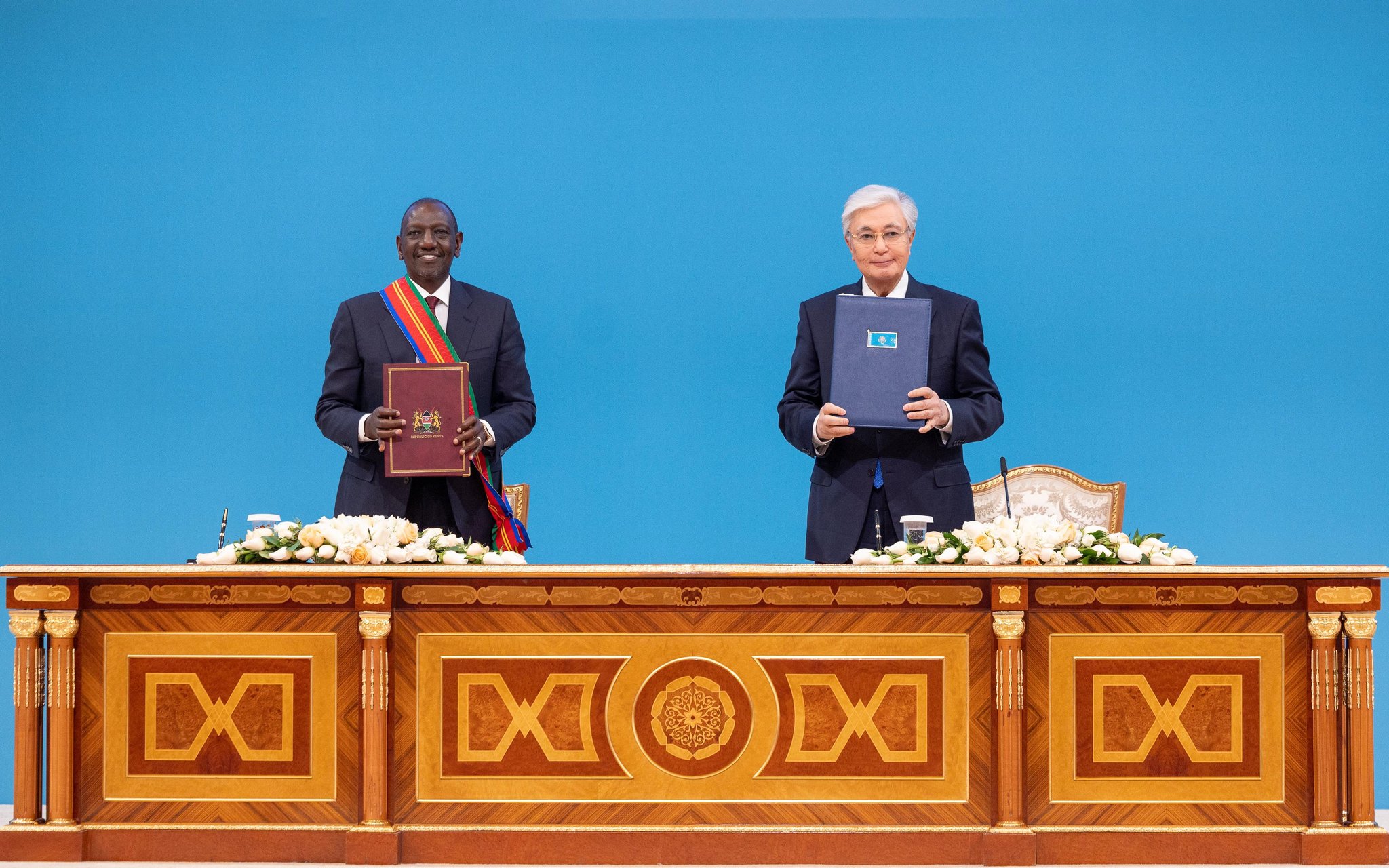
    Kenya and Kazakhstan have signed a raft of bilateral agreements aimed at strengthening and expanding diplomatic and economic ties between the two countries, during President William Ruto’s State Visit to the Central Asia nation.

    Importantly, the agreements seek to place Kenya as Kazakhstan’s anchor nation in East and Central Africa while positioning Kazakhstan as Kenya’s gateway to Central Asia.

    “Kenya views Kazakhstan as a vital partner and an important gateway to Central Asia and the wider Eurasia,” President Ruto said when he was hosted by Kazakhstan’s President Kassym-Jomart Tokayev at the Palace of Independence in the capital, Astana, on Wednesday.

    He added: “In turn, Kenya has invited Kazakhstan to establish Nairobi as a strategic base for its operations on the continent while utilising the ports of Mombasa and Lamu as key logistics gateways to regional markets.”

    Currently, Kenya serves as Kazakhstan’s second largest trading partner in Sub-Sahara Africa, mainly importing Kenyan agricultural products such as tea and cut flowers, while exporting fertiliser to Kenya.

    Present were First Lady Mama Rachel Ruto, Prime Cabinet Secretary Musalia Mudavadi, Cabinet Secretaries William Kabogo (ICT) and Lee Kinyanjui (Trade), among others.

    Welcoming his guest to Kazakhstan, President Tokayev commended President Ruto as a transformative leader in the African continent.

    “Under your strong leadership, Kenya has emerged as one of the most vibrant and forward-looking nations in Africa. Your country serves as a beacon of progress, proving that Africa is a true powerhouse of talent, limitless innovation and unique opportunities,” he said.

    During the function, President Tokayev conferred on President Ruto Kazakhstan’s prestigious Order of Dostyk (Frienship) First Degree for his role in strengthening Kenyan-Kazakhastan ties.

    In his acceptance remarks, President Ruto said: “This award is not only a personal recognition but a luminous symbol of the enduring symbol of friendship between Kenya and Kazakhstan. It reflects our shared commitment to peace, cooperation and the enrichment of cultures across continents.”

    Thereafter, the two leaders witnessed the signing of several bilateral agreements in tourism, ICT, finance, trade and investment, space science, transport and logistics, mining, commerce, trade and diplomatic sectors.

    “These agreements are instruments of action that reflect our shared determination to deepen collaboration, expand opportunity, and deliver tangible benefits to our citizens. We are fully committed to ensure their effective implementation,” he said.

    Both leaders agreed to continue advocating climate justice, fair access to climate financing and reform of the international financial architecture.

    Further, they reaffirmed the urgent need for reforms to the multilateral system, including the United Nations Security Council, to be more responsive to the needs of Africa and the entire Global South.

    President Ruto said his visit underscores the importance his government has placed on strengthenning diplomatic relations between the two countries, which began in 1993.

    “My visit here is intentional and deliberate to elevate our partnership to the next level,” he said.

  • More die of suspected Ebola as WHO warns that numbers will rise further

    More die of suspected Ebola as WHO warns that numbers will rise further

    The World Health Organization (WHO) says there have now been 600 suspected cases of Ebola and 139 suspected deaths, with numbers expected to rise further given the time taken to detect the virus.

    Fifty-one cases have now been confirmed in the Democratic Republic of Congo – where the first case was reported – and two in neighbouring Uganda, WHO chief Dr Tedros Adhanom Ghebreyesus said on Wednesday.

    Speaking to journalists in Geneva, he said the outbreak of the Bundibugyo species of Ebola was likely to have started “a couple of months ago”.

    On Sunday, the WHO declared a public health emergency of international concern, but said it was not at pandemic level.

    Ghebreyesus said that after meeting on Tuesday, the health organisation’s emergency committee agreed the situation was “not a pandemic emergency”.

    “WHO assesses the risk of the epidemic as high at the national and regional levels and low at the global level,” he explained.

    The 51 cases confirmed in DR Congo are in its eastern Ituri province – the epicentre of the outbreak – and the North Kivu province. Of the two confirmed in Uganda’s capital, Kampala, both had travelled from DR Congo, one of whom has died.

    “We know the scale of the epidemic in DRC is much larger,” the WHO chief said, adding that healthcare workers were among those who had died, which was a particular concern.

    A WHO official said investigations were underway to find out how long the virus had been spreading for, but that their priority was to curb transmission.

    The first known case was a nurse who developed symptoms and died on 24 April, in Ituri’s provincial capital Bunia.

    The body was repatriated to Mongwalu, one of two gold-mining towns where the majority of cases have been reported.

    Four areas in Ituri have been affected by the outbreak: Mongwalu, Bunia, Rwampara and Nyakunde.

    In North Kivu, rebel-controlled Goma, eastern DR Congo’s biggest city and Butembo have reported cases.

    DR Congo is facing its 17th outbreak of Ebola, but the Bundibugyo species – which has not been seen for more than a decade – brings its own difficulties.

    Bundibugyo has only caused two previous outbreaks, when it killed about a third of those infected.

    There is no approved vaccine for Bundibugyo, but experimental ones are in development. It is possible that a vaccine for another species, Zaire – which the country has dealt with on numerous occasions – may offer some protection.

    There are also no drugs that target Bundibugyo, making it harder to treat.

  • PS Oluga, WHO Europe Chief discuss health workforce collaboration

    PS Oluga, WHO Europe Chief discuss health workforce collaboration

    Principal Secretary for Medical Services Dr Ouma Oluga, who is attending the 79th World Health Assembly in Geneva, Switzerland, held high-level talks with WHO Regional Director for Europe Dr Hans Klugeat.

    The meeting focused on strengthening global health workforce collaboration, retention strategies, and ethical mobility frameworks for healthcare workers between Africa and Europe.

    They also discussed advancing a Health Workforce Collaboration Framework aimed at addressing growing global workforce shortages, improving retention, promoting social inclusion, and strengthening protections for healthcare workers against violence and burnout.

    Dr. Oluga highlighted Kenya’s longstanding leadership in health workforce advocacy, drawing from his experience as former IFMSA Vice President for External Affairs, Secretary General of Kenya’s largest doctors’ organisation, and Chair of the Health Workers for All Coalition.

    He further outlined Kenya’s contributions to health workforce policy reforms, including internship policy development, collective bargaining agreements, and leadership of the WHO Wellbeing Index study conducted across Kenya, Nigeria, and Ghana involving over 3,600 health worker interviews.

    The meeting also explored the proposed Africa Center for Health Workforce Initiatives, an umbrella platform seeking endorsement from WHO and Africa CDC to strengthen health workforce systems across the continent through policy reforms, education and specialisation training, migration and mobility management, and healthcare worker wellbeing.

    Key concerns discussed included ethical recruitment practices, implementation gaps in bilateral labour agreements, increasing migration of health professionals, curriculum harmonisation challenges in medical training institutions, and the need for stronger co-investment models to address workforce losses linked to brain drain.

    Dr. Kluge shared emerging workforce challenges across the WHO European Region, noting ageing healthcare workforces, increasing violence against healthcare workers, and growing concerns around burnout and mental health.

    The meeting further highlighted opportunities for shared learning, including formalisation of community health workers and adoption of Africa’s community health approaches within European health systems.

    The two leaders also discussed ongoing WHO-led initiatives on healthcare worker mental health and wellbeing, including facility-level interventions aimed at improving workplace support systems, shift organisation, and staff welfare.

    The engagement reaffirmed the importance of stronger Africa-Europe cooperation in building resilient, protected, motivated, and sustainable health workforces capable of supporting universal health coverage and future global health security priorities.


  • Kazakhstan awards Ruto top Order of Dostyk, First Degree

    Kazakhstan awards Ruto top Order of Dostyk, First Degree

    President William Ruto has been awarded Kazakhstan’s prestigious Order of Dostyk, First Degree, by President Kassym-Jomart Tokayev during his historic State Visit to the Central Asian nation.

    The honour, one of Kazakhstan’s highest state awards, is bestowed on leaders who embody strategic partnerships and exceptional international cooperation.

    The honour, one of Kazakhstan’s highest state awards, is conferred on leaders who symbolise strategic partnerships and exceptional international collaboration.

    Speaking during the conferment ceremony in Astana, Ruto described the award as a symbol of the growing ties between the two countries.

    “I am deeply humbled and profoundly honoured to receive the Order of Dostyk, First Degree, one of the highest distinctions of your great nation. This award is not only a personal recognition but a luminous symbol of the enduring friendship between Kenya and Kazakhstan. It reflects our shared commitment to peace, cooperation, and the enrichment of cultures across continents,” Ruto said.

    “As I wear this star and sash, I do so with reverence for the values they embody: unity, respect, and solidarity. I accept this honour on behalf of the people of Kenya, who stand with the people of Kazakhstan in the pursuit of harmony and prosperity”, he added.

    During bilateral talks, the two leaders agreed to deepen trade and investment ties, positioning Kenya and Kazakhstan as strategic gateways to Africa and Central Asia, respectively. They also explored opportunities to expand markets for Kenyan tea and other agricultural exports.

    The visit further yielded several Memoranda of Understanding (MoUs) aimed at strengthening cooperation across key sectors, including trade to expand market access and boost bilateral commerce; transport to improve cargo and logistics connectivity.

    Others are mining to create jobs through investment and value addition;  space technology to support agriculture and enhance climate, and disaster monitoring through satellite technology.

    Additional agreements were also signed in ICT, tourism, investment promotion, financial services and commerce.


  • Ebola: Kenya intensifies surveillance, screens 34,500 travellers

    Ebola: Kenya intensifies surveillance, screens 34,500 travellers

    Kenya has intensified screening and surveillance at all points of entry, including airports, seaports, and land border crossings, following the outbreak of Ebola Virus Disease (EVD) involving the Bundibugyo strain currently affecting parts of the Democratic Republic of the Congo and Uganda.

    Although no Ebola case has been reported, the country remains on high alert due to close regional connectivity via road, air, trade, and population movement.

    Health Cabinet Secretary Aden Duale, while giving a status report, said enhanced surveillance and preparedness measures had been activated across the country amid increased regional movement of people and goods.

    “Kenya has significantly intensified national preparedness measures aimed at preventing importation of the disease, ensuring rapid detection, and mounting a coordinated response should any case be identified in the country”, the CS said.

    As of May 18, 2026, more than 34,500 travellers had undergone screening, including 18,552 international travellers, 5,848 local travellers, 2,514 truck drivers, and 4,729 conveyances.

    Duale clarified that there is currently no blanket quarantine for truck drivers or travellers. However, enhanced risk-based screening and monitoring measures are in place in line with International Health Regulations and World Health Organization (WHO) guidance.

    Additional preparedness measures include:

    • Deployment of an online passenger surveillance system;
    • Population mobility mapping in high-risk border regions;
    • Enhanced airport surveillance through the Kenya Civil Aviation Authority; and
    • Strengthened cross-border coordination with Uganda, the DRC, WHO, the East African Community, and Africa Centres for Disease Control and Prevention.

    Kenya has also enhanced laboratory preparedness and diagnostic capacity through designated testing facilities at Kenya Medical Research Institute, Kisumu, KEMRI Nairobi, the National Public Health Laboratory, and mobile laboratory platforms.

    Counties have been further directed to maintain dedicated sample transport arrangements to support rapid testing and response efforts.

    On clinical preparedness, the Ministry is mapping ambulance capacity in high-risk counties with support from the Kenya Red Cross Society and strengthening engagement with private hospitals to improve early detection, referral, and reporting systems.

    “We are equally prioritising risk communication and community engagement to ensure the public receives accurate and timely information. Community Health Promoters are supporting surveillance and sensitisation activities, while engagements with transport operators, media houses, digital influencers, and telecommunications partners are ongoing to support the dissemination of verified public health information and reduce misinformation and panic,” he said.

    Kenyans have been advised to exercise caution by practising regular handwashing with soap and clean running water, avoiding contact with sick persons or bodily fluids where possible, and seeking immediate medical attention if they develop symptoms such as fever, weakness, vomiting, diarrhoea, or unexplained bleeding, particularly following travel to affected areas.

    Members of the public can access Ebola Virus Disease information and key public health messages by dialling *719# or calling 719.

    “We wish to assure the country that Kenya has significantly strengthened its preparedness systems over the years and remains better positioned to prevent importation, rapidly detect suspected cases, and respond effectively to any potential outbreak,” Duale assured.

    The Ministry pledged to continue closely monitoring the situation, working with regional and international partners, and keeping the public informed as the situation evolves.

    Meanwhile, a total of 543 suspected cases were recorded in DRC, including 32 laboratory-confirmed cases, while the death toll reached 136, said DRC Health Minister Roger Kamba during a media briefing on Tuesday.

    World Health Organization (WHO) Director-General Tedros Adhanom Ghebreyesus expressed deep concern over the “scale and speed” of the Ebola outbreak in the DRC and Uganda on Tuesday, saying an emergency committee would meet later in the day to issue temporary recommendations

  • Kenya likely to experience below-normal rainfall

    Kenya likely to experience below-normal rainfall

    Kenya is expected to experience below-normal rainfall and warmer-than-average temperatures during the June to September 2026 season, according to the IGAD Climate Prediction and Applications Centre (ICPAC).

    The latest regional climate outlook and forecast issued during the 73rd Greater Horn of Africa Climate Outlook Forum held in Addis Ababa indicates that western and coastal parts of Kenya are among areas likely to receive below-normal rainfall during the period, which is a critical season for several sectors, including agriculture and water resources.

    In a press statement by ICPAC, some parts of coastal Kenya are, however, expected to record near-normal rainfall, offering slight relief in areas dependent on seasonal rains.

    ICPAC noted that the June to September season is likely to be warmer than usual across much of the Greater Horn of Africa, with Kenya also expected to experience above-normal temperatures.

    The agency warned that the projected dry and warm conditions could negatively affect rain-fed agriculture, water availability, livestock production, food security, public health and hydropower generation.

    The forecast also raises concerns over possible pressure on pastoral communities and increased vulnerability in arid and semi-arid areas, already facing climate-related challenges.

    According to ICPAC, the evolving 2026 climate conditions resemble those experienced during the strong El Niño years of 1997 and 2023, when several parts of the region, including western Kenya, recorded below-normal rainfall.

    Speaking during the forum, IGAD Deputy Executive Secretary Mohamed Abdi Ware emphasised the need to translate climate information into timely action and preparedness measures across the region.

    “Across the region, we are increasingly shifting the conversation from ‘early warning’ to ‘early warning linked to anticipatory action,’ recognising that climate information must ultimately support action and preparedness to make a difference.”

    Fetene Teshome, Director General of the Ethiopian Meteorological Institute, called for sustained investment in climate services and regional cooperation to strengthen resilience across the Greater Horn of Africa.

    “We must continue to invest in and expand systems capable of generating knowledge-based, user-tailored climate information at both the national and regional levels,” Teshome said.

    ICPAC said it will continue providing regional updates, while Kenya’s meteorological authorities are expected to issue more detailed country-specific forecasts and advisories.

    Meanwhile, the Kenya Meteorological Department (KMD) has said that the country will in the next 24 hours experience rainfall in a few parts of the country, with heavier rainfall likely in the highlands of the west of the Rift Valley.

    Giving a summary of the weather from tonight to 9.00 p.m. Wednesday, KMD says strong southerly to southeasterly winds exceeding 25 knots (12.5 m/s) are expected in parts of the Northwestern, Northeastern, Coastal and Southeastern Lowlands.

    In the Highlands west of the Rift Valley, the Lake Victoria Basin, and Rift Valley counties, including areas such as Kakamega, Kisumu, Nakuru, Narok, Uasin Gishu, and Kisii, showers and thunderstorms are expected in a few places tonight.

    The region will have mainly sunny intervals, with light morning rains in some areas and more widespread afternoon showers and thunderstorms.