Author: Jared Ombui

  • Former Emir of Qatar Sheikh Hamad bin Khalifa Al Thani dies

    Former Emir of Qatar Sheikh Hamad bin Khalifa Al Thani dies

    Sheikh Hamad bin Khalifa Al Thani, the former Emir of Qatar whose nearly two-decade rule reshaped the small Gulf nation into a global energy powerhouse and diplomatic hub, has died at the age of 74.

    The Amiri Diwan, Qatar’s ruling office, announced his passing on Sunday morning, describing it as a profound loss for the nation and offering prayers for God’s mercy on his soul.

    Sheikh Hamad came to power in 1995 and ruled Qatar for 18 years before making the unusual decision to voluntarily hand the throne to his son, Sheikh Tamim bin Hamad Al Thani, in 2013 — a rare act of abdication among hereditary Gulf rulers.

    His tenure is widely credited with turning Qatar from a relatively obscure Gulf state into one of the wealthiest countries in the world by per-capita income, driven largely by the expansion of its liquefied natural gas industry. Under his leadership, Qatar also launched the Al Jazeera media network in 1996, adopted its first permanent constitution in 2004, and introduced municipal elections that allowed women to vote and run as candidates.

    Sheikh Hamad also secured Qatar’s successful bid to host the 2022 FIFA World Cup, a milestone that triggered a massive wave of infrastructure investment and helped redefine Doha’s skyline.

    Beyond domestic reforms, Sheikh Hamad positioned Qatar as an ambitious mediator in regional conflicts, involving the country in efforts to ease tensions in Sudan’s Darfur region, Lebanon’s internal political disputes, and the rivalry between Palestinian factions Hamas and Fatah. In 2012, he became the first head of state to visit Gaza since Hamas took control of the territory five years earlier, pledging hundreds of millions of dollars in aid and investment.

    His government’s willingness to engage with groups such as Hamas, the Muslim Brotherhood, and Iran drew criticism from some Western and regional allies, even as it cemented Qatar’s reputation as an independent power broker. Late in his rule, Qatar also opened a Taliban political office, a move that eventually paved the way for negotiations between the United States and the Taliban.

    Condolences arrived quickly from regional leaders. Egyptian President Abdel Fattah el-Sisi offered sympathies to Qatar’s government and people, while UAE President Mohamed bin Zayed Al Nahyan extended personal condolences to current Emir Sheikh Tamim, praising the late leader’s contributions to regional cooperation.

    Sheikh Hamad’s death marks the close of a defining chapter in modern Qatari history, one that saw the nation rise dramatically in global economic and diplomatic influence.

  • Uganda urges South Africa returnees to start small-scale value addition businesses

    Uganda urges South Africa returnees to start small-scale value addition businesses

    Uganda’s Trade, Industry and Cooperatives Minister Sanjay Tanna has urged the over 1,000 Ugandans repatriated from South Africa to tap into government wealth creation programmes and invest in small-scale value addition to generate income.

    Addressing the returnees at the National Leadership Institute in Kyankwanzi, Tanna told them not to lose hope, saying Uganda remains a land of opportunity where they can rebuild their lives.

    He cited several examples of people who lost everything but went on to succeed elsewhere. Indians expelled from Uganda in the 1970s who relocated to the UK and Canada started from nothing, he said, yet many are now among the wealthiest people in those countries. He also mentioned white farmers who were kicked off their land in Zimbabwe, as well as refugees from the Second World War, as further proof that displacement does not have to mean the end.

    “You are not the first ones to experience this. Many have been oppressed and displaced from the places they called home, but managed to start over and succeeded. The good thing is that the government of Uganda is very much willing to support you to start over,” Tanna said.

    He asked returnees to put the skills and experience they picked up in South Africa to use by starting small businesses in areas such as honey processing, cocoa processing, shea butter processing, avocado oil processing, tailoring, embroidery, leather production and cassava starch production. His ministry, he added, would back them with advisory services, training, market access and links to sources of capital.

    Tanna pointed to Uganda’s economic growth as reason for optimism, noting the country’s GDP currently stands at $65 billion, with government targeting $500 billion by 2040.

    “As you are being integrated into society, I encourage you to interest yourselves in the different government programmes like PDM, Emyooga, and others which provide opportunities for financing, enterprise development and improved livelihoods,” he said.

    He also pledged ministry support in helping the returnees form cooperatives, arguing that working collectively would make it easier for them to secure financing, access markets and benefit from government support.

    Tanna closed by appealing to Ugandans not to retaliate against anyone, saying such actions run counter to the spirit of Pan-Africanism.

  • Sovereign Wealth Fund will secure generations says PS Omollo

    Sovereign Wealth Fund will secure generations says PS Omollo

    The Government has taken a major step towards safeguarding Kenya’s natural resource wealth for future generations following President William Ruto’s assent to the Sovereign Wealth Fund Act, Principal Secretary for Internal Security and National Administration Dr.Raymond Omollo, has said.

    Speaking during a Women Empowerment Forum in Gem, Siaya County, Dr. Omollo said the new law establishes a framework for the prudent management of revenues generated from the country’s natural resources, ensuring that current and future generations benefit from the exploitation of national assets.

    He noted that for many years, Kenya has exploited natural resources without a comprehensive mechanism to account for and preserve the proceeds for future generations. The Sovereign Wealth Fund, he said, will ensure that a portion of revenues generated from natural resources is invested and safeguarded for the longterm welfare of Kenyans.

    “The President has now made this a reality. As a country, we must ensure that the wealth generated from our natural resources benefits our people today while also securing the future of generations to come,” said Dr. Omollo.

    The PS added that the new legal framework will also enhance transparency and accountability in the management of revenues from natural resources while creating confidence among investors interested in partnering with Kenya in resource-based development projects.

    Dr. Omollo further emphasized the need to attract private investment to complement Government efforts in driving development and creating economic opportunities across the country. He said investments in natural resources must translate into better livelihoods, jobs and improved public services for local communities.

    On governance and service delivery, the PS revealed that the Government has operationalized more than 1,800 administrative units across the country since President Ruto assumed office, including several new locations and sub-locations in Siaya County.

    He said the expansion of administrative units has brought government services closer to wananchi, making it easier for citizens to access national identity cards, civil registration services and other essential government programmes.

    Dr. Omollo urged residents to take advantage of the ongoing national registration and voter registration exercises, noting that identification documents are critical in enabling citizens to access government services and participate in democratic processes.

    He observed that the Nyanza region has the potential to register close to one million new voters and encouraged eligible citizens who have attained the age of 18 years to register and exercise their democratic rights.

    The PS also lauded women for their contribution to economic growth and community development, reaffirming the Government’s commitment to supporting women empowerment initiatives through programmes that enhance entrepreneurship, financial inclusion and household incomes.

    He called for unity, peaceful coexistence and collective participation in development programmes, noting that sustainable progress can only be achieved when citizens work together with government to advance shared development goals.

  • PS Omollo highlights administrative reforms, calls for unity

    PS Omollo highlights administrative reforms, calls for unity

    The Principal Secretary for Internal Security and National Administration, Dr. Raymond Omollo, has reaffirmed the Government’s commitment to strengthening grassroots administration and bringing public services closer to wananchi through the operationalization of administrative units across the country.

    Speaking during a worship service at the Seventh-day Adventist Church in Mutumbu, Siaya County, Dr. Omollo noted that the Government has operationalized more than 1,800 administrative units, including 74 sub-counties, to enhance service delivery, security coordination and citizen access to Government programmes.

    The PS observed that Siaya County has benefited from the initiative through the establishment of new administrative units, including in Bondo and Alego Usonga, enabling residents to access critical services closer to their communities.

    He called on residents to support the recruitment of qualified and people of integrity to serve as chiefs and assistant chiefs, noting that National Government Administrative Officers play a critical role in facilitating access to national identity cards, supporting voter registration exercises and coordinating development programmes at the grassroots level.

    Dr. Omollo further urged residents, especially young people, to embrace peace, unity and responsible citizenship as the foundation for sustainable development. He cautioned against divisive politics and actions that undermine social cohesion, emphasizing that leadership should be anchored on service, integrity and commitment to the welfare of citizens.

    Dr. Omollo further urged residents, especially young people, to embrace peace, unity and responsible citizenship as the foundation for sustainable development. He cautioned against divisive politics and actions that undermine social cohesion, emphasizing that leadership should be anchored on service, integrity and commitment to the welfare of citizens.

    The PS called on communities to work together in supporting development initiatives and creating an environment where opportunities can flourish. He encouraged the youth to take advantage of Government programmes aimed at expanding access to education, skills development and economic empowerment.

    On development, Dr. Omollo highlighted the Government’s continued investment in education, noting that the Kenya Kwanza Administration has prioritized learning infrastructure, teacher recruitment and expanded access to quality education. He described education as the greatest equalizer and a key driver of national transformation.

    The PS also pointed to ongoing investments in infrastructure and energy as critical enablers of economic growth. He noted that enhanced electricity connectivity and strategic energy projects are opening up opportunities for industrialization, job creation and improved livelihoods across the country.

    Dr. Omollo further welcomed the recent operationalization of the Sovereign Wealth Fund framework, describing it as a strategic step towards ensuring that proceeds from the country’s natural resources benefit both current and future generations. He observed that resource-rich counties such as Siaya stand to benefit from responsible and sustainable exploitation of minerals while attracting greater private sector investment.

    The PS reiterated the Government’s commitment to ensuring that development reaches every part of the country without discrimination, stressing that national progress can only be achieved when all regions are included in the country’s growth agenda.

    He concluded by calling on religious institutions to continue partnering with Government in promoting moral values, national unity and peaceful coexistence, while urging Kenyans to support initiatives that advance development and improve the lives of wananchi.

  • ‘Run for the Bibleless’ held in Mombasa

    ‘Run for the Bibleless’ held in Mombasa

    The Bible Translation and Literacy East Africa (BTL) has continued its efforts to raise funds to support the translation of the Bible into underserved local languages through its annual Run for the Bibleless event held at Mama Ngina Waterfront in Mombasa County.

    The initiative seeks to accelerate the translation of the Holy Scriptures into Coastal languages, building on the successful dedication of the Chonyi New Testament in 2024.

    The fundraising campaign aims to ensure more communities can access God’s Word in languages they understand best.

    Speaking during the event, BTL Board Member Rev. Canon Peter Maina said translating the Bible into indigenous languages is essential in making the Gospel accessible to all.

    He noted that the translations also help safeguard communities from false teachings and religious manipulation.

    “People are thirsty for the Word of God, and the best way to reach them is by bringing the Scriptures to them in the languages they understand. This helps prevent people from being misled,” said Rev. Maina.

    He added that access to Scripture in local languages will preserve God’s Word for future generations while strengthening faith within communities.

    “A lot is happening in our society today, and these translations will help preserve the Scriptures for generations to come while enabling more people to know God,” he said.

    BTL Resource Development Manager Caroline Kamau commended the Coastal community for embracing the annual charity event.

    She said participation has steadily increased since the initiative was launched.

    “We started with a small group, but every year the event continues to grow. We hope that more people will join us in supporting this noble cause so that every community can access the Bible in its own language,” she said.

    Kamau urged residents of the Coast region to continue supporting the initiative, noting that significant work remains to ensure every language community has access to God’s Word in their mother tongue.

    To date, BTL has translated and dedicated full Bible editions in Digo, Duruma, Giriama and Pokomo languages.

    Several New Testament translations, including the Chonyi New Testament, have also been completed, bringing the Scriptures closer to thousands of people across the Coast.

  • South Africa and UN sign framework to support sustainable development

    South Africa and UN sign framework to support sustainable development

    The South African government and the United Nations (UN) on Friday signed a five-year cooperation framework to support the country’s national development priorities and the Sustainable Development Goals.

    JOHANNESBURG, July 11 (Xinhua) — The South African government and the United Nations (UN) on Friday signed a five-year cooperation framework to support the country’s national development priorities and the Sustainable Development Goals.

    The UN Sustainable Development Cooperation Framework 2026-2030 was signed in Pretoria, South Africa’s administrative capital, by South African Minister in the Presidency for Planning, Monitoring and Evaluation Maropene Ramokgopa and UN Resident Coordinator in South Africa Nelson Muffuh.

    Under the framework, the UN will support South Africa’s development priorities through policy advice, technical assistance, innovation, institutional strengthening, knowledge sharing and strategic partnerships.

    The framework focuses on three priorities, including promoting inclusive economic growth, strengthening accountable governance, and building resilience through climate action, environmental sustainability and disaster risk reduction.

    Speaking at the signing ceremony, Ramokgopa said the agreement marks the beginning of a new phase of cooperation focused on delivering measurable improvements in the lives of South Africans.

    “The signing of the framework confirms our shared vision. It represents something even more significant: our collective readiness to shift from planning to action, from commitments to measurable outcomes, and from aspirations to real improvements in the lives of our people,” Ramokgopa said.

    Muffuh said the framework would guide cooperation between the UN and the South African government with greater focus and urgency during the final years leading to 2030.

    “The role of the United Nations development system is to stand alongside the government and the people of South Africa, bringing global experience, technical expertise, convening power, data and evidence, and international solidarity in support of the country’s own development journey,” said Muffuh.

  • China ramps up disaster response as Typhoon Bavi nears Zhejiang

    China ramps up disaster response as Typhoon Bavi nears Zhejiang

    Zhejiang Province in east China raised its typhoon emergency response to the highest level on Saturday as Typhoon Bavi, the 9th typhoon of 2026, barrels toward the country’s eastern coast, triggering widespread disaster prevention efforts across multiple provincial-level regions.

    According to Zhejiang Meteorological Observatory, the severe typhoon was located some 489 km off the coast of the province’s city of Wenzhou as of 9 a.m. on Saturday, packing strong-typhoon-level winds near its center. It is forecast to move northwest at a speed of 30 to 35 km per hour and make landfall in Zhejiang around midnight.

    As of 8 a.m. on Saturday, Zhejiang had evacuated nearly 1.72 million residents to safe locations, local authorities said. A total of 12,154 primary and secondary schools, kindergartens and off-campus tutoring institutions have suspended classes, while 830 construction sites have halted work. All 163 local passenger ferry routes are suspended, 38 trains and 461 flights have been canceled, and 444 A-level tourist attractions are temporarily closed to avoid safety risks.

    The province has fully activated its emergency command system, with 10 task groups stationed at the command headquarters, five working groups dispatched to guide local response work, a total of 46,000 flood control personnel on duty, and 308,000 grassroots staff deployed to frontline positions.

    In Zhejiang’s provincial capital Hangzhou, the iconic West Lake scenic area has been fully closed as of Saturday as a precaution. All parks, museums, mountain hiking trails, cruise services and sightseeing buses around the lake have been shut down temporarily, according to the scenic area management committee.

    The neighboring Shanghai Municipality, also in east China, has launched full-scale flood and typhoon control efforts, as the typhoon is set to bring gales and rainfall to this megacity from Saturday to Monday.

    As of Saturday noon, 34,000 residents in high-risk areas had been evacuated, 32 scenic spots closed and several professional sports matches postponed to reduce residents’ outdoor activities.

    Local water authorities in Shanghai have lowered the water level of the city’s river network and drainage pipelines in advance, freeing up more than 450 million cubic meters of storage capacity. A total of 2,730 flood control rescue teams, 185 mobile pump trucks and 416 flood control material warehouses are on standby for possible emergencies, said the Shanghai flood control headquarters.

    Several other nearby provincial-level regions have also rolled out targeted response measures against the approaching typhoon. Fujian Province has maintained its Level II typhoon emergency response and activated a Level IV flood control emergency response, while Jiangxi Province raised its flood control response to Level III, as heavy rainfall is forecast to hit northern parts of both these east China provinces.

    Jiangsu Province, also in east China, has upgraded its typhoon emergency response to Level III, with 6,460 people who work at sea or in coastal areas already evacuated to safety.

    In north China, Beijing is still under a Level II flood control emergency response as continuous heavy rainfall lashes the city, with eight of its districts activating the highest level flood response. As of Saturday morning, the city had evacuated 104,042 residents, shut down 181 tourist attractions and 4,311 rural homestays, with 27,418 rescue workers on standby to handle disasters such as mountain floods and landslides.

  • Burkina Faso reviews implementation of Sahel roadmap

    Burkina Faso reviews implementation of Sahel roadmap

    Burkina Faso’s National Commission of the Confederation of Sahel States (AES) on Thursday reviewed progress in implementing the second-year roadmap of the AES, calling for faster execution and stronger resource mobilization to advance regional integration.

    Chaired by Bassolma Bazie, president of the National Commission, the meeting reviewed progress in implementing the roadmap as of June 30, identified key challenges, and outlined priority measures to speed up the implementation of commitments made by the heads of state of Burkina Faso, Mali and Niger.

    In his remarks, Bazie said the AES represents a long-term project that requires perseverance, commitment and collective responsibility.

    Presenting the implementation report, Mohamed Savadogo, secretary-general of the National Commission, said progress had been recorded across the Confederation’s three pillars: defense and security, development, and diplomacy.

    The review also identified several challenges, including the need for earlier planning of financial requirements for scheduled activities, faster implementation procedures, and stronger mobilization of resources needed to carry out planned actions.

    Participants recommended accelerating financial resource mobilization, strengthening coordination and monitoring among stakeholders, and improving implementation and oversight mechanisms to enhance the effectiveness of the roadmap.

    Mali, Burkina Faso and Niger first established a mutual defense alliance in 2023 before announcing the creation of a confederation in July 2024. They formally withdrew from the Economic Community of West African States in January 2025.

  • Manufacturing and tourism drive Kenya’s economic growth to 5.3%

    Manufacturing and tourism drive Kenya’s economic growth to 5.3%

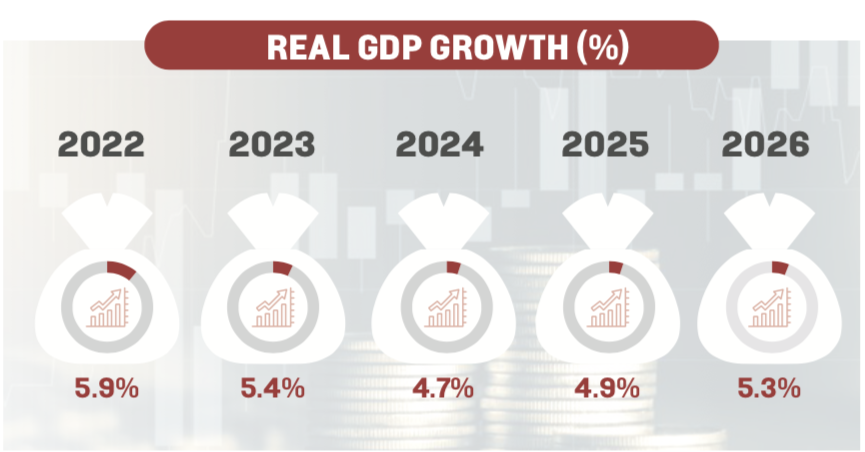
    Kenya’s economy grew faster in the first quarter of 2026 than it did a year earlier, with the Kenya National Bureau of Statistics reporting real GDP growth of 5.3 per cent, up from 4.9 per cent in the same period of 2025. Every sector of the economy expanded, though the pace varied widely, and the numbers point to a recovery gathering real momentum rather than a one-off bounce.

    The standout performer was accommodation and food services, which grew 14.7 per cent as international arrivals through Jomo Kenyatta and Moi International Airports jumped 13.1 per cent to just over 506,000 visitors. That is a sharp turnaround from the near-flat growth the sector posted a year ago, and it suggests Kenya’s tourism recovery, long promised, is finally translating into consistent numbers rather than seasonal spikes.

    Manufacturing also had a strong quarter, growing 4.4 per cent compared with 2.8 per cent last year. The gains were broad-based: sugar output rose 4.4 per cent, soft drink production climbed 7.6 per cent, and vehicle assembly jumped 18.1 per cent. Cement and galvanised sheet production both grew by double digits, a signal that factories tied to construction are running harder to keep up with demand. Banks appear willing to back that expansion too, with credit to manufacturers rising to KSh 588 billion from KSh 566.2 billion a year earlier.

    Construction itself grew 6.6 per cent, up from 4.5 per cent, with cement consumption up nearly 18 per cent and credit to the sector rising by close to a third to over KSh 200 billion. Mining and quarrying grew 9.1 per cent, while agriculture, the sector that still employs the largest share of Kenyans, expanded 4.9 per cent, a touch slower than the 5.3 per cent recorded a year ago. Tea, sugarcane and milk deliveries all improved, and cut flower exports grew as well, but coffee and fruit exports fell, pulling down what would otherwise have been a stronger showing from the farm sector.

    The financial sector had a good quarter too, expanding 6.3 per cent as borrowing became noticeably cheaper. The Central Bank Rate came down to 8.75 per cent in March, from 10.75 per cent a year earlier, and commercial banks passed some of that relief on: average lending rates fell to 14.70 per cent from 15.77 per cent. Cheaper credit fed through to activity at the Nairobi Securities Exchange, where trading volumes rose by more than a third and the NSE 20 Share Index climbed from 2,227 points to 3,432 points, a strong signal of returning investor confidence.

    Not every indicator moved in Kenya’s favour. Inflation ticked up to 4.35 per cent from 3.45 per cent, driven mainly by pricier food and non-alcoholic drinks, and the current account deficit widened sharply, from KSh 70 billion to KSh 120.9 billion, meaning the country is spending more on imports and foreign obligations than it is earning from exports and other inflows. The shilling had a mixed year against major currencies too, holding steady against the US dollar and gaining against the yen, but losing over 11 per cent of its value against the euro and nearly 7 per cent against the pound. It also weakened against the South African rand and regional currencies, including the Ugandan and Tanzanian shillings.

    There were softer patches elsewhere in the economy. Mobile money transactions fell by 13.6 per cent even as mobile voice traffic and international bandwidth use both grew, a sign that Kenyans are talking and browsing more but transacting differently, possibly reflecting shifts toward bank-linked digital payments rather than pure mobile money platforms. Electricity generation rose 7.4 per cent, powered largely by a 21 per cent jump in geothermal output, though both wind and solar generation declined during the quarter.

    Taken together, the picture is of an economy where the traditionally strong pillars, tourism, manufacturing, construction and finance, are doing the heavy lifting, while agriculture and the currency remain the areas to watch. With interest rates continuing to ease and credit flowing more freely into productive sectors, the coming quarters will show whether this growth can broaden further or whether rising import costs and a wider current account gap start to weigh on the gains.

  • KRA collections hit Kshs. 2.8 Trillion

    KRA collections hit Kshs. 2.8 Trillion

    Kenya’s tax collector closed the 2025/26 financial year on its strongest footing in recent memory, hauling in Kshs. 2.844 trillion and posting growth that nearly doubled the pace set a year earlier.

    Kenya Revenue Authority said that collections rose 10.6% over the twelve months to June, a sharp acceleration from the 6.8% expansion recorded in FY 2024/25. The haul amounts to roughly Kshs. 273 billion more than the Kshs. 2.572 trillion banked the previous year — a performance the agency is pointing to as evidence that domestic revenue mobilisation is gaining traction even as businesses continue to navigate a difficult operating climate.

    Five Sectors Carry the Load
    A handful of industries did most of the heavy lifting. Manufacturing, energy, financial and insurance services, information and communication, and wholesale and retail trade together generated about 62% of everything KRA collected, despite representing just over a quarter of the country’s nominal economic output — a sign, the authority suggests, of how disproportionately these sectors feed government coffers relative to their size in the economy. Collectively, revenue from the five grew 8% for the year.

    Manufacturing edged out energy as the single largest contributor among them, bringing in Kshs. 462 billion, up from Kshs. 423 billion — a 9.2% climb. VAT, PAYE, excise and corporation tax accounted for nearly three-quarters of that total, while raw material imports into the sector made up roughly half of all import value for the year.

    Energy wasn’t far behind, delivering Kshs. 445 billion on 9.1% growth, with customs oil taxes doing much of the work. Financial and insurance firms contributed Kshs. 320 billion, up from Kshs. 311 billion, with corporation tax and combined withholding-and-PAYE remittances driving most of that. ICT collections climbed to Kshs. 248 billion — a comparatively modest 7.9% gain — while wholesale and retail trade rounded out the group with Kshs. 288 billion, a 10.3% jump attributed largely to stronger consumer and business activity.

    Where the Money Actually Came From
    Beneath the headline figure, the breakdown tells a more layered story. Exchequer revenue — the core pool that funds government operations — grew 10.5% to Kshs. 2.568 trillion, landing at 95.2% of target. Customs collections outperformed expectations entirely, coming in at 100.8% of target and growing 12.4%, powered by both oil and non-oil trade. Domestic revenue grew more modestly, at 9.7%, and fell short of its target, reaching 93% of the Kshs. 1.991 trillion goal.

    Individual tax heads moved at different speeds. PAYE, the tax on salaries, grew just 6.7% — an improvement on the anemic 3.3% of the prior year, but still trailing the 8.5% average KRA had grown accustomed to in 2022/23 and 2023/24. The authority linked the slowdown to a shrinking formal-employment base, which has slipped from 15.7% of total employment in 2022 to 15.3% last year, according to the 2026 Economic Survey.

    Corporation tax told the opposite story, climbing 14% — its third straight year of acceleration — with banks alone contributing more than a quarter of all corporate tax remittances. Betting and gaming taxes blew past their target entirely, coming in nearly 16% ahead of plan, while digital service tax collections from non-resident platform operators doubled after lawmakers scrapped a Kshs. 5 million revenue threshold that had previously shielded smaller foreign digital earners.

    Technology and Enforcement Behind the Numbers
    KRA credited much of the improvement to a widening digital compliance net. Its electronic invoicing system had onboarded more than 750,000 taxpayers by June, while integration between its tax platforms and government payment systems now gives the authority near real-time visibility into withholding taxes on state contracts. A whistleblower platform, iWhistle, helped recover Kshs. 3.2 billion tied to nearly 900 tips, and debt-recovery efforts on non-compliant taxpayers clawed back a further Kshs. 144.8 billion.

    Cargo clearance times also improved, dropping to an average of 42.3 hours against a 43.15-hour target, which the authority attributed to expanded scanning technology and a shift toward pre-arrival customs processing.

    Looking to the year ahead, KRA said it intends to widen its use of electronic tax registers, build out a dedicated data analytics unit, and lean further into artificial intelligence to sharpen enforcement — part of a broader push to close the gap between what the economy generates and what actually reaches the treasury.