Author: Jared Ombui

  • Will the ceasefire hold after U.S. seized Iranian cargo ship?

    Will the ceasefire hold after U.S. seized Iranian cargo ship?

    The already-strained ceasefire between Washington and Tehran took a sharp turn for the worse Sunday when the U.S. Navy attacked and seized an Iranian-flagged cargo vessel in the Gulf of Oman.

    U.S. President Donald Trump announced on Truth Social that the Navy destroyer USS Spruance intercepted the nearly 900-foot cargo vessel Touska. The U.S. Central Command said the destroyer had issued repeated warnings over a six-hour period before taking action. Trump said the Navy “stopped them right in their tracks by blowing a hole in the engine room,” and that U.S. Marines had boarded and taken custody of the vessel. Iran’s armed forces accused Washington of a brazen violation of the ceasefire agreement, with its military command saying it had launched drones in response and vowing further retaliation against what it called “armed piracy.”

    ESCALATING TENSIONS
    The seizure did not occur in a vacuum. Iran reimposed restrictions on the Strait of Hormuz Saturday, citing what it described as repeated breaches of trust by the United States, just one day after declaring the waterway “completely open” under the ceasefire. The Revolutionary Guard Navy warned that “no vessel should make any movement from its anchorage in the Persian Gulf and the Sea of Oman,” and that approaching the strait would be considered cooperation with the enemy. The maritime chaos has alarmed global shipping. According to London-based maritime analytics firm Windward, 35 outbound vessels reversed course after Iran reimposed control over the Strait of Hormuz. About 20 percent of the world’s oil and natural gas normally transits the waterway, and the disruptions have sent Brent crude prices soaring, which repeatedly passed the key psychological threshold of 100 U.S. dollars per barrel since March.

    DIPLOMACY DERAILS
    Against this combustible backdrop, U.S. hopes for a second round of peace talks in Islamabad appeared to collapse Sunday, even as Washington insisted the talks were on track.

    The White House said Vice President JD Vance, who led the first round of face-to-face talks over 21 hours, would lead the U.S. delegation to Pakistan alongside envoys Steve Witkoff and Jared Kushner. Trump said on social media that the U.S. team would arrive in Islamabad by Monday evening and told The New York Times that he might travel to Pakistan if a deal were signed there. Pakistan appeared to be preparing for a high-profile visit. Authorities in Islamabad tightened security in the capital’s Red Zone, home to government ministries and foreign missions, and ordered officials to work from home Monday, widely interpreted as contingency measures for a possible Trump arrival. Meanwhile, the Iranian Foreign Ministry denied such arrangements on Monday, saying Tehran has no plans to hold a second round of talks with the United States yet. Iran’s state-run IRNA news agency previously reported that there was “no clear prospect” for talks under current conditions. It cited Washington’s excessive demands, unrealistic expectations, constant shifts in stance, and the ongoing naval blockade, which Tehran considers a breach of the ceasefire. Iran cited the ongoing blockade as one of its primary reasons for calling off the expected negotiations. Iran’s semi-official Tasnim news agency went further, reporting that Tehran now considers a return to fighting more likely than continued diplomacy, and that the country is fully prepared for that scenario.

    WHAT’S NEXT
    The current ceasefire is set to expire by Wednesday, and Washington and Tehran remain deadlocked over control of the Strait of Hormuz. Trump agreed to the original two-week ceasefire on April 7 in exchange for Iran completely opening the strait. Trump threatened that if Iran did not accept U.S. terms, Washington would “knock out every single Power Plant, and every single Bridge, in Iran.” Iran said that if war were to resume and Iranian infrastructure came under attack, Tehran would abandon the restraint it had previously shown toward energy firms and facilities in Saudi Arabia, the United Arab Emirates and other regional states. Iran’s parliament is also moving to codify its maritime posture into law. A lawmaker announced Sunday that Tehran is drafting comprehensive legislation to govern the Strait of Hormuz, which would bar Israel-linked ships and cargoes from the waterway, require vessels from hostile nations to obtain approval from Iran’s Supreme National Security Council, and mandate compensation from countries that have caused Iran losses before their ships are permitted passage. After the first round of talks collapsed, Pakistan said it would continue to play a mediating role and urged both sides to uphold the ceasefire. Whether that goodwill is enough to forestall a return to hostilities before Wednesday’s deadline remains uncertain.

  • China unveils package of policies, measures to boost ties with Taiwan

    China unveils package of policies, measures to boost ties with Taiwan

    The Chinese mainland on Sunday rolled out a package of 10 policies and measures — spanning inter-party communication, infrastructure, travel, trade and culture — aimed at boosting exchanges and cooperation with Taiwan.

    The announcement by the Taiwan Work Office of the Communist Party of China (CPC) Central Committee followed a meeting on Friday between Xi Jinping, general secretary of the CPC Central Committee, and Cheng Li-wun, chairwoman of the Chinese Kuomintang (KMT) party, the first such top-level meeting between the two political parties across the Taiwan Strait in a decade.Invited by the CPC Central Committee and Xi, Cheng led a KMT delegation on a six-day visit to mainland cities including Nanjing, Shanghai and Beijing, which concluded on Sunday.Atop the 10 initiatives announced by the mainland on Sunday is a proposal to explore a regular communication mechanism between the CPC and the KMT.

    The CPC and the KMT will, on the common political foundation of adhering to the 1992 Consensus and opposing “Taiwan independence,” take “stronger measures” to promote cross-Strait exchanges, interaction and integration, the CPC’s Taiwan work office said in a statement.The Taiwan question is a scar left over by a full-blown civil war fought between the forces led by the CPC and the KMT about eight decades ago. In 1949, the remnants of the defeated KMT retreated to Taiwan, and the People’s Republic of China was founded under the leadership of the CPC.The unresolved civil war and foreign interference have left the two sides of the Strait in a prolonged state of political confrontation. However, the fact that Taiwan is an inalienable part of China’s territory has never changed.

    The latest policies and measures, according to the statement, aim to advance the peaceful development of cross-Strait relations and enhance the kinship and well-being of compatriots across the Strait.The policy package demonstrates the mainland’s sincerity, goodwill and firm resolve in promoting the peaceful and integrated development of cross-Strait relations, said Wang Yingjin, director of the cross-Strait relations research center of the Renmin University of China. “The measures will inject fresh momentum into efforts to sustain the steady improvement of cross-Strait relations.”

    INFRASTRUCTURE, TRAVEL, TRADE
    According to the statement, efforts will be made to support the coastal areas of Fujian Province — the mainland region closest to Taiwan — in sharing water, electricity and gas supplies with the offshore islands of Kinmen and Matsu, and to promote construction of sea-crossing bridges linking them, when conditions permit.

    The mainland will also move to resume regular direct passenger flights across the Strait, including routes to and from Urumqi, Xi’an, Harbin, Kunming and Lanzhou.Kinmen will be supported to use a new airport under construction in the nearby mainland city of Xiamen, expected to begin operations by the end of 2026.Lee Chou-hsi, a Tsinghua University graduate student from Taiwan, welcomed the new measures. “During my undergraduate study in Changsha, I had to transfer flights to and from Taiwan, which was very inconvenient at the time,” said Lee. “More direct flights between mainland cities and Taiwan will surely benefit students and tourists.”

    A communication mechanism will be set up on the common political foundation of adhering to the 1992 Consensus and opposing “Taiwan independence” to facilitate the entry of Taiwan’s agricultural and fishery products that meet the quarantine standards into the mainland.
    Efforts will also be made to help Taiwan’s agricultural and fishery products gain access to various mainland trade fairs to expand their sales channels.The mainland will explore building wharves and berths in regions where conditions permit for distant-water fishing vessels from the Taiwan region, and mull providing convenience for the sales of their fish catch on the mainland.It will also facilitate registration procedures for qualified Taiwan food manufacturers and the entry of their food products into the mainland market.

    The mainland will explore the establishment of more trading markets for small-ticket items with Taiwan and support micro, small and medium-sized enterprises from Taiwan to expand business on the mainland.Mainland cities such as Fuzhou and Xiamen have long established such markets, allowing small businesses from Taiwan to directly sell specialty commodities to mainland buyers.Wu Chia-ying, executive vice president of the Association of Taiwan Investment Enterprises on the Mainland, said that the measures respond to the practical needs of business development such as reducing operating costs and improving access to the mainland market.”We hope these measures will be implemented as soon as possible,” Wu said, adding that the association will play a bridging role to help Taiwan businesses better seize opportunities and participate in the country’s modernization drive, contributing to a stronger Chinese economy.

    YOUTH, CULTURE
    The statement said that an institutionalized platform will be set up to promote two-way exchanges between young people on both sides of the Strait. The All-China Youth Federation and other relevant mainland institutions will invite 20 youth groups from Taiwan to visit the mainland for exchanges every year.Fan Chiang-feng, a young Taiwan entrepreneur based on the mainland, said that the establishment of a regular platform for young people on both sides of the Strait would help break down information barriers. “Our generation on both sides of the Strait should move forward together,” he said.

    To boost cultural ties, the mainland will allow qualified TV shows, documentaries and animations from Taiwan to be aired, and permit Taiwan residents to take part in the mainland’s fast-growing micro-drama industry.Working in youth services in Xiamen, Wu Ping-chang from Taiwan was encouraged by the policies. “With more opportunities and confidence, I hope to take cross-Strait stories into the drama production in the future, enabling audiences on both sides to see more authentic and warm exchanges,” Wu said.The statement also noted that the mainland will promote the resumption of individual tours for Shanghai and Fujian residents to Taiwan.A pilot scheme allowing mainland individuals to tour Taiwan was introduced in 2011, but was suspended in 2019 — a few years after the secessionist Democratic Progressive Party came to power in Taiwan and stepped up plots to seek “Taiwan independence.”Sheng Jiuyuan, director of the center for Taiwan studies at Shanghai Jiao Tong University, told Xinhua that the cumulative effect of these measures may reshape the pattern of cross-Strait exchanges.”The two-way integration across the Strait, grounded in tangible improvements to people’s livelihoods, will lay a broad and durable foundation of public support and foster profound mutual trust,” Sheng said.

  • ODM-UDA cracks widen as zoning row rocks Nyanza rallies

    ODM-UDA cracks widen as zoning row rocks Nyanza rallies

    Fresh cracks have emerged in the fragile working relationship between ODM and President William Ruto’s Kenya Kwanza administration, with a fierce row over electoral zoning threatening to unsettle the broad-based government arrangement ahead of the 2027 General Election.

    The simmering tensions burst into the open on Friday during separate political events attended by National Assembly Speaker Moses Wetang’ula in Migori and Homa Bay counties, where leaders sharply differed on the future of the ODM-UDA partnership and the push to ring-fence elective seats.

    At the heart of the dispute is a proposal to introduce zoning in selected regions before the 2027 polls , a move that has triggered resistance from grassroots supporters and deepened divisions among leaders allied to both political formations.

    While Speaker Moses Wetang’ula and Senate Majority Leader Aaron Cheruiyot moved to steady the alliance, influential leaders from the region openly rejected attempts to predetermine political contests, insisting that voters must be allowed to choose their leaders freely.

    The emerging fallout now lays bare the delicate balancing act facing ODM leader Dr. Oburu Odinga and President Ruto as their allies struggle to contain growing unease over the shape, terms and political cost of the broad-based arrangement.

    Speaking in Ndhiwa Constituency during a women’s empowerment fundraiser, Speaker Wetang’ula sought to remind residents of the origins of the political truce.

    “I want to thank the people of Nyanza for being steadfast and firm. Even when we campaigned here in previous elections, no was no and yes was yes. That is the same conviction Raila Odinga had when he agreed that ODM works with Kenya Kwanza under the broad-based arrangement and allowed some of your leaders to serve in government. That is the position you should uphold,” he said.

    In Migori County, Senate Majority Leader and Kericho Senator Aaron Cheruiyot, who joined the Speaker during a youth empowerment fundraiser, sought to allay fears that the political relationship between ODM and its Kenya Kwanza allies was on the verge of collapse.

    “Even in a marriage, it is not always blissful; there are bound to be issues. The ODM-UDA matters will be resolved through negotiation. We will not part ways; we will talk and find common ground,” Mr. Cheruiyot said.

    On his part , Rarieda MP Hon. Otiende Amollo called for a structured conversation on the matter.

    “We must have a structured negotiation on the question of zoning , whether it is good or bad. Those in ODM must exercise restraint and focus on negotiating solutions to the thorny issues,” he said.

    Former Migori Governor Okoth Obado, however, opposed the zoning proposal, arguing that it would discriminate against leaders by favouring specific individuals.

    “If you know that you have worked well for the people, you have no reason to be worried. If you slept on the job, that is your undoing. Prepare to go home,” Mr Obado said.

    Migori Woman Representative Hon. Fatuma Mohamed also weighed in, warning against leaders exploiting the tensions between ODM and UDA for personal gain.

    “There are those hell-bent on fuelling the ODM-UDA war for their own benefit. Do not fall into their trap. If you are denied a ticket through zoning, why worry? Run on an independent ticket. I was denied by ODM but was elected as an independent,” she said.

    Despite the divisions, several leaders and their supporters appeared to cautiously back President William Ruto’s re-election bid, while insisting that contests for other elective positions should remain open.

    “In Migori, we do not want to hear about zoning. We want total freedom. We want people to compete fairly so that the best candidate wins,” Mr Obado said.

    Speaker Wetang’ula, while championing President Ruto’s re-election bid, urged residents of Nyanza and Western Kenya to rally behind the government, citing what he described as increased development projects in the regions.

    “For a long time, seeing the President in Nyanza was a mirage. In the last three years, the President has visited Nyanza and Western more than 10 times. He has surpassed the visits by Presidents Kibaki and Uhuru combined,” he said.

    “And he does not just visit; he launches development projects across sectors that uplift the lives of the people. This is how it should remain.”

    Ndhiwa MP Hon. Martin Owino praised the administration’s development record in the area.

    “Ruto has done a lot for us and we are grateful. There is infrastructure development, resources allocated for a TVET, hospitals, schools, among others. We are fully behind him,” he said.

    The Speaker also cautioned against divisive politics driven by self-interest.

    “There are individuals who are selfish and oppose development simply because it is not in their region. We want all Kenyans to feel equal. A country driven by hate and division will never prosper,” he said.

    He further renewed his call to young people who have attained the age of 18 to take advantage of the relaxed national ID registration requirements and register as voters.

    “Your vote is your weapon and your voice. You cannot threaten to send leaders home if you are not a registered voter,” he said.

  • Israeli army continues offensive in Lebanon despite ceasefire

    Israeli army continues offensive in Lebanon despite ceasefire

    Israeli forces continued military operations in southern Lebanon on Saturday despite a ceasefire that took effect late Thursday night, according to Lebanon’s National News Agency.

    In the Nabatieh district, Israeli artillery targeted the outskirts of Deir Siriane village; Further south in Marjayoun, Israeli forces carried out large-scale home demolitions in the village of Taybeh, the news agency reported.

    Israeli forces in Khiam sealed off the town entirely, blocking all entrances with earth mounds and barriers to prevent residents from returning. Separate reports confirmed further Israeli detonation operations inside the town.

    In the Bint Jbeil district, Izzat Hammoud, the mayor of Bayt Lif village, urged Lebanese authorities to immediately halt ongoing Israeli demolitions, bulldozing, and home destruction.

    Hammoud accused Israel of exploiting the ceasefire to continue violations, saying residents are still barred from returning to inspect their properties.

    Hezbollah has so far refrained from retaliation, according to Lebanese officials.

    A 10-day ceasefire between Israel and Lebanon took effect at midnight between Thursday and Friday local time (2100 GMT), following an earlier announcement by U.S. President Donald Trump.

  • Togo launches new 2026-2028 strategy for the Sahel

    Togo launches new 2026-2028 strategy for the Sahel

    Lome, the capital of Togo, hosted a high-level meeting on Saturday marked by the launch of Togo’s new 2026-2028 strategy for the Sahel, notably targeting Mali, Burkina Faso and Niger, which form the Confederation of Sahel States.

    Championed by Faure Gnassingbe, President of the Council, the new strategy continues Togo’s engagement in the Sahel and replaces the 2021 strategy that had guided the country’s actions in the region over the past four years.

    The new Sahel Strategy (2026-2028) aims to adapt Togo’s engagement in the region to emerging realities, while strengthening its contribution to regional stability and cooperation between Sahel countries and those of the Gulf of Guinea.

    The Lome meeting sought to enhance political dialogue between Togo and Sahel states, provide a platform for exchanges among governments as well as regional and international organizations, and contribute to dialogue promoting stability, security and regional integration.

    The meeting brought together representatives of the Togolese government, governments of Sahel states, special envoys for the Sahel, and representatives of sub-regional, regional and international organizations, including the United Nations.

    According to Abdoulaye Diop, Mali’s minister of foreign affairs and International Cooperation, the new 2026-2028 strategy “once again demonstrates Togo’s determination to adapt its engagement to new geopolitical and security realities in order to strengthen regional stability, as well as cooperation between Sahel states and those of the Gulf of Guinea in a rapidly changing geopolitical environment and world.”

    Togolese authorities noted that the terrorist threat persists in the Sahel and is gradually spreading toward the coastal states of the Gulf of Guinea, stressing that the need to act further in the interest of regional stability remains a priority.

  • Kindiki: Kenyans we have a plan, oil prices will go down

    Kindiki: Kenyans we have a plan, oil prices will go down

    Deputy President Kithure Kindiki has called on Kenyans to remain patient as the government rolls out measures to mitigate the impact of rising global oil prices.

    Speaking on Saturday at his residence in Irunduni while addressing residents from Chuka Igambang’ombe, Kindiki attributed the recent surge in fuel costs to external geopolitical tensions rather than domestic policy failures.

    He pointed to the ongoing conflict between Iran and Israel as the primary driver of global oil price volatility, dismissing claims that the situation is locally driven.

    “The recent escalation of oil prices is a result of the Israel-Iran conflict. Those calling for oil protests should understand that demonstrations will not bring prices down,” Kindiki said.

    The Deputy President reassured the public that the government is actively working to prevent the situation from escalating into a broader economic crisis.

    “I am confident that the current pressure on oil prices will not destabilise our economy. We ask Kenyans to be patient as we address the issue,” he added.

    As part of its intervention measures, the government has already reduced Value Added Tax (VAT) on petroleum products from 13 percent to 8 percent, a move that has lowered pump prices by up to KSh 10 per litre.

    Kindiki indicated that additional policy measures are under consideration to further cushion consumers and stabilise prices in the coming weeks.

    “We will take more steps to ensure oil prices drop further,” he said.

    On the political front, Kindiki urged leaders to embrace tolerance, noting that electoral competition should not breed hostility.

    “Competition is not enmity. Once voting is complete, winners will proceed to lead, while others will wait for another opportunity,” he said.

    He also dismissed critics of the Kenya Kwanza administration, saying calls against the government were in bad faith.

    “We have had many presidents and deputy presidents, but not once have we sustained chants of ‘one term’. Even those who lost did so with our votes in their basket,” he added.

  • Slum Soccer Starlets receive kits from Obonyo Foundation

    Slum Soccer Starlets receive kits from Obonyo Foundation

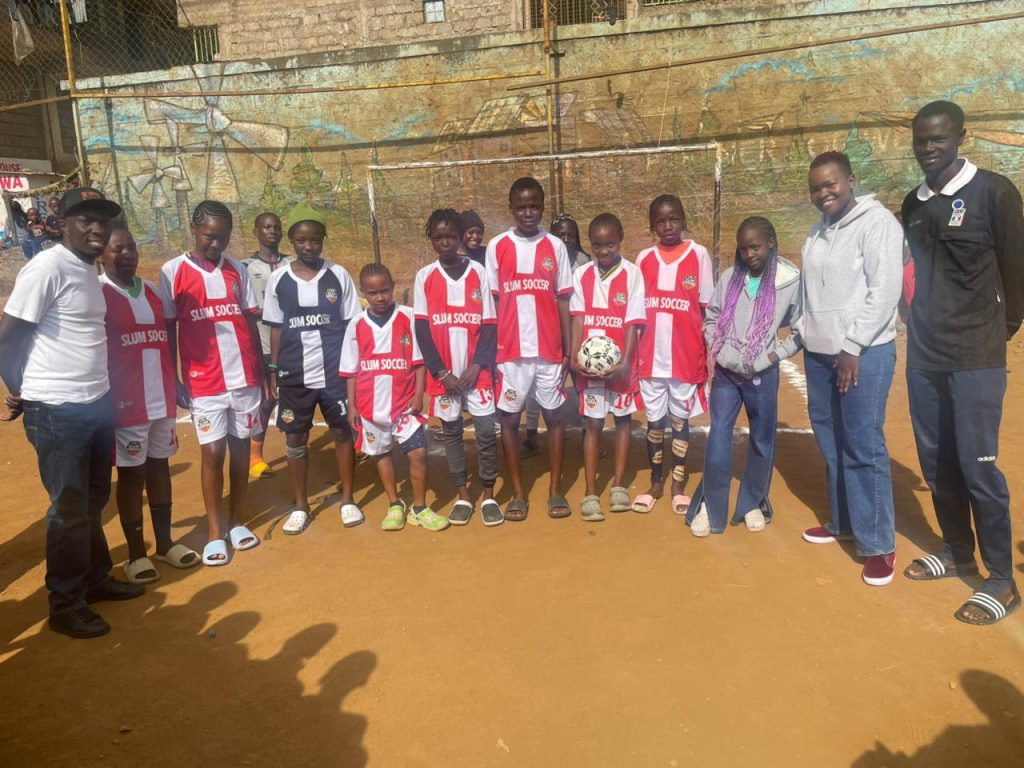
    The Slum Soccer Starlets of Mathare received a major boost this week after public policy analyst Raphael Obonyo, through his Obonyo Foundation, donated new sports kits and balls to the team.

    The foundation delivered 17 pairs of kits and balls, joined by former Chief Justice Willy Mutunga and Cynthia Omondi, a girls’ and women’s rights advocate. The group pledged continued support for the Mathare-based team, which represents the community in local tournaments.

    “We have a squad of 30 players in the girls’ team, so this is a huge boost for us,” said Coach Edwin Ojiambo. “We often face shortages of equipment like balls and jerseys, and this donation will go a long way.”

    Obonyo emphasized the importance of grassroots support in sports development. “Many local teams struggle to afford kits,” he noted. “The Obonyo Foundation recognizes the power of sports to drive social change and unearth big talent. That’s why we continue donating kits and balls to support development through sports.”

    So far, the foundation has donated kits to over 200 teams across the country, including in Nairobi, Marsabit, Kisumu, Isiolo, and Busia counties. Beneficiaries include Slum Soccer Starlets in Mathare, Making A Difference (MAD) Sisters in Kibra, ACOFOA in Korogocho, Kisumu All Starlets, Kolwa, Moreno United in Eastleigh, and the Women Rising Initiative in Marsabit and Isiolo.

    Through its “For The Girls” initiative, the foundation focuses on empowering girls and promoting women’s football as a tool for development and equal opportunity.

    Obonyo encouraged the Slum Soccer Starlets to stay committed and use sports as a path to eradicating poverty and achieving sustainable development.

    Omondi echoed that sentiment, highlighting the broader impact of supporting women’s football. “Girls and women’s football provides valuable opportunities for empowerment and growth,” she said. “It deserves all the support it can get.”

    During the handover, Obonyo also relayed a message from Dr. Mutunga, who urged young people to view the slums as “places of hope” and to keep building a better future through dedication and innovation including in sports.

  • Reimagining Academic Integrity in the Era of AI

    Reimagining Academic Integrity in the Era of AI

    The modern classroom is standing at a crossroads. On one side is the exciting promise of artificial intelligence: personalized learning, smart feedback, faster research, and new digital skills that match the demands of the future. On the other side stands academic integrity: honesty, originality, critical thinking, and the timeless value of human effort. The real question is no longer whether AI belongs in education, but how institutions can embrace innovation without sacrificing standards.

    For many educators, AI feels like both an opportunity and a threat. It can help students brainstorm ideas, summarize difficult readings, generate practice quizzes, and even support learners with language or accessibility challenges. In this sense, AI is not just a tool; it is becoming a learning companion. Institutions that ignore it risk preparing students for a world that no longer exists. The workplace is changing rapidly, and graduates must know how to use AI responsibly, ethically, and intelligently.

    Yet the concerns are real and cannot be dismissed. If students rely on AI to write essays, solve assignments, or think on their behalf, education loses its soul. Assessment becomes unreliable. Effort becomes invisible. The danger is not simply cheating; it is the gradual erosion of deep learning. When learners stop struggling with ideas, they also stop growing through them. Academic integrity is not an outdated tradition. It is the foundation that gives education meaning, credibility, and public trust.

    So, should institutions redesign education around AI or protect education from AI? The most innovative answer is: both. Universities and colleges must not build walls against technology, nor should they surrender to it blindly. Instead, they should redesign learning systems that integrate AI while preserving human judgment. This means shifting from fear-based reactions to smart academic leadership.

    First, institutions should rethink assessment. If an assignment can be completed entirely by an AI tool, then the problem may not only be the student’s behavior, but also the design of the task. More oral presentations, reflective journals, case-based analysis, practical projects, and in-class demonstrations can make learning more authentic. Such methods assess not just the final answer, but the student’s reasoning, creativity, and personal understanding.

    Second, AI literacy should become part of the curriculum. Students need to learn when AI is useful, when it is misleading, and where ethical boundaries must be drawn. They should be taught how to cite AI assistance, verify outputs, question bias, and remain accountable for whatever they submit. In the same way institutions once taught digital literacy, they must now teach AI integrity.

    Third, educators need support, not blame. Lecturers require training, policy guidance, and practical tools to adapt their teaching. Without institutional support, the burden of managing AI falls unfairly on individual instructors. Strong policies should clearly define acceptable use, prohibited practices, and consequences for misuse, while still encouraging experimentation in teaching and learning.

    The future of education is not AI alone, and it is not tradition alone. It is a thoughtful partnership between human wisdom and technological power. Institutions can absolutely do both: adapt to AI innovation and maintain academic standards. The winners in this new era will not be those who reject AI, nor those who worship it, but those who govern it with courage, clarity, and integrity.

    Dr. Yusuf Muchelule is a Senior Lecturer & a Consultant

  • Why information ethics is everyone’s responsibility now

    Why information ethics is everyone’s responsibility now

    There was a time when a trusted few wrote the story of Kenya. The journalist with the notepad. The editor behind the heavy desk. The broadcaster leaning into the microphone at Kenya Broadcasting Corporation at exactly seven o’clock.

    They were the gatekeepers. Imperfect, yes. Sometimes slow, sometimes cautious. But they carried a weight: the weight of verification, the burden of truth, the duty to distinguish fact from rumour before ink touched paper or sound filled the airwaves.

    That time has passed. The gate is gone.

    Today, the most powerful printing press in Kenya is not housed in any industrial area. It is the smartphone in your palm. The broadcast studio is no longer confined to official buildings; it lives on your WhatsApp status, your TikTok video, your X post.

    We have all become editors. We have all become publishers. And every day, with a thumb swipe and a tap, we write new pages of Kenya’s story.

    But here is the uncomfortable question we have not yet answered collectively: Do we know the rules of this new newsroom?

    More specifically, do we understand the differences among misinformation, disinformation and fake news, and the harm each poses?

    Let us be clear. Misinformation is false information shared without harmful intent. A relative forwards a health alert that turns out to be untrue. They meant well.

    Disinformation, however, is deliberately created and spread to deceive. It is a weapon. And fake news, a term often misused, refers to fabricated content designed to look like legitimate journalism.

    All three poison our public square. But disinformation is the most dangerous because it is intentional. It is a lie with a mission.

    For decades, the Kenya Yearbook Editorial Board has operated on a principle that today’s digital world often finds inconvenient: pause before publishing.

    Before any fact, image, or narrative enters the permanent record of this nation, we ask three questions:

    Is it true?

    Is it fair?

    Does it honour the dignity of the Republic and its people?

    These questions are not bureaucratic delays. They are the foundation of information ethics. And in today’s digital economy, they are more necessary than ever.

    Speed has become the dominant virtue of the digital space. Algorithms reward the first, not the accurate. The forward button on WhatsApp is faster than the delete button.

    And in that split second between receiving information and sharing it, we have seen the consequences of careless or malicious publishing.

    We have seen disinformation about abductions spark unwarranted panic. We have seen manipulated images of political leaders deepen ethnic mistrust. We have seen rumours escalate tensions before facts have time to breathe.

    In this new environment, the citizen cannot verify everything on their own. That is why trusted national institutions matter now more than ever.

    At the Kenya Yearbook Editorial Board, verification is not a slogan. It is a discipline. When we publish data on school enrollment, healthcare access, infrastructure development or national progress, that information is the result of months of cross-referencing with ministries, counties and independent sources.

    When you see a Kenya Yearbook publication, you are not consuming opinion. You are engaging with a verified national record, an information asset designed to stand the test of time.

    For decades, the Kenya Yearbook Editorial Board has been the custodian of Kenya’s development story. Today, Kenyans themselves are shaping the nation’s digital footprint through daily online activity. Every post and message contributes to how Kenya is recorded and remembered.

    This is why information ethics is no longer optional. It is a shared responsibility between institutions and citizens.

    But credibility alone is no longer enough.

    Today, a fabricated screenshot can reach a million Kenyans before lunch. A viral voice note can outrun months of verified research.

    The challenge before us is not just to produce accurate information, but to ensure that accurate information moves at the speed of modern communication.

    That is why the Kenya Yearbook Editorial Board is expanding its mandate beyond documentation into leadership on national information ethics and literacy.

    We are strengthening our role as more than publishers. We are positioning ourselves as conveners, educators, and custodians of responsible information use in the digital age.

    Our work increasingly includes making verified national data more accessible digitally, supporting public education on information literacy, and contributing to national conversations on ethical communication.

    Because information ethics is no longer the responsibility of journalists alone. It belongs to every Kenyan.

    Information ethics in the digital economy demands three disciplines from every citizen.

    First, verify before you disseminate. If you cannot confirm information by checking against an official or credible source, do not share it. That simple pause is the first line of defense against misinformation.

    Second, seek context before judgment. A video without a date is not evidence. A screenshot without a source is not truth. Disinformation thrives on fragments stripped of context.

    Third, prioritise dignity before engagement. Before posting that image, allegation or forwarded voice note, ask yourself: Would I say this to the person’s face? If the answer is no, you are likely holding information that does not belong in the public domain.

    The most dangerous actor in Kenya’s digital space is not always the one who invents a lie. Often, it is the well-meaning citizen who forwards misinformation without verification because it confirms what they already believe.

    It is also the malicious actor who creates disinformation knowing that once released, no editor can fully recall it.

    We have all forwarded something we later regretted.

    The pressure to be first, to be relevant, to appear informed, is immense. But the cost of that speed is rising. Trust is eroding. Public confidence is weakening. And the distance between rumour and reality is shrinking.

    Every social media user today is an editor without a manual.

    That is precisely why institutions like the Kenya Yearbook Editorial Board must step forward, not only as publishers of verified records, but as leaders in shaping the ethical use of information in Kenya’s digital future.

    Our commitment is clear. Beyond our annual publications, we are investing in public education, digital accessibility, and national awareness on information responsibility.

    We are working to ensure that verified information is not just available, but reachable, shareable and trusted.

    Because if truth does not travel at the speed of a WhatsApp message, the lie will win.

    We are not asking Kenyans to stop being active, engaged, vocal citizens. Democracy depends on information flowing freely. But democracy also depends on that information being real.

    The difference between a functioning republic and a collapsing one is often just the distance between a rumour and a fact.

    The next time your thumb hovers over the forward button, remember: you are not just a user. You are an editor. You are a publisher.

    And the Kenya Yearbook Editorial Board exists to provide the national standard against which information can be measured.

    Before you share, ask:

    Would this pass KYEB’s three tests? Is it true? Is it fair? Does it honour the dignity of Kenya?

    Let us make every share a page we are not ashamed to read ten years from now.

    That is information ethics. That is our shared responsibility. And it begins with each of us.

    Lilian Kimeto is the CEO of the Kenya Yearbook Editorial Board

  • Reclaim Your Full Range to Make a Difference

    Reclaim Your Full Range to Make a Difference

    We rarely admit it out loud that low, steady pressure running in the background of almost every day. We call it being “busy,” “in demand,” or “under pressure.” Quietly, we’ve normalized living in a state our nervous system reads as threat.

    The problem is not just that stress feels bad. It’s that long-term stress starts to edit your life choices in ways that look reasonable from the outside and devastating from the inside. Psychologists warn that chronic stress can slash cognitive performance by up to a third. That’s not just slower thinking; it’s smaller thinking fewer bold ideas, less mental range, less willingness to hold complex, uncomfortable truths.

    Stress doesn’t only drain your energy. It shifts your internal settings: how you judge risk, how quickly you move, how you decide whose voice matters in the room including your own. It often looks like this:
    * You delay decisions you already know are right because you “need more time” or “one more input.”

    * You dial down your true opinion when the stakes rise, then replay the moment for days.

    * You stay inside what you’ve mastered, convincing yourself it’s “strategic focus,” when it’s really fear dressed up as logic.

    On the surface, you’re still performing. You respond to emails, hit deadlines, show up to meetings, and maybe even get praised for being reliable. But underneath, your decisions become safer, more defensive, more about avoiding loss than pursuing possibility. Careers rarely stall because people suddenly lose capability. They stall because a pattern of smaller decisions slowly tightens around a once-expansive sense of what was possible.

    The real cost of chronic stress is this shrinking of your range your capacity to think widely, choose bravely, and act in alignment with who you actually are. You do not correct this by waiting for life to calm down. You correct it by building a simple, non-negotiable system that keeps you expansive even when pressure spikes.

    Try this:
    * Decide within 24–48 hours when you feel stuck. Make the call with the information you have now; momentum creates clarity that rumination never will.

    * Say the thing before it feels comfortable. Share the concern, the conviction, the idea that makes your voice shake a little.

    * Do one visible, uncomfortable action every day ask for feedback, volunteer for a stretch task, decline a misaligned request.

    These aren’t motivational tricks; they’re structural counterweights. They remind your nervous system that you can move, speak, and choose even when stress is loud.

    Because in a world that isn’t slowing down, you don’t need more pressure or more willpower. You need a system that holds under pressure one that protects your range, your courage, your focus and your ability to make big, aligned decisions when it matters most. Stress shrinks your world. Deliberate, visible action is how you quietly take it back.

    Dr. Yusuf Muchelule is a Senior Lecturer & a Consultant.