The Ugandan military has stepped up security along its border with the Democratic Republic of the Congo (DRC) following a surge in cross-border attacks, kidnappings and robberies by armed groups operating in eastern DRC.
Kiconco Tabaro, second division military spokesperson, told Xinhua on Wednesday that security patrols have been intensified in response to the growing threat.
Local media on Wednesday reported heightened insecurity in the western border district of Kisoro, allegedly linked to the Democratic Forces for the Liberation of Rwanda.
“We have a very active and vigilant population with security committees engaged in security mobilization along the borderline,” Tabaro said.
“We continue to monitor how the situation is unfolding so as to enable us to protect our area from any criminal activity which can be perpetuated by any armed personnel from eastern DRC,” he added.
Tabaro urged armed groups and militias intending to cross into Uganda to surrender to security forces.
Canada “affirms recognition” of Morocco’s autonomy plan as a “basis for a mutually acceptable solution” to the regional conflict over the Moroccan Sahara.
This position was expressed in a statement published in Ottawa by Canada’s Ministry of Foreign Affairs, following a previous phone conversation between Anita Indira Anand, Minister of Foreign Affairs of Canada, and Nasser Bourita, Minister of Foreign Affairs, African Cooperation and Moroccan Expatriates.
The statement also underlined that, acknowledging “the importance” of the issue of Sahara to Morocco, Canada noted the adoption of UN Security Council resolution 2797 on October 31, 2025, and will act accordingly.
Emphasizing “the need to reach a lasting, just, and mutually acceptable political settlement in accordance with the principles of the UN Charter and relevant Security Council resolutions,” the Canadian ministry’s statement describes the autonomy plan presented by Morocco as “a serious and credible initiative in achieving a just and lasting settlement of the conflict.”
This shift in Canada’s position comes ahead of an “official visit to Morocco” by Minister Anand “in the coming weeks,” which will provide an opportunity “to further discuss the two countries’ relations and to deepen discussions on Sahara,” the statement concludes.
Assimi Goita, Mali’s transitional president, on Wednesday chaired a session of the Superior Council of National Defense to assess the security situation across the country following the coordinated attacks launched on April 25.
According to a statement posted by the Malian presidency on its official Facebook page, Minister of Security and Civil Protection Daoud Aly Mohammedine told the press that the April 25 attacks, which targeted several localities, had been carefully planned by armed terrorist groups with clearly defined strategic objectives.
He said the attackers suffered heavy human and material losses before being forced to retreat, thanks to the responsiveness, determination, and professionalism of the defense and security forces.
Mohammedine also expressed condolences to the victims of the April 25 events and paid tribute to the late Minister of State and Minister of Defense and Veterans Affairs Sadio Camara.
According to the statement, the defense council conducted an in-depth review of the security situation, after which Goita, also the supreme commander of the armed forces, issued 16 strategic directions aimed at further strengthening the country’s defense and security apparatus.
Mohammedine said the situation remained under control nationwide and praised the patriotic mobilization of the population, particularly its contribution through operational intelligence.
He also urged the public to remain calm, vigilant, and united, as well as to rely exclusively on official communication channels in the face of disinformation circulating on social media.
A car carrier with a maximum capacity of 10,800 car equivalent units, described as the world’s largest of its kind, was delivered Tuesday in the southern Chinese city of Guangzhou.
The vessel, named Glovis Leader, was built by Guangzhou Shipyard International Company Limited under the China State Shipbuilding Corporation (CSSC), together with China Shipbuilding Trading Co., Ltd. It was delivered to HMM, a leading shipping company in the Republic of Korea (ROK). After delivery, the vessel will be operated by Hyundai Glovis Co., Ltd., a logistics company also based in the ROK.Lee Kyoo-bok, CEO of Hyundai Glovis, said at the delivery ceremony that the new-generation ultra-large vessel is more than an ordinary means of transport. With its large capacity and enhanced green operating system, it is expected to set a new benchmark for global seaborne automobile transport and mark an important milestone for the shipping industry.
Industry insiders say the delivery demonstrates China’s growing capabilities in high-end shipbuilding and reflects broader efforts by the global shipping industry to move toward lower-carbon operations.Classified as a pure car and truck carrier, the ship is 230 meters long and 40 meters wide, with a design draft of 10.5 meters and a cruising speed of 19 knots. It features 14 vehicle decks and can carry a range of cargo, including electric vehicles, hydrogen-powered vehicles and heavy trucks.In recent years, Chinese-built vessels have renewed the record for the world’s largest car carrier. In late April 2025, BYD Shenzhen, with 9,200 standard vehicle spaces, made its maiden export voyage. Less than a month later, Anji Ansheng, with 9,500 vehicle spaces, set off from Shanghai for Europe on its maiden voyage. Both vessels were independently built by Chinese shipyards.
The Glovis Leader is powered by a dual-fuel system using liquefied natural gas and conventional fuel, meeting the International Maritime Organization’s Tier III emissions standards. It also incorporates energy-saving technologies, including optimized hull design, waste heat recovery systems and shore power capability.A shaft generator developed by a research institute under the CSSC enables the vessel to generate electricity while sailing, reducing fuel consumption.Car carriers are typical high-value-added vessels with a high technical threshold. The vessel type poses technical challenges in areas such as multi-layer thin-plate structures, vehicle fire safety, roll-on/roll-off systems and high-stability design.Zhou Xuhui, general manager of Guangzhou Shipyard International, said the company has overcome a number of key technical challenges through the batch construction of car carriers while production efficiency has also improved significantly.
Industry insiders said the large number of orders placed by overseas shipping giants with Chinese shipyards, especially for high-end vessels, shows that the technical maturity and product reliability of relevant Chinese-built vessels have been widely recognized by the global market.Guangzhou, one of China’s major shipbuilding bases, has developed a complete supply chain. Local authorities have pledged to continue building Guangzhou into a hub for marine innovation, targeting cutting-edge sectors such as the deep sea, green and smart marine industries.Guangzhou Shipyard International highlighted its commitment to innovation and efficiency with the delivery of its latest car carrier. The company has secured more than 40 orders for car carriers and delivered 26 to date. All vessels delivered so far were completed ahead of schedule, with 11 ships delivered in 2025 averaging 151 days early.
The company currently holds orders worth about 100 billion yuan (about 14.58 billion U.S. dollars), with overseas contracts accounting for more than 95 percent of the total. Production is scheduled through 2030.China’s ocean economy withstood pressure and maintained high-quality development in 2025, with faster shifts toward quality and efficiency, innovation-driven growth, and integrated marine development and conservation, said Shen Jun, an official with the Ministry of Natural Resources, in March.The country’s shipping volume and container throughput each exceeded one-third of the global total, while China held more than 50 percent of the global market share in shipbuilding and offshore engineering equipment, according to data released by the ministry.In 2025, the country’s three major shipbuilding indicators — completed shipbuilding output, new orders and orders on hand — accounted for the largest share of the global market for the 16th consecutive year, according to data released by the Ministry of Industry and Information Technology.
The United Arab Emirates (UAE) on Tuesday announced its decision to quit the Organization of the Petroleum Exporting Countries (OPEC) and the wider OPEC+ alliance, effective on May 1, following “a careful look at the regional power’s energy strategies.”
Why is the UAE leaving one of the world’s most important oil alliances? What internal disagreement drove the UAE’s decision? And, as one of the world’s major oil producers, what potential impact could the UAE’s exit have?
WHY IS THE UAE LEAVING?
Established in 1960, OPEC is a group of the world’s largest oil exporters that coordinates output to influence global supply and prices.
In a statement released by the official Emirates News Agency (WAM), the UAE said the decision to quit follows a comprehensive review of the state’s production policy and its current and future capacity, and is based on the UAE’s national interest and commitment to contributing effectively to meeting the market’s pressing needs.Analysts believe the statement reflects the UAE’s desire to break free from output limits and remove restrictions on its oil production by leaving the cartel.Robin Mills, CEO of Dubai-based consultancy Qamar Energy, told CNN that OPEC had most recently limited the UAE’s oil output to about 3.2 million barrels per day, while the country’s production capacity is closer to 5 million barrels per day.”The UAE has been planning to grow oil production by up to 30 percent, and it would be difficult to do so within the limitations of OPEC and OPEC+,” said Sergey Vakulenko, a senior fellow at the Carnegie Russia Eurasia Center.Bao Chengzhang, an expert on the Middle East at China’s Shanghai International Studies University, also believes that, amid ongoing disruptions in the Strait of Hormuz, the UAE aims to break free from OPEC’s quota restrictions, unlock idle production capacity, and leverage the Port of Fujairah, which is largely unaffected by the ongoing crisis, to adjust production more flexibly.
A BURST OF LONG-STANDING DISAGREEMENT?
Asked whether the UAE had consulted with other OPEC members before making the decision, the UAE’s Energy Minister Suhail Mohamed Al Mazrouei told media that the country had not discussed the issue with any other nation and called the exit a “sovereign” decision.
In fact, as a key OPEC member, the UAE has had differences with other members, including Saudi Arabia, particularly over OPEC’s quota-based management system.Francesco Sassi, a researcher in energy geopolitics and markets at the University of Oslo, said the UAE’s departure “signals that the long-standing friction with Saudi Arabia over production quotas has evolved from a diplomatic disagreement into a structural hindrance to any meaningful energy cooperation.”Bao told Xinhua that the current developments confirm the UAE’s determination to take full control of its oil production.He added that, against the backdrop of a global energy transition, the UAE has long sought to diversify its economy and aims to sell more oil before global demand for fossil fuels declines.Leaving OPEC and OPEC+ allows the UAE to exceed production quotas, maximize revenues, and fund its domestic economic transformation, Bao noted.
WHAT IMPACT WILL IT HAVE?
Some experts say that the UAE’s decision to leave OPEC and OPEC+ is not only driven by its own economic interests and long-standing dissatisfaction with OPEC, but is also closely linked to the current regional crisis.During the U.S.-Israel-Iran conflict, the UAE suffered some of the heaviest losses from Iran’s retaliatory attacks and was disappointed by the Gulf Cooperation Council’s response, which also influenced its decision, Bao argued.The UAE’s departure will reduce OPEC’s control of global supply from around 30 percent to 26 percent, Dan Pickering, chief investment officer at investment firm Pickering Energy Partners, said in an interview with CNN.”Without the UAE, OPEC will be much weaker; other major producers, Iran and Iraq, did not maintain any substantial spare capacity. It was mostly done by the UAE and Saudi Arabia,” Vakulenko noted.”The UAE’s withdrawal comes amid record-high oil prices,” Sassi noticed. “This suggests that even significant price spikes are no longer sufficient to bridge the widening trust deficit between producers.”It will have lasting consequences for post-war energy strategies and will undoubtedly inject fresh volatility into the markets, added the scholar. “The era of a unified Gulf oil policy appears to be at an end.”
Honduras has suspended its recognition of the self-proclaimed “Sahrawi Arab Democratic Republic” (SADR), marking the sixth such withdrawal in the past two years and underscoring a surge in global support for Morocco’s sovereignty over Moroccan-Sahara.
Honduras’ Foreign Minister, Mireya Agüero de Corrales, conveyed the decision in an official letter to Morocco’s Foreign Minister, Nasser Bourita, received on Wednesday.
The move, framed as a sovereign act rooted in principles of non-interference and respect for other states’ internal affairs, reaffirms Honduras’ backing of UN Secretary-General António Guterres and his Special Envoy’s efforts for a political, fair, and lasting solution. It also aligns with UN Security Council Resolution 2797 (2025).
Honduras, which first recognized the SADR in 1989 and reconfirmed it in 2022, notified Guterres directly of the suspension.
In a parallel development, Austria voiced strong support for Resolution 2797 during a meeting in Vienna between Foreign Minister Beate Meinl-Reisinger and Bourita, who was on a working visit. A joint communiqué praised the resolution’s endorsement of negotiations based on Morocco’s 2007 autonomy plan under Moroccan sovereignty as a “most feasible solution.” Austria specifically welcomed Morocco’s openness to detailing the autonomy framework.
These announcements reflect broadening international consensus, propelled by King Mohammed VI’s diplomatic push, in favour of Morocco’s Autonomy Initiative and the Moroccanness of the Sahara culminating in the UN Security Council’s adoption of Resolution 2797 on October 31, 2025.
In a move seen as a masterstroke in grassroot mobilization, National Assembly Speaker Rt. Hon. Moses Wetang’ula has intensified his efforts to secure Western Kenya in favour of President William Ruto’s re-election bid.
Following a series of high-level engagements with religious leaders and community elders across Bungoma County, the Speaker today met with teachers and their union leadership from across the county.
This meeting marks a critical phase in his strategy to consolidate opinion leaders who hold significant sway over the region’s political direction.
Addressing a gathering of educators, Wetang’ula assured the teachers of the government’s commitment to transforming the education sector, citing the recent employment of thousands of teachers and the ongoing recruitment drives as proof of President Ruto’s dedication to the “Bottom-Up” agenda.
”Teachers are the heartbeat of our community. When you speak, the village listens. By aligning with President Ruto, we are ensuring that the stability and growth we see today continue for the benefit of our children,” Wetang’ula told the receptive audience.
Political analysts term this move as “highly strategic.” By targeting teachers—who serve as informal advisors in every village — Wetang’ula is effectively building a campaign infrastructure that operates at the household level.
The Bungoma meeting comes on the backdrop of yet another successful mission in Homa Bay and Migori counties last week, where the Speaker received a surprisingly warm and receptive welcome in what has traditionally been an opposition stronghold.
His ability to charm audiences in the Nyanza region has signaled his growing influence as a national unifier and a key pillar in the President’s 2027 re-election machine.
Wetang’ula has been credited as the “engine” behind the government’s successes in the 13th Parliament. As Speaker, he has played a pivotal role in: facilitating the passage of critical government bills and the Finance Acts, Maintaining stability within the House to ensure the government’s legislative agenda is not derailed, and Bridging the gap between the Executive and the Legislature to fast-track development policies.
Wetang’ula is leaving nothing to chance. His systematic approach in Bungoma is being viewed as a blueprint for how the Kenya Kwanza administration intends to lock in the Western vote.
As the political landscape shifts toward the next general election, Speaker Wetang’ula has made it clear: his mission is to ensure that Bungoma—and the wider Western region—remains at the high table of government by standing firmly behind President William Ruto.
The UK Maritime Trade Operations (UKMTO) said on Saturday that it had received a report of a hijacking incident about 45 nautical miles northeast of Mareeyo, Somalia.
According to the advisory, military authorities informed the UKMTO on April 21 that unauthorized persons had taken control of a tanker and maneuvered the vessel approximately 77 nautical miles south within Somali territorial waters. The vessel’s last known position was at 08°56′N, 50°32′E, in waters off southeastern Somalia.
Separately, the UKMTO said on Thursday that it had received a report of a suspicious incident about 83 nautical miles southeast of Eyl, Somalia.
The master of a cargo vessel reported that two small craft with armed persons onboard approached the ship. One of the small craft came within 600 meters, during which warning shots were fired and the suspicious craft returned fire. The craft later moved away and kept clear of the reporting vessel.
Hell’s Gate National Park, about 100 kilometers northwest of Kenya’s capital Nairobi, is famed for its otherworldly landscape. Less known is its central role in powering Kenya’s electricity grid.
Sheer red cliffs rise like walls cloven by a giant’s axe, their faces layered with the solidified scars of ancient magma flows. Between them, compact power units dot the savannah, while steel pipelines thread through acacia groves, channelling underground heat into turbines.
Zebras, antelopes and giraffes graze freely, unfazed by the wisps of steam that periodically vent into the air. Here, heat drawn from the earth’s interior is converted into electricity and fed directly into the national grid.
This striking setting underpins a rare distinction: geothermal power supplies more than 40 percent of Kenya’s electricity — the highest share of any country in the world.
ANCHOR FOR POWER PRICES
Data from Kenya’s Energy and Petroleum Regulatory Authority and the International Energy Agency show geothermal has consistently contributed 40 to 48 percent of Kenya’s electricity in recent years, making it the foremost source by a considerable margin. The lion’s share flows from the Olkaria geothermal field within Hell’s Gate itself.
Located on the floor of the Great Rift Valley, Olkaria hosts one of the world’s most concentrated and accessible high-enthalpy geothermal reservoirs. Kenya’s total geothermal potential is estimated at around 10,000 MW, yet by the end of 2025, installed capacity remained below 4,000 MW — leaving most resources untapped.
Once built, geothermal plants have near-zero fuel costs. In Kenya, generation costs roughly 0.07 U.S. dollars to 0.08 dollars per kilowatt-hour, compared with over 0.20 dollars for heavy fuel oil — a gap of more than two to one. For a country with limited fossil fuel reserves, this has proven transformative: expanding geothermal capacity has helped stabilize industrial tariffs, cushioning the economy from imported inflation and supporting manufacturing competitiveness.
Unlike wind and solar, geothermal provides reliable baseload power, operating around the clock with annual utilization exceeding 8,000 hours. During droughts, when hydropower output drops sharply, it fills the gap and keeps the grid secure.
Its applications extend beyond electricity. Near Lake Naivasha, the Oserian flower farm uses geothermal well water to heat its greenhouses, making it Kenya’s only fully renewable-powered flower estate. The state-owned Geothermal Development Company (GDC) has expanded direct-use projects across agriculture, industry and tourism — including milk pasteurization, aquaculture and greenhouse heating. From the national grid to the furrowed field, this subterranean heat is weaving itself into the fabric of the Kenyan economy.
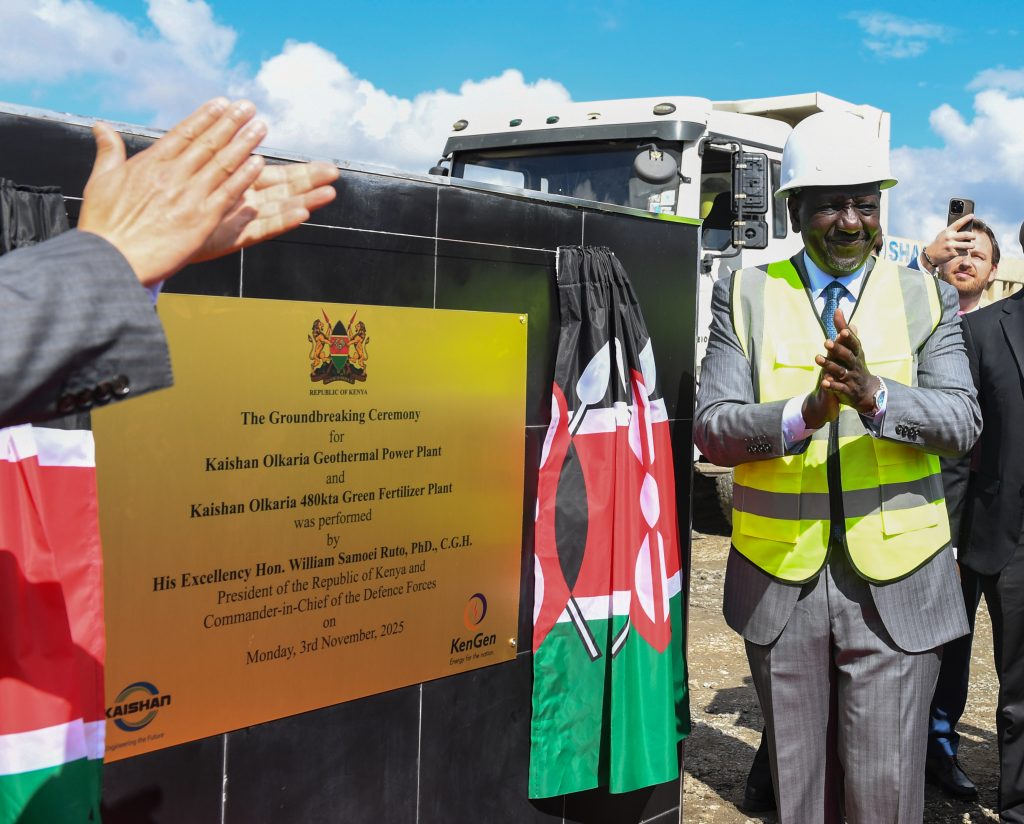
(251103) — NAIROBI, Nov. 3 (Xinhua) — Kenyan President William Ruto attends a groundbreaking ceremony for a Chinese-funded green fertilizer project held in Nakuru County, Kenya on Nov. 3, 2025. The groundbreaking ceremony was held Monday in Nakuru County, west-central Kenya, marking a major step toward sustainably boosting the country’s agricultural productivity. (Xinhua/Li Yahui)
DISRUPTING MONOPOLY
Kenya’s geothermal journey dates back to the 1950s. The commissioning of the Olkaria I plant in 1981 made it the first African country to generate electricity from geothermal energy.
For decades, however, progress was slow, constrained by a technological monopoly held by Western and Japanese firms over core equipment. At its nadir, the GDC went more than a decade without commissioning a single new power station.
That dynamic has shifted. Chinese companies have cracked the monopoly open, offering more cost-effective solutions. Leading the push is Kaishan Group, a private company from Quzhou in Zhejiang Province — though its entry was not easy.
“Initially, the Kenyan government was sceptical of us,” chairman Cao Kejian has recalled. “So I personally funded the construction of the first plant — over 53 million U.S. dollars out of my own pocket.” The gamble paid off. Serving as EPC contractor, Kaishan built the Sosian Menengai plant — the first privately operated geothermal facility at the Menengai field — which began operations in August 2023 after passing rigorous third-party assessments.
With its credentials established, Kaishan moved from contractor to owner. In late 2023, it acquired OrPower 22, an independent power producer at Menengai, and immediately launched construction of a new plant. Completed in just 14 months, the facility began commercial operations in March 2026, becoming Africa’s first geothermal project fully invested in, built and operated by a Chinese enterprise. It is now regarded as the best-performing geothermal plant currently operating in Kenya.
The ambition does not stop at electricity. At Olkaria, Kaishan is developing the world’s first integrated geothermal-to-hydrogen-and-ammonia project. A 165.4 MW plant will generate electricity to produce green hydrogen through electrolysis; that hydrogen is then combined with atmospheric nitrogen and naturally occurring carbon dioxide from the geothermal wells to manufacture green ammonia and fertilizer — with raw materials drawn almost entirely from local sources.
The project is expected to produce 180,000 tonnes of urea and 300,000 tonnes of calcium ammonium nitrate annually, plugging a gaping hole in Kenya’s domestic fertilizer production and easing the burden on local farmers.
At the groundbreaking ceremony, President Ruto called the investment “efficient, reliable and sustainable,” adding that it would bolster food security and “save Kenya vast sums of hard currency previously spent on importing fertilizer — marking a significant stride toward climate-resilient green industrialization.”
Kaishan’s general manager Dr. Tang Yan set out a broader vision. “We hope to work hand-in-hand with Kenya’s energy sector,” he said, adding that “leveraging Kaishan’s modular geothermal technology and Kenya’s extraordinary resources to build a green energy ecosystem covering clean power, green hydrogen, green ammonia and green methanol — and together lead Africa toward a greener and more sustainable future.”
(260422) — NAIROBI, April 22, 2026 (Xinhua) — This photo taken on April 21, 2026 shows a view of the Hells Gate National Park in the Great Rift Valley, Nakuru County, Kenya. The Great Rift Valley, located in eastern Africa, is one of the largest and most prominent continental rift systems in the world and is often referred to as the “scar of the Earth.” The region features remarkably diverse landscapes, including volcanoes, escarpments, gorges, as well as numerous lakes. A vast array of wildlife lives and migrates here, creating some of the world’s most renowned natural spectacles. Kenya serves as one of the main gateways for exploring the Great Rift Valley and its key attractions. (Xinhua/Xie Jianfei)
BUILDING GREEN TOGETHER
President Ruto has made “green industrialization” a central pillar of his agenda. At his inauguration, he told Kenyans the country was “on a transition to clean energy that will support jobs, local economies and sustainable industrialization,” and called on fellow African leaders: “Africa can lead the world. We have immense potential for renewable energy.”
Kenya aims not only to meet its own energy needs, but to demonstrate that developing countries can achieve rapid growth while honoring their climate commitments. In that effort, China has emerged as a decisive partner.
At the Forum on China-Africa Cooperation Beijing Summit, China announced 10 partnership actions for jointly advancing modernization, including a Green Development Partnership committed to implementing clean energy projects across Africa. In Kenya, that commitment is visible across the map.
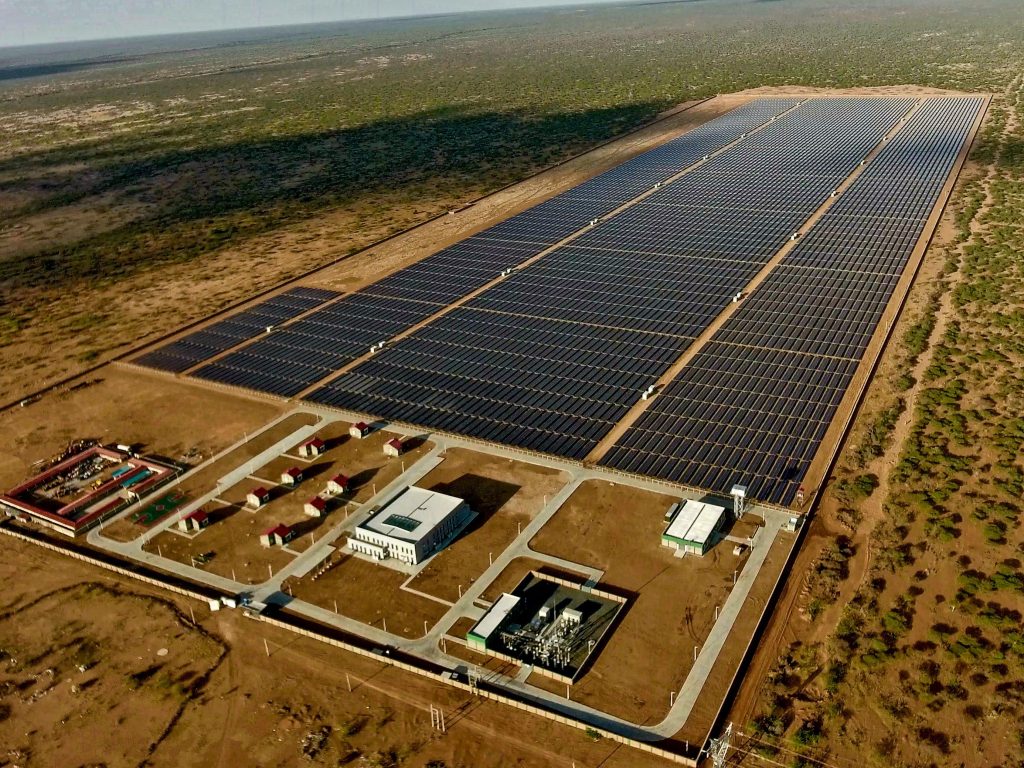
China Gezhouba Group’s Thwake Dam will bring water security, irrigation and hydropower to over 1.3 million people in Kenya’s historically water-scarce lower eastern region. In Garissa County, a Chinese-built 50 MW solar farm — East Africa’s largest photovoltaic facility — supplies clean power to communities long cut off from the national grid. In Nairobi, Chinese firms are contributing to the Dandora waste-to-energy project, converting a longstanding waste management burden into a model of circular economy.
The grid itself has been transformed. China Energy Engineering Group built the Kenya-Tanzania 400 kV interconnector, while China State Grid helped construct East Africa’s first high-voltage direct current line, bringing Ethiopian hydropower into the Kenyan network. Together, they have turned an isolated national grid into a regional system.
(230825) — GARISSA, Aug. 25, 2023 (Xinhua) — This aerial photo taken on Feb. 15, 2019 shows the Garissa Solar Power Plant in northeastern Kenya. TO GO WITH “Feature: Chinese-built solar plant boosting Kenya’s clean energy aspirations” (Xinhua)
“As a global leader in this space,” President Ruto has said, “Kenya continues to demonstrate how every nation can achieve sustained, rapid and transformative growth while remaining true to climate action commitments.”
Deep in the Rift Valley, steam continues to rise ceaselessly from the earth’s interior. Turbines hum quietly among the acacia trees, converting this subterranean energy into light for millions — and soon, into nutrients for the nation’s fields.
In a turbulent world hungry for certainty in energy, Kenya’s offers a compelling answer: the green transition can begin from the ground beneath your feet.
Kenya is stepping into a defining moment in its digital journey, choosing not just to adopt technology, but to rebuild how government works around Agentic Artificial Intelligence (AI). Across ministries and counties, a new governance model is emerging where intelligent systems do more than support officials: they analyse, decide, execute, and continuously improve public services in real time.
From Harambee House to the most remote Huduma Centre in Turkana, the state is stitching together a dense fabric of AI-ready policies, infrastructure, and institutions. The Kenya National AI Strategy 2025–2030, AI Ethics and Governance Framework (2025), Artificial Intelligence Bill (2026), and the Data Protection Act (2019) form the legal and strategic backbone of this transformation. Programmes such as DigiKen, Kenya School of Government AI training, and the plan to skill 100,000 public servants signal a deliberate bet on people, not just machines.
Around this legal and human core sits a rapidly evolving digital infrastructure. KES 152 billion is earmarked for digital hubs, an expanded National Optic Fibre Backbone Infrastructure (NOFBI) backbone, AI-ready data centres and a strengthened Konza Technopolis AI centre. Sectoral initiatives such as the Digital Agricultural Information Bill 2026 and the KIAMIS Ecosystem Data Governance Framework point to a future where data from farms, clinics, roads, and markets flows into intelligent platforms that continuously optimise policy and service delivery.
Practical examples bring this future into sharp focus. In healthcare, AI can spot early patterns of disease before they become outbreaks, guiding targeted interventions in high-risk counties. In agriculture, smallholder farmers can receive real-time advice on weather, soil, pests, and prices, turning data into higher yields and better incomes. In public finance, AI-driven systems can simulate different budget scenarios, tighten leakages, and align spending with county and national priorities.
This moment marks a fundamental shift: AI is no longer a peripheral tool in Kenya’s development story; it is moving to the centre as a co-executor of policy and a guardian of service quality. Core workflows from procurement to licensing, from land records to social protection are being redesigned so that AI systems handle scale, complexity, and speed, while humans focus on judgment, ethics, and leadership.
Yet Kenya insists on anchoring this revolution in the enduring principle of Watu Kwanza (People First). AI is framed as an executive partner, not a replacement for public servants or citizens. Training programmes at the Kenya School of Government and other institutions are designed to ensure officers can interrogate algorithms, interpret dashboards, and translate insights into humane decisions.
Governance of this transition will be just as important as the technology itself. A dedicated AI transformation taskforce under the Ministry of ICT and the State Department for Public Service will oversee implementation, monitor progress, and enforce accountability. Adoption will be judged not only by how many systems go live, but by the quality, safety, ethics, and inclusiveness of AI embedded in everyday government work.
Kenya’s innovation ecosystem is ready to co-create this future. Local startups, universities, and research labs are increasingly equipped to build solutions suited to Kenya’s languages, cultures, and administrative realities. Rather than import foreign systems wholesale, the vision is to develop context-aware AI that reflects local priorities from boda boda safety to climate-smart agriculture and county-level revenue optimisation.
If done well, this wave of Agentic AI will tackle long-standing governance challenges that legislation alone has struggled to solve. Automated, traceable processes can cut bureaucratic delays, narrow spaces for corruption, and open new channels for citizen feedback. Business registration, land transactions, bursary management, and social protection can become faster, more transparent, and reliably accessible on any device, in every county.
As delegates converge for Connected Summit 2026, Kenya is not merely showcasing gadgets; it is inviting the continent to witness a state in the act of rewiring itself. The message is clear: African governments can harness AI to build institutions that are not only smarter, but also more humane, inclusive, and accountable. The future of governance is already unfolding and Kenya intends to be one of the places where it is written.
Dr. Yusuf Muchelule is a Senior Lecturer & a Consultant