Author: Christine Muchira/Release

  • Huawei boosts digital inclusion with smart ICT donation at Mukuru Affordable Housing project

    Huawei boosts digital inclusion with smart ICT donation at Mukuru Affordable Housing project

    Huawei has strengthened its commitment to advancing digital inclusion in Kenya through a donation of broadband equipment to an ICT Hub classroom at the New Mukuru primary school, within the Mukuru affordable housing project.

    The firm has developed low cost, quick to install, easy to maintain internet infrastructure solution known as DQ-ODN that is Safaricom enabled, to offer entry level unlimited home fiber access from Ksh 800 a month, which translates to between 50 -70pc cheaper than regular packages.

    The equipment, comprising of a fiber-to-the-office solution, with five Wi-Fi 7 access points , suitable for large number of devices and high speed, two CCTV security cameras, and a smart screen (Idea Hub), will enhance connectivity, safety, and digital learning for one of Nairobi’s fastest-growing urban communities, positioning Mukuru as a digitally enabled affordable housing model where access to connectivity is treated not as a luxury but as a basic utility essential for participation in modern life.

    “At Huawei, we believe connectivity is the foundation of opportunity,” said Freshina Morogo, the Information and Communication Technology (ICT) Manager at Huawei.

    “By supporting the Mukuru community with digital infrastructure and tools, we are not only connecting homes but enabling access to education, livelihoods, and a better quality of life. This initiative reflects our long-term commitment to building inclusive digital ecosystems across Kenya.” Said Freshina.

    As Kenya accelerates the delivery of affordable housing, the focus is increasingly shifting beyond physical structures to access to opportunity.

    Reliable internet connectivity is now fundamental for education, employment, digital finance, and access to government services.

    Huawei’s intervention aligns with its global digital inclusion vision under the Huawei Tech4All initiative and builds on its commitment announced at Mobile World Congress 2026 to connect 170 million people worldwide by 2030, bringing global ambition into local action within communities such as Mukuru.

    The Mukuru Affordable Housing Project reflects a broader shift toward integrating digital infrastructure into urban development from the outset.

    Kenya’s recent building code reforms requiring fiber-ready infrastructure in new developments underscore the importance of embedding connectivity during construction rather than retrofitting it later.

    This approach aligns with global best practices championed by the International Telecommunication Union and supports the development of inclusive, future-ready cities where digital access is foundational to economic and social participation.

    “The donated equipment will deliver immediate and tangible benefits to over 500 learners and neighbouring Mukuru affordable housing project residents Reliable Wi-Fi connectivity will enable access to online learning, digital work opportunities, and e-government services, particularly for young people seeking to build market-relevant skills. CCTV surveillance will enhance safety and contribute to a more secure environment for families and small businesses, fostering confidence and supporting local economic activity” Said Freshina.

    The IdeaHub smart screen will enable interactive, digital-first learning experiences, expanding access to knowledge and improving learning outcomes within the ICT hub.

    Together, these interventions transform the facility into a community gateway for opportunity, skills development, and innovation.

    The Affordable Housing Programme is designed to deliver dignity, inclusion, and opportunity, and that integrating digital infrastructure into these developments ensures residents are not left behind in the country’s digital transformation.

    Partnerships of this nature demonstrate how public and private sector collaboration can accelerate the development of smarter and more inclusive communities.

    This initiative contributes directly to the United Nations Sustainable Development Goals, particularly those focused on quality education, industry and infrastructure, reduced inequalities, and sustainable cities.

    By addressing digital exclusion in underserved urban communities, Huawei and its partners are helping to bridge the digital divide and unlock pathways to inclusive growth.

    As African cities continue to expand, integrating digital infrastructure into housing developments will be critical to ensuring equitable access to opportunity.

    Mukuru offers a compelling example of how housing policy, connectivity, and community empowerment can converge to drive sustainable urban transformation, with Huawei reaffirming its commitment to working alongside government, developers, and communities to scale similar initiatives across Kenya and the continent.

  • DPP secures death sentence against four linked to Muchai murder

    DPP secures death sentence against four linked to Muchai murder

    The Director of Public Prosecutions (DPP) has secured the death sentence against the four individuals who were linked with the murder of George Muchai, former Kabete Member of Parliament, his two bodyguards, and a driver.

    Those sentenced to death are Erick Munyera, Raphael Kimani, Mustafa Kimani and Stephen Asitiva.

    The four were sentenced to death on Thursday by Milimani’s Chief Magistrate Lucas Onyina following their conviction on three counts of robbery with violence.

    The prosecution proved that on the nights of 6th and 7th February 2015, the four accused persons violently robbed Michael Ngatia, Gladys Waithera, and Irene Muthoni on separate occasions while armed with a G3 rifle and pistols and threatened to use violence against them.

    During the robbery incidents, the accused persons stole property valued at KSh 1.1 million. The stolen items included two motor vehicles, a gas cylinder, four mobile phones, a laptop, and cash.

    The court also sentenced two other accused persons, namely Jane Wanjiru and Margaret Njeri, to 10 years imprisonment for being in possession of a firearm and ammunition without a valid firearm certificate.

    The death sentence was secured after the prosecution presented a strong case supported by testimony from 36 witnesses who provided evidence linking the accused persons to the crimes.

    The case was prosecuted by Willy Momanyi, Principal Prosecution Counsel.


  • Security Council: Russia and China veto resolution on Strait of Hormuz

    Security Council: Russia and China veto resolution on Strait of Hormuz

    The UN Security Council has failed to adopt a resolution aiming to boost security in the Strait of Hormuz as the critical shipping corridor remains largely closed to global trade and the transport of humanitarian aid, with war continuing to rage across the region. 

    Eleven countries voted in favour of the draft, which was vetoed by permanent members China and Russia while Colombia and Pakistan abstained.

    The draft resolution sought to strongly encourage States interested in the use of commercial maritime routes in the Strait of Hormuz which lies between Iran, Oman and the United Arab Emirates and to “coordinate efforts” defensively, to contribute to ensuring the safety and security of navigation there, including the use of escorts for merchant and commercial vessels.

    The draft also demanded that Iran immediately cease all attacks on shipping and any attempt to impede transit or freedom of navigation in the strait.

    Wrong signal sent: Bahrain

    The text was submitted by Bahrain alongside Jordan, Kuwait, Qatar, Saudi Arabia and the United Arab Emirates. Speaking after the vote, Bahrain’s Foreign Minister Abdullatif bin Rashid Al Zayani expressed regret on their behalf.

    “The Council failed to shoulder its responsibility in relation to an illegal conduct that requires decisive action with no delay,” he said.

    “Failing to adopt this resolution sends the wrong signal to the world, to the peoples of the world, the signal that the threat to international waterways can pass without any decisive action by the international organization responsible for the maintenance of international peace and security.”

    Strait of Hormuz cannot be held hostage: US

    United States Ambassador Mike Waltz said that his country stands with Bahrain and the people of the Gulf “at this moment of reckoning.”

    He told the Council that 47 years ago, the Iranian regime’s first act was to take dozens of Americans hostage.

    “Now it’s taking the Strait of Hormuz hostage, and with it, attempting to take the world’s economy hostage. Well, colleagues, that may be its last act. We’ll see,” he said.

    He stressed that “the Strait of Hormuz is too vital to the world to be used as hostage, to be choked, to be weaponized by any one State.”

    Voting against

    Explaining Russia’s vote, Ambassador Vassily Nebenzia said that the resolution presented Iranian actions as the sole source of regional tensions while illegal attacks by the United States and Israel were “not mentioned at all”.

    Chinese Ambassador Fu Cong said the draft “failed to capture the root causes and the full picture of the conflict in a comprehensive and balanced manner.”

    He expressed hope that peace and stability would be restored and affirmed China’s commitment to addressing the situation properly by tackling the root causes.

    Iran’s Ambassador Amir Saeid Iravani said the draft sought “to punish the victim for defending its sovereignty and vital national interests in the Persian Gulf and the Strait of Hormuz, while providing political and legal cover for further unlawful acts by the aggressors.”

    Veto power

    Fifteen countries sit on the UN Security Council whose five permanent members – China, France, Russia, the United Kingdom and the United States – have the right of veto any resolution or decision.

    The 10 non-permanent members are elected by the UN General Assembly and serve for two-year terms.

  • Stakeholders push for enhanced digital safety in Africa

    Stakeholders push for enhanced digital safety in Africa

    Stakeholders are calling for action to ensure safe internet access, stressing  that digital connectivity should benefit young people’s ability to learn, to build skills and to contribute to the economy.

    However, the future of digital access and safety remains a complex and pressing issue among child protection actors, particularly in the face of rising cases of Online Child Sexual Exploitation and Abuse (OCSEA).

    ChildFund last week convened civil society, government leaders and academia in Nairobi for a roundtable discussion on the future of digital access and safety in Africa, especially for children who are most vulnerable to abuse.

    In Africa, the world’s youngest continent, 40% of children aged 15 and above now have access to the internet, according to African Union Child Online Safety and Empowerment Policy.

    Access to digital technology in Africa is accelerating at a rapid pace, but safety is not being prioritized, ChildFund notes. “Technology is growing at a very fast rate and we cannot sit and watch,” said Chege Ngugi, Africa Regional Director at ChildFund International.

    “There are gaps in terms of digital literacy, training and the resources available to equip our young people, parents, communities, and law enforcement to protect children online,” he said.

    ChildFund has been a global leader in the fight against online exploitation and abuse of children online since 2019 when online sexual exploitation and abuse was identified as a critical issue facing young people globally.

    The Nairobi meeting featured experts, policy advocates and young people who shared their experiences and possible solutions. The collective theme centered on the need for co-creation, co-investment and a shared understanding that the implications of online harm go beyond child protection.

    “Embedding safety into access through regulation, education, and partnership is our collective duty,” said Isam Ghanim, ChildFund’s President and CEO. “Digital access creates opportunity, but the risks evolve as fast as technology does. We know the risks. It is up to us to make sure we are ahead of them.”

    ChildFund has been instrumental in advancing a nationwide grassroots movement within the US to promote online safety for children and urge Congress to move online safety legislation forward.

    Additionally it has also convened and leads the End Online Sexual Exploitation and Abuse of Children (End OSEAC) Coalition, a group of like-minded organizations advancing online safety legislation and giving a platform to survivors and parents of children who have lost their lives to online exploitation and abuse.

    ChildFund, the Coalition and the Coalition’s Survivor’s Council are leaders in the online safety advocacy space and will continue advocating for legislation to protect children and young people from online sexual exploitation and abuse.

  • ‘We watched them die before our eyes’: Sudan health workers helpless amid medical shortages

    ‘We watched them die before our eyes’: Sudan health workers helpless amid medical shortages

    As violence forces tens of thousands to flee Sudan’s South Kordofan state, doctors in a key maternity hospital are facing impossible choices with too few supplies, too many patients, and lives slipping away.

    “We had to watch two of the babies die before our eyes,” said Dr. Hasan Babikir, describing the death of premature triplets he was unable to treat due to a lack of intensive care beds.

    As tens of thousands of people, many in urgent need of healthcare, flee the violence engulfing South Kordofan, health workers at the El-Obeid Maternity Hospital in neighbouring North Kordofan describe dire conditions.

    Shortages

    “There’s a severe shortage of surgical and normal delivery equipment, as well as essentials such as antibiotics, surgical sutures and gloves,” Dr. Babikir told the UN’s sexual and reproductive health agency, UNFPA.

    “This forces us to buy them from the market at very high prices.”

    The maternity hospital is the only referral hospital in western Sudan and currently serves over 230,000 displaced people, most of them women and girls facing sexual violence, hunger and a near total lack of healthcare.

    The city of El-Obeid has also come under frequent drone attacks, with multiple attacks against health facilities that have killed and injured health workers and patients.

    A growing maternal health crisis 

    “Previously, the hospital didn’t have a neonatal intensive care unit,” said Dr. Babikir. “At the beginning of 2026, we opened one with only four beds, which are constantly occupied, and we urgently need to expand capacity.”

    The increasingly fraught conditions are driving up maternal death rates, he warned. “We have lost patients due to prolonged waiting times. Although there are two emergency operating rooms, they are currently out of service.”

    “In many cases, emergency patients arrive while all rooms are occupied, sometimes resulting in the loss of the mother or fetus.”

    Newborns’ lives are in danger too, “we don’t have tables to place newborns on, nor do we have adequate infection control equipment in the delivery rooms,” said midwife Laila Sarfo.

    To combat these challenges, UNFPA has installed a solar power system to help mitigate power outages at the maternity hospital, rehabilitated delivery rooms, and trained and deployed skilled health workers to assist with emergency obstetric and neonatal services.

    Health workers under pressure 

    “The salaries we receive are not enough to cover even basic transportation or the meals we need during our shifts,” explained Insaf, a senior midwife.

    “Many times, women arrive without the means to purchase essential delivery supplies, and we find ourselves paying for these items out of our own pockets,” added Insaf.

    Yet she and her colleagues are determined to keep delivering care, “some midwives are working 24-hour shifts to meet the overwhelming demand,” said Insaf.

    ‘Women are exhausted from the war’ 

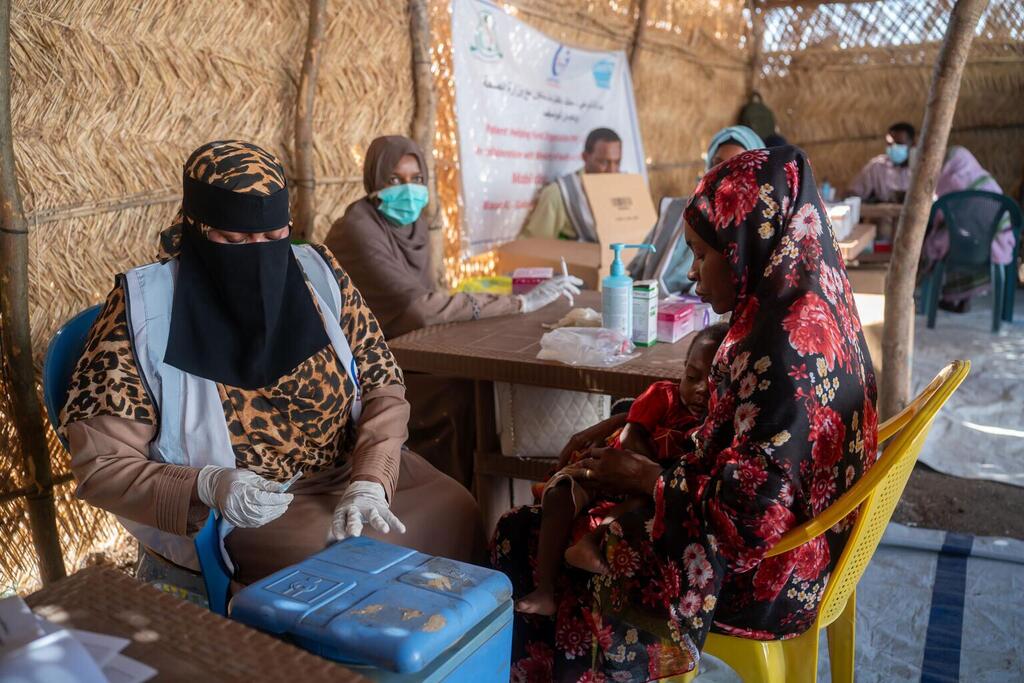
    © UNICEF

    Nearly three years of civil war have pushed more than 33 million people in Sudan into severe need of humanitarian aid.

    The conflict has been marked by horrific sexual violence, kidnappings and child marriage, with survivors struggling to access any safe spaces or healthcare.

    In the crowded Al Moaskar Al Mwahhad displacement camp in South Kordofan, UNFPA operates a mobile health clinic and a safe space for women and girls who are survivors or at risk of abuse.

    “Women are exhausted from the war,” said Salma, 50, who has been sheltering at the camp for eight months now.

    “Many crimes have been committed against women, including rape. Many women have been widowed. In this camp, the number of women who are still with their husbands can be counted on one hand,” she added.

    For girls, the crisis is impacting almost every part of their lives and their futures, “We travelled by donkey for three days, and after those trucks brought us here,” 16-year-old Ismailia told UNFPA.

    “I hope to return to my town and my school. Please allow us to rebuild our home and go back.”

    To continue supporting women and girls in 2026, UNFPA is urgently calling for $129 million, of which just $33 million has so far been pledged.

  • Kenya mounts strategic push for Justice Njoki Ndung’u ICC bid

    Kenya mounts strategic push for Justice Njoki Ndung’u ICC bid

    Kenya has launched a coordinated diplomatic campaign to secure the election of Njoki Ndung’u as a judge of the International Criminal Court, signaling both confidence in her credentials and a broader ambition to deepen the country’s influence within global legal institutions.

    Prime Cabinet Secretary and Foreign Affairs Minister Musalia Mudavadi confirmed that the government has fully endorsed Justice Ndung’u’s candidacy, describing it as a nationally backed effort with the support of William Ruto and the Cabinet.

    Speaking after consultations with Martha Koome and Justice Ndung’u, Mudavadi emphasised that Kenya is not leaving the outcome to chance, but instead pursuing a deliberate, structured campaign.

    At the heart of this effort is a multi-agency strategy bringing together the Judiciary, the Ministry of Foreign and Diaspora Affairs, and Kenya’s diplomatic missions abroad.

    The goal is to translate Kenya’s judicial reputation into tangible electoral support ahead of the ICC vote scheduled for December 2026 in New York, where six judges will be elected by the Assembly of States Parties. 

  • PS Beacco pledges emergency housing support after Lang’ata Prison fire displaces 30 families

    PS Beacco pledges emergency housing support after Lang’ata Prison fire displaces 30 families

    Correctional Services PS Dr Salome Beacco has pledged emergency support for Kenya Prison Service officers who were affected by Thursday night’s fire at the Lang’ata Women Maximum Prison staff lines.

    Speaking while she visited the 30 families affected by the inferno, the PS said plans are already underway to construct semi-permanent houses to shelter those affected by the fire.

    This even as she assured that the government is working on resolving the housing challenge facing officers from the Kenya Prisons Service.

    She was accompanied by Commissioner General of Prisons Patrick Aranduh.

  • DPP commends NIRU’s AI push in national development

    DPP commends NIRU’s AI push in national development

    The Director of Public Prosecutions (DPP) Renson Ingonga CBS, OGW has lauded the National Intelligence Research University (NIRU) for its forward-thinking initiative to integrate Artificial Intelligence (AI) into Kenya’s national development agenda.

    Speaking during the culmination of the AI Hackathon 2025, the DPP praised the university for fostering innovation and creating a platform that empowers young minds to contribute practical technological solutions to national challenges.

    The event attracted an impressive 2,600 proposals from participants across the country, all competing for the grand prize of Ksh. 2,000,000.

    The DPP emphasized that embracing AI is critical for enhancing efficiency in governance, strengthening security systems, and driving economic growth.

    He noted that initiatives such as the hackathon align with the country’s broader vision of leveraging technology to improve public service delivery and national competitiveness.

    “This initiative demonstrates the power of innovation in shaping the future of our nation. By investing in Artificial Intelligence, we are not only preparing for tomorrow but actively building it,” the DPP remarked.

    The event drew attendance from key government officials and stakeholders. Among those present were the Cabinet Secretary for Interior and National Coordination, Kipchumba Murkomen, and the Director General of the National Intelligence Service Noordin Haji, alongside Supreme Court Judge Isaac Lenaola.

    The leaders collectively underscored the importance of collaboration between academic institutions, government agencies, and the private sector in harnessing emerging technologies for national progress.

    They highlighted AI’s potential in areas such as security intelligence, public administration, healthcare, and economic planning.

    The NIRU AI Hackathon 2025 marks an important milestone in Kenya’s innovation landscape, positioning the country as a growing hub for technological advancement in the region.

    Organizers expressed optimism that many of the ideas generated during the competition would evolve into scalable solutions capable of addressing real-world challenges.

    As Kenya continues to invest in digital transformation, initiatives like NIRU’s hackathon signal a strong commitment to nurturing homegrown talent and driving sustainable development through technology.


  • DPP secures arrest warrant against immigration officer in Human-Trafficking case

    DPP secures arrest warrant against immigration officer in Human-Trafficking case

    The Director of Public Prosecutions (DPP) has secured a warrant of arrest against an immigration officer based at Jomo Kenyatta International Airport (JKIA) after he failed to appear in court for plea-taking.

    The accused, John Poriot, was to be charged before the Kahawa Law Courts today under the Counter-Trafficking in Persons Act, No. 8 of 2010.

    He is accused of facilitating the unlawful exit of two Kenyans from the country for purposes of exploitation.

    It is alleged that on 3rd October 2024 at JKIA, within Embakasi Sub-County, the officer, jointly with others not before court, trafficked Evans Kipyegon and Isaac Kipruto by deceiving them with promises of employment in the Kingdom of Thailand.

    The accused also faces a second charge under the Proceeds of Crime and Anti-Money Laundering Act, No. 9 of 2009, for allegedly possessing Ksh. 11,087 suspected to be proceeds of crime.

    Gideon Kiage issued the warrant and scheduled the matter for mention on 8th April 2026.


  • Kenya steps up livestock disease detection to protect farmers, public health

    Kenya steps up livestock disease detection to protect farmers, public health

    Livestock diseases continue to pose a significant threat to farmers’ livelihoods, food security and public health in Kenya.

    Diseases such as Foot-and-Mouth, Peste des Petits Ruminants (PPR), and parasitic infections reduce productivity, limit market access, and in some cases spread from animals to humans, causing zoonotic outbreaks. Yet many small-scale livestock producers and pastoralist farmers lack access to affordable and reliable disease testing (diagnostic) tools needed to detect these diseases early, limiting their ability to respond effectively.

    In response to this challenge, a high-level workshop on improving livestock disease detection has convened in Nairobi, bringing together government officials, veterinarians, researchers, development partners, private sector actors and farmer representatives.

    The meeting was focused on practical solutions to make disease detection more accessible, affordable, and effective for livestock keepers across Kenya.

    “If we are to strengthen animal health systems, then we must pay close attention to one of the most important pillars of veterinary service delivery: diagnostic capacity. Strong veterinary diagnostics are central to early disease detection, outbreak response, surveillance, food safety, and trade assurance. Without timely and reliable diagnostics, our ability to prevent and control disease is significantly weakened. I therefore wish to commend the ongoing efforts to strengthen Kenya’s veterinary laboratory network, improve disease reporting systems, and expand the use of innovation and technology in animal health service delivery,” said Jonathan Mueke, the Principal Secretary in the State Department for Livestock Development.

    Dr. Allan Azegele, the Director of Veterinary Services, added: “Early and accurate disease detection is critical not only for protecting livestock productivity, but also for safeguarding human health and ensuring food security. By strengthening diagnostics, we can respond faster to outbreaks, reduce misuse of drugs, and guide targeted vaccination campaigns.

    The workshop has been co-organized by the Directorate of Veterinary Services (DVS) and the Transforming Animal Health Solutions and Services for Low- and Middle-Income Countries (TAHSSL) platform, operated by GALVmed, the International Livestock Research Institute (ILRI), and Clinglobal.

    Its timing is significant as Kenya steps up efforts to control livestock diseases and align with regional and global priorities, including the eradication of PPR by 2030 and the strengthening of One Health approaches that link animal and human health systems.

    “We are committed to partnering with governments, research institutions, and the private sector to ensure that small-scale producers have access to the tools they need to manage animal diseases effectively,” said GALVmed’s Head of Research and Development Dr Karelle De Luca.

    Discussions have focused on closing the gap between laboratory capacity and the realities faced by farmers, particularly in smallholder and pastoralist systems.

    Through plenary sessions and roundtable discussions, participants are identifying priority diagnostic needs, explored innovative delivery models, and co-developed a roadmap to make reliable disease testing a routine part of Kenya’s livestock health programs.

    The workshop has also underscored the importance of partnerships. Stakeholders agree that stronger collaboration between government, research institutions, the private sector, and communities is essential to build an effective disease detection and surveillance system.

    “Diagnostics are the eyes of the surveillance system. By aligning efforts from county-level disease reporters to national laboratories, we can build a system that controls disease, supports trade, and safeguards public health,” said Musa Mulongo, the Program Coordinator for the Transforming Animal Health Solutions and Services (TAHSSL).

    Mueke further noted: “The transformation we seek in the animal industry sector cannot be achieved by government alone. It will require strong partnerships, sustained investment, scientific innovation, and collective commitment. I therefore urge all stakeholders present today to continue supporting the animal health sector through collaboration, innovation, and strategic investment.”

    Following the workshop, a report and a roadmap outlining key actions, partnerships, and investment opportunities will be produced.

    By improving access to reliable disease testing, these efforts aim to keep animals healthy, strengthen farmer livelihoods, and better protect Kenya against future outbreaks that could affect both animals and humans.