Author: Christine Muchira

  • Stories of resilience, inclusion mark Huawei Digitruck graduation in Lamu

    Stories of resilience, inclusion mark Huawei Digitruck graduation in Lamu

    The graduation of over 140 youths from the Huawei DigiTruck Programme in Lamu County was marked by powerful stories of resilience, determination, and hope, underscoring the transformative impact of digital inclusion in underserved communities.

    Among the standout graduates was Rose Waithera, a young mother who enrolled in the programme while expectant and remained committed throughout the five week training.

    During the training, she delivered her baby and later returned to complete the sessions. At the graduation ceremony held at the Mokowe Kenya Maritime Authority Command Centre, Rose proudly received her certificate while carrying her newborn, an enduring symbol of perseverance and the power of opportunity.

    Reflecting on her journey, Rose said: “Joining the Huawei DigiTruck programme gave me hope and confidence for my future. During the training period, I delivered my baby but returned to continue learning because I did not want to miss this opportunity. Graduating today while carrying my child is a proud moment for me and my family.”

    She added that her daily commute, boarding two boats from her home in Manga to Mokowe, was a worthwhile sacrifice that has now opened new possibilities for her future.

    Also celebrated was Simon Murimi, a student living with disabilities affecting both his hands and legs, who demonstrated remarkable determination by attending all training sessions and successfully completing the programme. His achievement inspired fellow participants and highlighted the importance of inclusive access to digital education.

    “This programme has shown me that disability is not inability. Despite the challenges I face, I attended every session because I believe these digital skills will shape my future. I am grateful to Huawei Kenya and the Lamu County Government for giving us equal opportunities to learn and grow,” said Simon.
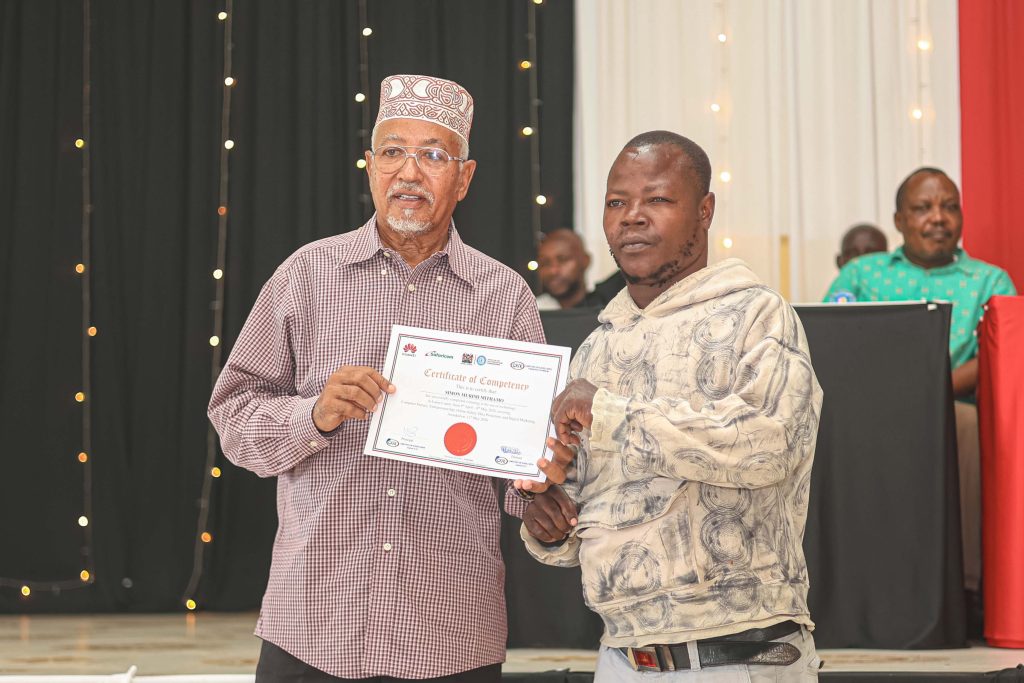
    Photo 2: L-R: Aisha Shariff Omar, County Executive Committee Member for Climate Change, ICT, E Government and Citizen Participation, Lamu County presents a Certificate of Completion to Simon Murimi, an outstanding participant of the Huawei DigiTruck program who is also disabled.

    The DigiTruck Programme in Lamu, implemented through a partnership between Huawei Kenya, the County Government, and Computers for Schools Kenya, equips young people in areas such as Mokowe and Mpeketoni with practical ICT and digital literacy skills to enhance employability, entrepreneurship, and innovation.

    The graduation ceremony was graced by Dr. Mbarak Bahjaj, Deputy Governor of Lamu County, alongside Aisha Shariff Omar, County Executive Committee Member for Climate Change, ICT, E Government and Citizen Participation, as well as county officials, Huawei Kenya representatives, and other ICT stakeholders.

    Speaking during the event, Dr. Bahjaj applauded the programme for equipping youth with the digital competencies needed to thrive in a technology driven economy and for bridging the digital divide in Lamu County.

    “Programs like the DigiTruck are critical in bridging the digital skills gap among young people. By equipping Lamu’s youth with practical digital knowledge and modern ICT competencies, this initiative is not only preparing them for today’s technology driven world, but also opening up pathways to innovation, entrepreneurship, and meaningful participation in the digital economy,” he said. “This is a significant step toward empowering local communities through access to opportunity and inclusive growth.”

    The Huawei DigiTruck, a solar-powered mobile digital classroom, continues to transform lives across Kenya by extending access to digital learning and emerging technologies to remote communities. With Lamu now the 43rd county reached, the programme has trained nearly 11,000 youth nationwide since its launch in 2019, with recent deployments in counties such as Wajir and Garissa in February and March 2026, respectively.

    Speaking at the event, Khadija Mohammed, Public Affairs and Media Director at Huawei, commended the graduates for their resilience and encouraged them to apply their newly acquired skills in real world contexts.

    “Digital literacy and skilling are critical enablers for youth to actively participate in the digital and knowledge economy. Through opportunities such as online jobs, e-commerce, and digital entrepreneurship, young people can unlock new pathways to income generation and self-reliance,” she said.

    She further emphasized Huawei’s commitment to advancing Kenya’s digital transformation agenda saying, “At Huawei, we believe that technology and digital literacy form the foundation of a thriving digital economy. By investing in programmes like DigiTruck and partnering with like-minded organisations, we aim to expand access to opportunity and support youth from historically underserved communities like Lamu to actively participate in Kenya’s digital future.”

    The inspiring journeys of Rose Waithera and Simon Murimi serve as a powerful reminder that digital transformation is not just about technology, it is about changing lives, creating opportunities, and ensuring that no one is left behind.



  • Konza signs landmark deal to boost cross-border startup collaboration

    Konza signs landmark deal to boost cross-border startup collaboration

    Kenya’s position as a leading innovation hub was reinforced Friday as Konza Technopolis hosted the first-ever IPDAYS forum in Nairobi, bringing together startups, investors, and policymakers from Tunisia, Egypt, and Kenya to drive cross-border collaboration.

    The IPDAYS Nairobi x Silicon Savannah Startup Fair 2026, held in partnership with RedStart Tunisie, Seketak, Fie Labs, and GAK Advisory, marked a milestone in Kenya’s ambition to serve as a gateway for North African startups expanding into Sub-Saharan Africa.

    The forum featured matchmaking sessions, investor pitches, policy briefings, and training workshops, designed to accelerate market entry and strengthen innovation partnerships across Africa.

    Konza Technopolis CEO John Paul Okwiri emphasized the importance of collaboration in building Africa’s digital future saying, “This occasion is more than a gathering; it is a statement of intent that Africa’s digital future will be built through collaboration, innovation, and partnerships. Innovation must be protected, commercialized, financed and supported through skills development if Africa’s startup ecosystem is to thrive.”

    A major highlight was the signing of a collaboration agreement between Konza Technopolis, RedStart Tunisie, and Seketak Solutions to formalize cooperation on startup exchange programs, joint acceleration initiatives, and ecosystem development.

    Douja Gharbi, CEO of RedStart Tunisie noted, “We return to Kenya to deepen collaboration, align roadmaps and create scalable pathways that support startup growth across borders.”

    The event comes just a day after President William Ruto assented to the Technopolis Bill, 2024, establishing a legal framework for technopolises across Kenya. The legislation is expected to attract technology-driven enterprises, streamline governance, and further position Kenya as a regional innovation hub.

    Discussions at the forum focused on market entry strategies, financing cross-border expansion, and policy alignment under the African Continental Free Trade Area (AfCFTA), which seeks to create a single African market for goods, services, and digital trade.

    Konza Technopolis is leveraging Kenya’s strong digital infrastructure, progressive policy environment, and strategic location to support the expansion of North African startups into East Africa and beyond.

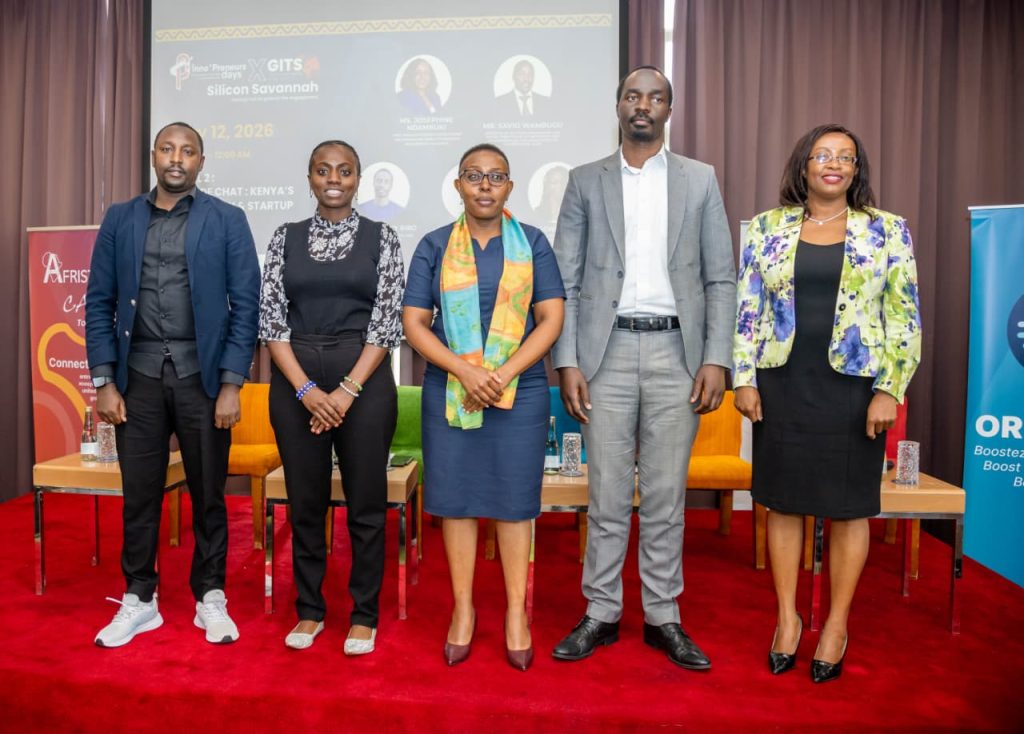
    R-L Josephine Ndambuki from Konza Technopolis, Jeremy Riro,MD FIE-LABS innovation Hub, Anne Ichung’wa, MD GAK advisory, Diana Maina,Senior Innovation Officer Kenya National Innovation Agency and Savio Wambugu,Director, Mount Kenya Innovation hub and Board Director ICT Authority


  • How UAE-Kenya trade corridor is redefining East Africa’s economic future

    How UAE-Kenya trade corridor is redefining East Africa’s economic future

    For years, the narrative of Africa-global trade partnerships has been defined by extraction or aid dependency.

    Kenya has felt this acutely supply chain disruptions, infrastructure gaps, and foreign investment that rarely reaches the small-scale farmer or the young job-seeker. But a new model is emerging along the Indian Ocean corridor, and it is being built not on aid pledges, but on logistics, private capital, and long-term industrial integration.

    The partnership between the United Arab Emirates (UAE) and Kenya is often described in terms of rising trade volumes or new investment announcements. But those metrics capture only part of the story.

    What has taken shape over the past two decades is a mature, strategic relationship rooted in shared economic ambition and a belief that South–South cooperation can be both transformative and commercially sound.

    At a time when global economic patterns are shifting and new growth corridors are emerging, the UAE and Kenya are demonstrating that developing economies can chart a path defined not by dependency but by joint capacity building and long-term investment. As His Excellency Sheikh Shakhboot bin Nahyan Al Nahyan, the UAE Minister of State at the Ministry of Foreign Affairs, recently affirmed: “The UAE enjoys historic ties with African nations, and today our partnership has evolved into one grounded in a shared commitment to prosperity particularly across East Africa. In Kenya, this is demonstrated through our strategic focus on logistics, infrastructure, and innovation supporting supply chain continuity, strengthening business resilience, and driving long-term investment”.

    The anchor of this partnership is the Comprehensive Economic Partnership Agreement (CEPA) the first agreement of its kind signed by the UAE with a mainland African country, representing a transformative step in enhancing trade, investment, and economic cooperation.

    The agreement strengthens Kenya’s position as a gateway to East and Southern Africa and reaffirms the UAE’s role as a global logistics and financial hub connecting the Middle East, Asia, and beyond.

    Signed in January 2025, the agreement includes the elimination of tariffs, provides market access for Kenyan service providers in sectors such as transport, construction, and logistics, and encourages foreign direct investment and public-private partnerships in agri-value chains with the UAE.

    On this point, Al Nahyan noted: “This approach is further supported by the UAE’s broader trade agenda, including the CEPA program, which is expanding opportunities for deeper economic engagement across global markets, noting here that in 2024, the UAE-Kenya bilateral trade volumes reached USD 3.9 billion.” But the real story lies beneath the diplomatic headlines.

    Early this year, UAE-based logistics firm Al Sharqi Shipping officially expanded into Kenya and Uganda, creating a dual operational footprint aimed at digitising and accelerating trade between the UAE and Africa’s high-growth markets.

    The expansion targets the full logistics value chain in East Africa, with Kenya leveraging CEPA to serve as the primary coastal gateway for cargo entering the continent, while Uganda will act as a critical transit hub for the Great Lakes region, managing on-carriage logistics to landlocked markets, including Rwanda, South Sudan, and the Democratic Republic of Congo.

    In March, the Dubai-based AriseIIP announced plans to pool over $3bn for industrial projects in Kenya in the next five years. The infrastructure developer will commit funds towards three industrial and export parks, as well as the Rivatex textiles firm.

    The projects include two export zones along Kenya’s coast and one in Naivasha, Nakuru County. AriseIIP has pledged between 30% and 40% of the investment for an equity stake, while the remaining capital will be sourced through debt from development finance institutions and additional lenders.

    The firm, which is owned by Afreximbank’s private equity unit (FEDA), Africa Finance Corporation, UAE-based Equitane Group and Saudi Arabia’s Vision Invest, will collaborate with KCB Group and Afreximbank to create an $800m facility that will support future investors occupying the new zones.

    The strength of the UAE–Kenya partnership lies in its combination of pragmatism and strategic vision. Both governments recognize that development is accelerated when infrastructure is modern, when logistics are efficient, when energy systems are reliable, and when private investment is protected and incentivized. By aligning on these fundamentals, the two countries have avoided the pattern in which bilateral relationships remain transactional or narrowly focused on extractive sectors.

    Instead, they have built a partnership that aims to deliver jobs, enhance productivity, and unlock regional value chains.


    Zachary Ochieng is a former Business and Technology Editor and currently a Global Communications Strategist with deep knowledge of East Africa’s logistics and trade landscape Email: zachary.ochieng@gmail.com

  • UDA wins Emurua Dikirr, Endo and Porro by-elections

    UDA wins Emurua Dikirr, Endo and Porro by-elections

    David Kipsang Keter of the United Democratic Alliance Party (UDA) has been declared winner of Emurua Dikirr Constituency seat after securing 18,266 votes, defeating Vincent Kibet Rotich of the Democratic Change Party (DCP), who garnered 10,760 votes.

    According to a statement by the Independent Electoral and Boundaries Commission (IEBC) out of the 44,353 registered voters, 29,538 votes were cast giving a voter turnout of 66.6%.

    Meanwhile, in Elgeyo/Marakwet County, Festus Korir Kiprop of UDA Party was declared winner of Endo Ward CAW after garnering 4,475 votes.

    Festus Korir Kiprop (L)

    His closest challenger National Democratic Party’s (NDP) Shadrack Kosgei Chelang’a got 752 votes.

    Voter turnout in the ward stood at 36.59% with 5,260 votes were cast out of 14,361 registered voters.

    Elsewhere in Samburu County, Daniel Lolngojine of UDA Party won Porro Ward CAW with 2,328 votes, ahead of Josphat Jumani Leleur of KANU Party who got 1,036 votes.

    Out of 6,358 registered voters, 4,194 votes were cast giving a voter turnout of 65.96%.

    Daniel Lolngojine (R)

    IEBC says the by-election results can be accessed by the public on the Commission’s results portal: http://forms.iebc.or.ke


  • PCS Mudavadi arrives in Azerbaijan for World Urban Forum

    PCS Mudavadi arrives in Azerbaijan for World Urban Forum

    Prime Cabinet Secretary Musalia has arrived in Baku, Azerbaijan as an advance Kenyan delegation to attend the World Urban Forum 13 (WUF13) between May 17th-22nd.

    Themed “Housing the world: Safe and resilient cities and communities” brings together world leaders, policy makers and stakeholders in the Housing sector to shine a global spotlight on the urgent need to address the global housing crisis.

    The global leaders will also seek to position housing as a driver of inclusive, resilient and sustainable urban development.

    According to Mudavadi, time has come to move from conversation to execution on housing noting that it was imperative to deliberate on strategic urban planning.

    “Kenya, and Africa’s urbanisation is accelerating at an unprecedented pace, and the time to move from conversation to execution is now.”

    PCS has previously emphasized the urgent need to translate dialogue into actionable strategies and bankable projects that will shape the continent’s cities for generations.

    The WUF13 comes just a month after Nairobi hosted African Heads of States and Government, policymakers, urban planners, development partners, private sector leaders, and international experts for the Second Africa Urban Forum (AUF2) to discuss financing, governance, technology, and climate resilience

    Mudavadi argues that projections indicate that Africa’s urban population, will double from 700 million to 1.4 billion by 2050.

    “Within a single generation, our cities will absorb hundreds of millions of new residents,” says Mudavadi.

    He warns that urban growth, if left unmanaged, could worsen housing deficits, overstretched public services, air pollution, and climate-related risks.

    “These challenges are compounded by constrained fiscal space, weak governance structures, and limited access to long-term and innovative financing through a reflection on Kenya’s own urban development journey.”

    PCS noted that Kenya has gone through a very interesting episode to reach where it is now under the affordable housing programme championed by President William Ruto, appreciating difficulties in mobilising resources for large-scale housing and infrastructure projects .


  • Government launches crackdown on rising SGBV, child abduction cases in Central

    Government launches crackdown on rising SGBV, child abduction cases in Central

    Government has announced a raft of measures aimed at tackling the rising cases of Sexual and Gender-Based Violence (SGBV), child abduction and murder in the Central Region.

    Speaking during a high level security Central Region Security and Child Protection meeting in Nyeri County, Cabinet Secretary for Gender, Culture, the Arts and Heritage Hanna Wendot Cheptumo directed that a 90-day Rapid Results Initiative (RRI) be immediately undertaken to intensify interventions against the rising cases of Sexual and Gender-Based Violence (SGBV) in the Central Region.

    “I am in Nyeri County to assess ongoing child protection and security iinterventions and engage security and child protection teams on the ground,” CS said.

    The CS further ordered that all relevant Government agencies work towards declaring the Central Region SGBV-free within the next 11 months through sustained prevention, enforcement, protection and community response measures.

    To strengthen coordination and response against SGBV and crimes against children, the CS established a multi-agency team at the regional level, to be cascaded to county and sub-county levels, bringing together security agencies, Children Services, local administration and relevant stakeholders.


  • Prof. Ayub Gitau appointed UoN Vice Chancellor

    Prof. Ayub Gitau appointed UoN Vice Chancellor

    The University of Nairobi has appointed Prof. Ayub Gitau as the 9th Vice-Chancellor of the University of Nairobi, while Prof. Josiah O. Aduda has been appointed Deputy Vice-Chancellor (Finance, Planning & Development).

    The appointments were approved by the University Council during a special sitting held on May 14, 2026.

    In a statement the Council Chair Chacha Nyaogotti stated: “These appointments mark a new chapter for the University of Nairobi as we strengthen leadership for excellence, innovation, and global competitiveness.”

    Further, the Council also appreciated Prof. Margaret J. Hutchinson for her service as Acting VC.

    Prof. Aduda brings over 25 years of experience in academic leadership, governance, and institutional development.

    He has previously served in key leadership roles including Dean of the School of Business and Chair of the Department of Finance and Accounting, contributing significantly to academic growth and administrative excellence.

    Prof. Aduda is widely respected for his expertise in financial management, research supervision, and strategic planning, having supervised numerous PhD and Master’s students and published extensively in his field.

    In his new role, he is expected to strengthen financial sustainability, enhance resource mobilization, and support the University’s long-term development and transformation agenda.

  • Ukambani votes must be earned, declares NLP leader Augustus Muli 

    Ukambani votes must be earned, declares NLP leader Augustus Muli 

    National Liberal Party (NLP) leader Dr. Augustus Kyalo Muli has declared that the Kamba community will no longer give away its votes cheaply, insisting that Ukambani’s estimated two million ballots must be tied to tangible development commitments ahead of the 2027 elections.

    In a statement released this week, Muli accused successive governments and political leaders of treating the region as a “political ATM,” withdrawing votes during campaigns and abandoning the community afterward.

    He said the cycle of loyalty without results has left Ukambani lagging behind in basic infrastructure, jobs, and services despite producing senior government officials for decades.

    “Leave Nairobi and drive 30 minutes past our county headquarters, and you will find villages without water or electricity, children learning under trees, and roads that turn to mud in the rains,” Muli said. “Our votes have been used as bargaining chips for personal ambition, not for community development. That cycle ends now.”

    Rejecting Automatic Alignments

    Muli emphasized that NLP will not automatically back President William Ruto, Wiper leader Kalonzo Musyoka, former Interior CS Fred Matiang’i, or Deputy President Rigathi Gachagua. Instead, he said the party’s loyalty is to its members and the people of Ukambani, and any leader seeking support must present clear policies on jobs, affordable living, and effective devolution.

    “We are not in Nairobi to beg for a seat at someone else’s table. We are building our own table,” he stated.

    Rising Membership and National Debate

    NLP’s position has sparked national debate, with reports in a section of the media noting the party’s rapid membership growth and growing influence. Muli said Kenyans are tired of being used and are seeking a political vehicle that defends their interests and demands respect.

    He insisted that partnership with Ukambani voters must include concrete plans, timelines, and accountability mechanisms. “Anything less is an insult,” he said.

    Ukambani’s Decisive Role

    Analysts note that Ukambani’s votes could prove decisive in 2027. In 2022, the presidency was decided by just over 200,000 ballots. With Mt Kenya showing signs of drifting from the current administration, both major camps are expected to court Ukambani heavily.

    “Kalonzo Musyoka will be counting on the entire region to deliver him the presidency. William Ruto will be looking to us to shore up his numbers,” Muli observed. “If our 2 million votes can decide the presidency, then our issues must decide the agenda.”

    Muli concludes with a direct appeal to the Kamba electorate: “Your vote is valuable. Your dignity is non-negotiable. Your future is worth fighting for. It is time we got our true worth.”

  • Waiguru urges Mt. Kenya to pay “Two Terms” debt as she rallies region behind Ruto

    Waiguru urges Mt. Kenya to pay “Two Terms” debt as she rallies region behind Ruto

    Kirinyaga Governor Anne Waiguru has intensified calls for the re-election of President William Ruto saying Mt. Kenya should honour its past political commitments.

    Waiguru said the region risk being isolated for betraying President Ruto for failing to honour political pact made during former President Uhuru Kenyatta’s tenure.

    She reminded residents of the region’s widely expressed commitment to support former President Uhuru Kenyatta for two terms and thereafter back Ruto for ten years, arguing that keeping that promise would earn the region respect nationally.

    “It is the former President Uhuru who said “Kumi yangu, kumi ya Ruto,” we must keep our promise. Our credibility as a community depends on keeping our word,” Waiguru said.

    Speaking during the homecoming and thanksgiving ceremony in hounor of Nyeri Women Representative Rahab Mukami following her election as President of Women’s Caucus of the Pan African Parliament, Waiguru said the region must remain consistent and trustworthy in its political dealings by honouring promises it made during the last election cycle.

    “A promise is a debt that must be paid. As a region, we must be known as people who keep our word. That is how we build trust and secure our place at the national table,” Waiguru said.

    At the same time, the governor sought to calm political tensions in the region following the impeachment of Deputy President Rigathi Gachagua, a development that has reportedly stirred discontent among sections of Mt Kenya voters.

    Waiguru offered an apology to residents, acknowledging the unease caused by the episode and appealing for unity moving forward.

    Her sentiments were echoed by Nakuru Governor Susan Kihika, who emphasized the importance of consolidating support for President Ruto.

    Kihika noted that re-electing Ruto would help safeguard the interests of Mt Kenya people living and doing business across the country, strengthening their sense of inclusion and security within the broader national fabric.

    Nominated Senator Veronica Maina also rallied the region behind the President, pointing to what she described as tangible development gains under his administration. She cited ongoing and completed mega projects in the region as evidence of the government’s commitment to improving livelihoods.

    “We cannot abandon a government we elected and that is already delivering for us, only to pursue an uncertain alternative,” she said, urging voters to remain steadfast.

    Maina further called on the electorate to exercise their democratic rights freely in the upcoming General Election, encouraging them to use their vote to elect leaders of their choice without intimidation or coercion.

    Taita Taveta Woman Representative, Lydiah Haika, emphasized that the Central region had enjoyed the fruits of the current government more than other regions including the Coast.

    The event brought together a host of political leaders from across the region, including Mathira MP Eric Wamumbi, Nyeri Senator Wahome Wamatinga and Bahati MP Irene Njoki, among others.

    The leaders used the platform not only to celebrate Mukami’s continental achievement but also to signal a renewed push to consolidate Mt Kenya’s political direction ahead of the next polls, with a strong emphasis on unity, consistency, and strategic alignment.


  • Practical business toolkit launched to guide African entrepreneurs through high-uncertainty markets

    Practical business toolkit launched to guide African entrepreneurs through high-uncertainty markets

    A new business playbook is seeking to reshape how African entrepreneurs are trained, as debate grows over the relevance of imported management models in fast-changing local markets.

    As 11 of the world’s 15 fastest-growing economies in 2026 emerge from the African continent, a critical gap has surfaced: the continent’s entrepreneurs are still being trained using foreign business models that often fail in the “unstructured” reality of African markets.

    In response, veteran enterprise creator and SNDBX International CEO Joram Mwinamo has launched The Enterprise Jungle: An Entrepreneur’s Navigation Toolkit. The book marks a shift toward an indigenous business curriculum, moving away from academic theory toward a practical decision-making system designed for high-uncertainty environments.

    Current entrepreneurship education in Africa frequently mirrors foreign environments where legal structures and high-trust indices are a given. In reality, African founders operate in “jungles” characterized by contract law illiteracy, payment delays, and investor misalignment.

    “The majority of professionals join the jungle without proper preparation,” says Mwinamo. “It’s like a doctor who is trained to heal but never taught how to run a hospital. In this region, you don’t just build a business; you have to build the environment around it. This requires a unique logic where uncertainty is the norm and building trust is a core competitive advantage.”

    The book seeks to replace dominant Western-led management models with frameworks built on 21 years of experience across 10 African countries.

    It specifically addresses the challenge of operating where trust cannot be taken for granted, focusing on fraud-wary customers and a lack of legal literacy.

    “What sets this apart is that it isn’t about theories; it’s a decision-making system for stress-filled environments,” says Mike Macharia, founder of Founders’ Battlefield.

    Beyond the publication, the launch signals the start of a broader platform of learning programs designed to move founders from “guessing” to “structured growth.”

    The Enterprise Jungle is currently available via Amazon and Joram Mwinamo’s website.

    L-R: Mike Macharia, creator of Founders’ Battlefield, Mbithe Anzaya, board member at SNDBX International, and Joram Mwinamo, CEO of SNDBX International and author of The Enterprise Jungle, at the Nairobi launch of The Enterprise Jungle book.