Author: Christine Muchira

  • EAC tables US$103,842,880 Budget Estimates before EALA for 2023/2024 FY

    EAC tables US$103,842,880 Budget Estimates before EALA for 2023/2024 FY

    The East African Community (EAC) Tuesday tabled before the East African Legislative Assembly (EALA) the budget estimates for the 2023/2024 Financial Year totaling US$103,842,880 for the 2023/2024 Financial Year.

    Tabling the speech before the Assembly, the Chairperson of the Council of Ministers and Burundi’s Minister for EAC Affairs, Youth, Sports and Culture, Amb. Dr. Ezéchiel Nibigira, said that the budget estimates for the Financial Year 2023/2024 were being presented at a time when the EAC economies were experiencing global shocks arising from the on-going Russia-Ukraine war, tight global financial conditions, lingering effects of Covid-19 and the impact of climate change.

    “Despite these challenges, economic growth in the region improved to 4.8 percent in 2022 from 3.5 percent in 2021. The strong growth in the region was supported by the good performance of the industry, services, construction, mining and manufacturing sectors,” said Dr. Nibigira.

    “Global economic growth is expected to remain weak, mainly due to anti-inflationary measures and geopolitical risks,” added the Minister.

    Nibigira projected a positive outlook for EAC economies, largely driven by the strong performance of the services sector, prudent government policies and increased public and private investment.

    “However, downside risks remain, attributed to weaker global growth, tight financial conditions and climate change risks,” said the Minister.

    Hon. Nibigira disclosed that the EAC total trade increased by 13.4 percent to US$74.03 billion in 2022 from US$65.268 billion in 2021.

    “In 2022, EAC total exports to the rest of the world were valued at US$20.139 billion, while total imports from the rest of the world into the EAC amounted to US$53.891 billion. Further, total intra-EAC trade grew by 11.2 percent to US$10.910 billion in 2022 from US$9.810 billion in 2021,” said the Minister.

    “The major Intra-EAC traded products are cereals, cement, iron and steel, live animals, petroleum products, sugar, foods and beverages, which signify that our economies are agro-based with good signs of moving to industry-based.”

    The 2023/2024 Budget is themed “Accelerating Economic Recovery, Climate Change Mitigation and Enhancing Productive Sectors for Improved Livelihoods.”

    On priorities for the 2023/2024 FY, Hon. Nibigira said that the Community would focus on nine (9) priority areas, namely: strengthening of regional governance processes, and domestication of regional and international commitments for sustainable peace and stability; increasing sensitisation, visibility, knowledge, awareness and participation of the private sector, citizens and other stakeholders in the EAC integration process, and; harmonisation of trade related policies, laws and regulations, and streamlining of customs and trade facilitation systems for increased trade and investment.

    Other priority areas are: harmonisation of fiscal and monetary policies, and establishment of requisite institutions towards the realisation of the East African Monetary Union, and; leveraging modern technologies to enhance productivity, value addition, and to promote regional supply and value chains and digital platforms;

    Also under focus will be the: enhancement of the regional productive capacity and increase in value addition to improve the economic welfare of East Africans; strengthening of the social sectors to improve the social welfare of East Africans; improvement and expansion of quality multi-modal and multi-sectoral infrastructure to support free cross-border movement, and; strengthening of the capacity of all EAC Organs and Institutions to effectively discharge their mandate.

    The 2023/2024 Budget has been allocated to the EAC Organs and Institutions as follows: EAC Secretariat – US$50,931,553; East African Court of Justice – US$4,450,488; East African Legislative Assembly – US$17,681,365; Lake Victoria Basin Commission – US$8,471,980; Inter-University Council for East Africa – US$12,394,945; Lake Victoria Fisheries Organisation: US$2,807,993; East African Science and Technology Commission – US$2,016,543; East African Kiswahili Commission – US$1,502,535; East African Health Research Commission – US$2,193,811, and; East African Competition Authority – US$1,391,667.

    This year’s budget is an increase from the amount of US$91,579,215 approved by the August House for the 2022/2023 Financial Year.

    On the EAC Single Customs Territory, the Minister said that enhancement and interconnectivity of Customs Systems is at the forefront to facilitate seamless exchange of trade information and faster clearance of goods across borders.

    “All processes relating to the accreditation of Regional Authorized Economic Operator Programme, and the issuance of the EAC electronic certificate of origin have been automated.”

    “In the 2023/2024 FY, Customs will, among other things, focus on: the consolidation and updating of the regulatory framework for the Single Customs Territory to ensure sustainability of the gains made so far; integrating the Electronic Cargo Tracking Systems along the Transit Corridors, and; enhancement of interconnectivity of systems in key sectors to facilitate information exchange;

    On trade, the Minister disclosed that the EAC has continued to put in place mechanisms to enhance intra-EAC trade and, at the same time, actively participating in the negotiations at the Tripartite (COMESA, EAC and SADC) and at the African Continental Free Trade Area (AfCFTA).

    Among the achievements in the 2022/2023 FY were the resolution of 23 out of 32 Non-Tariff Barriers (NTBs) that were reported with the remaining nine (9) NTBs at different stages of resolution. The Community also finalised and submitted to the African Continental Free Trade Area (AfCFTA) Secretariat the EAC offers for tariff and services liberalisation.

    “This facilitates trade between the EAC Partner States with other African countries under the AfCFTA framework. Additionally, three of the EAC Partner States are participating in the AfCFTA Guided Trade Regime which involves match-making of firms ready to trade within the AfCFTA framework,” he said.

    On the implementation of the Common Market Protocol, Nibigira said that in the FY 2023/2024, the Secretariat will continue tracking Partner States’ progress in amending identified noncompliant laws, regulations and administrative guidelines impacting on the key freedoms and rights under the EAC Common Market Protocol.

    On the Monetary Union, the Minister informed the Assembly that during the FY 2022/2023, the EAC Statistics Development and Harmonisation Regional Project was restructured into the EAC Project of the Eastern Africa Regional Statistics Program for Results (EARSPforR).

    “The project is supporting the production of harmonised and quality statistics through capacity building of the National Statistical Offices (NSOs) and the EAC Secretariat and the delivery of the statistical requirements for monitoring the progress towards attaining the macroeconomic convergence criteria as set out in the East African Monetary Union (EAMU) Protocol.”

    On the establishment of institutions to support the EAMU, the Dr. Nibigira said that the Council of Ministers had approved the organisational structure for the East African Monetary Institute (EAMI) and initiated the administrative process for identifying the host Partner State for the EAMI, adding that the EAMI is expected to carry out the preparatory work for the creation of the EAMU.

    On the establishment of payment and settlement systems in the region, the Minister said that the EAC Secretariat continues to support the Partner States’ Central Banks in implementing a secure, efficient, and reliable payment and settlement system to ensure efficient flow of transactions within the region through the EAC Payment and Settlement System Integration Project (EAC-PSSIP).

    “The EAC-PSSIP is supporting the modernisation of financial market infrastructure, including: putting in place business continuity and disaster recovery sites for Central Banks; upgrading the high value payment systems (real time gross systems); implementing Automated Clearing House (ACH) for retail payments systems; and capacity building for staff through training and exchange programmes in financial institutions with advanced payment systems operations.”

    With regard to conducting national consultations for the drafting of the Constitution of the EAC Political Confederation, Nibigira said that the consultations in Kenya were held in May 2023.

    “Consultations have already been undertaken in Burundi and Uganda. In the FY 2023/2024, the national consultations will be undertaken in the remaining Partner States.”

    On the East African Legislative Assembly (EALA), the Minister said that the Assembly had recorded many achievements including the: passage of the EAC Customs Management (Amendment) Bill, 2022 to enhance seamless operations of the EAC Single Customs Territory; the EAC Financial Service Commission Bill, 2022 and the EAC Surveillance, Compliance and Enforcement Commission Bill, 2022 which further lays the foundation for the establishment of the EAC Monetary Union; and the EAC Supplementary Appropriation No.3 Bill, 2022 which provided the legal framework for the Supplementary Budget.

    “In the FY’ 2023/2024, the Assembly will prioritise enactment of the remaining Bills that are a prerequisite for the establishment of the Monetary Union, and enactment of the following pending bills from the 4th Assembly: The Persons with Disabilities (PWDs) Bill; The EAC Youth Bill; The EAC Cross Border Trade in Professional Services Bill; The EAC Pharmaceuticals Bill, The EAC Emblems (Amendment) Bill; The EAC Sexual and Reproductive Health Bill; The EAC Cultural Heritage Bill; and The EAC Standardization, Accreditation and Conformity Assessment Bill” said the Minister.

    On the East African Court of Justice, the Minister disclosed that the Court had seen an increased number of matters filed before it, as a result of its enhanced visibility and the rising confidence among East Africans in the its operations.

    “During the FY 2022/2023, 105 matters were filed before the Court compared to the 77 matters filed in the FY 2021/2022.”

    Dr. Nibigira said that though the Court has seen an increase in the number of matters filed, it has also seen a considerable increase in its case backlog. The case backlog increased from 183 matters in FY 2021/2022 to 265 matters in FY 2022/2023.

    The Minister said that the Court’s priority interventions in the FY 2023/2024 will be to increase the number of days for its sittings, conclude more cases in a timely manner, enhance the skills of Judges and staff for efficient delivery of justice, conduct sensitisation and awareness programmes in the Partner States, and enhance collaboration with other regional and international Courts.

  • Kenya unveils plan on sustainable cooling solutions

    Kenya unveils plan on sustainable cooling solutions

    Kenya Wednesday unveiled a five-year plan to reduce greenhouse gas emissions from refrigeration appliances by enhancing availability and accessibility of sustainable cooling solutions.

    The 2023 to 2027 National Cooling Action Plan for Kenya (NCAP) was unveiled at a Nairobi hotel on Wednesday by Environment and Climate Principal Secretary Eng Festus Ng’eno who said the plan puts the country on a path towards a “green, cool revolution”.

    “With this plan in place, we are charting a course towards a more efficient, eco-friendly, and inclusive Kenyan refrigeration and air-conditioning sector.

    “Our goal is clear: to make sustainable cooling accessible for every Kenyan by using efficient appliances, environmentally-safe refrigerants, and enhancing access to agricultural cold chains,” Eng Ng’eno said.

    Environment and Climate Principal Secretary Eng Festus Ng’eno

    Besides making Kenya’s cooling sector eco-friendly as a climate change mitigation measure, PS Ng’eno said NCAP would help Kenya meet her global climate action obligations.

    “Kenya’s Nationally Determined Contributions (NDC) has committed to reducing greenhouse gas (GHG) emissions by 32pc or 143MT of CO2 equivalent by 2030. Therefore, providing conventional cooling services poses a challenge to attainment of this ambitious target,” the PS noted.

    He said NCAP was part of Kenya’s climate change mitigation strategy of transitioning the country to low a carbon development pathway.

    PS Ng’eno said full implementation of NCAP would enhance performance and energy efficiency of cooling appliances, transition the sector climate friendly refrigerants, and increase access to agricultural cold chains.

    He said NCAP, which was developed by the State Department for Environment and Climate Change, will create appropriate conditions for adoption of sustainable cooling systems.

    “We are talking about providing financial incentives for cold storage systems and making sure everyone understands the incredible benefits of zero-emission cold-chains.

    “The action plan will also support research and development that suits our unique local needs. Our goal is to make innovative business models easily accessible to everyone,” PS Ng’eno said.

    At the same time, Eng Ng’eno applauded refrigeration, air-conditioning and cooling systems sector stakeholders for increasingly embracing sustainable cooling solutions, and urged them to partner with Government in the roll out of NCAP.

    “I urge all stakeholders to actively engage and collaborate in implementing NCAP. By integrating the actions outlined in this document into your institutional framework, we can collectively achieve its goals and make a significant impact,” PS Ng’eno urged.

    NCAP was developed through a participatory process that brought together cooling sector stakeholders that included the private sector, academia, state and non-state actors.

    It’s development was supported by Kenya’s development partners led by the Government of Germany through GIZ’s Green Cooling Initiative,
    Collaborative Labeling and Appliance Standards Program (CLASP), and Sustainable Energy for All (SEforAll).

    At the State Department for Environment and Climate Change, NCAP’s development was coordinated by the National Ozone Unit within the Multilateral Environmental Agreements (MEAs) Directorate. National Ozone Unit and MEAs are headed Kirui Marindany and Cyrus Mageria respectively.


  • Celebrating contemporary literature from every Africa

    Celebrating contemporary literature from every Africa

    At the very first Africa Writes festival I attended, back in 2013, I remember hearing Ngugi wa’Thiongo speak about how “no language ‘out-languages’ another,” a remark that has long echoed with me.

    Over the years, I’ve had the pleasure of attending many Africa Writes events, and those of its sister biennial festival, Film Africa, and each time have been transported by the breadth and diversity of African stories in so many languages, from so many ‘Africas’- from the continent, from the Caribbean, U.K and U.S, and beyond.

    Soft power is, although misleadingly-named, very powerful, and there is nothing like storytelling and connecting socio-culturally that helps transform narratives and shift negative misrepresentations and stereotypes. Contemporary African literature transcends boundaries and decreases the divide between Africa and the diaspora.

    The world, via London, and thanks to our partner, The British Library, is invited listen in on the authors’ voices, experiences, and invaluable literary contributions.

    Over the years we have had the honour of hosting writers including Nawal El Sadaawi, Liv Little, Chimamanda Ngozi Adichie, Warsan Shire, Yomi Sode, Margaret Busby, Emma Dabiri, Akwaeke Emezi, Afua Hirsch, Caleb Femi, Inua Ellams, Julianknxx, Mona Eltahawy, and Nana Darkoa Sekyiamah. The 10th edition of Africa Writes will take place September 29-October 1 2023 and we can’t wait to get together again.

    For the first time, we are emulating our Film Africa format by inviting distinguished curators to pull together the programme. We have powerhouses Nancy Adimora and Ainehi Edoro, from Afreada and Brittle Paper, respectively. We have Sulaiman Adonnia, the critically-acclaimed writer and award winning director of Asmara-Addis Literary Festival (In Exile). They are joined by Booker Prize shortlisted writer Maaza Mengiste; Angolan writer and musician, Kalaf Epalanga; and poet Yomi Sode, whose latest work, Manorism, was a Guardian and Financial Times Book of The Year.

    Through the lenses of curators, our soon-to-be-announced headliners, and our brilliant array of partners, we are exploring the theme of Intangible Heritage. What elements of our cultural identity define and unite us, indelibly? How can we build on these shared, resilient, yet often unspoken strands of interconnectedness? Over the course of the festival, the conversations, panels, and workshops will foster a deeper understanding of the African heritage written between the lines of these wordsmiths and worldmakers. Readers worldwide will get to explore the nuances of African and diaspora life, cultivating empathy and mutual respect.

    African time is polychronic : past and present intertwine daily, the tone of time zones carry context and clues to unlock multiple storylines. Africa Writes is a journey through so many cultures and texts that it leaves us all richer and wiser. Not only as readers, but as writers, who will be able to access expert advice on pitching, editing and more. Poets, publishers and educators will be represented, and tuning in from Lagos, Nairobi, Cape Town and further afield, to create new art and share insights into their history and people. Africa Writes enables us to travel without moving, and also inspires many to follow with real visits. The economic benefits of contemporary African literature can contribute to the broader cultural economy, strengthening literary initiatives within the continent and boosting tourism.

    Let us write a more interconnected and inclusive future together, at this 10th edition of Africa Writes. Words need readers, listeners– and vice versa. You will find a universe of stories old and new throughout September and at The British Library over that last weekend, 29 September-October 1.


    Desta Haile is the Deputy Director at the Royal African Society. She can be reached on dh35@soas.ac.uk and at @royafrisoc.


    Views expressed in this article do not reflect the position of Kenya Broadcasting Corporation. 


  • Civil society decry slow pace of dialogue at SB58

    Civil society decry slow pace of dialogue at SB58

    Members of the civil society are raising concerns over the slow pace of dialogue at the ongoing subsidiary body for scientific and technological advice better known as SB58.

    The Pan African Climate Justice Alliance (PACJA) is accusing the developed economies of employing delay tactics in closing climate financing, loss and damage as well as the global goal on adaption.

    PACJA Executive Director Dr. Mithika Mwenda says they are concerned about proposals to adopt a philanthropy model in climate financing.

    Mwenda says this will technically shift responsibility of climate financing from rich nations to non-state actors, which is a departure from the deal reached during the Paris agreement in 2015.

    He argues, that funding related to loss and damages must be delivered within the United Nations Framework Convention on Climate Change (UNFCC) framework of accountability.

    “As African stakeholders, we stand against attempt to balkanize the continent on the basis of differentiated economic capacities” Mithika Mwenda says.

    This is coming at a time when reports are emerging that rich nations are pushing to have an insurance model as a response mechanism.

    According to negotiators the global north wants African countries to adopt an insurance-based model where countries pay underwriters to insure them against the vagaries of weather.

    On the issue of national adaption agenda, the civil societies are worried that no much progress has been made, with the matter now being pushed to next year.

    On the matter of global stock take, PACJA is calling for an enhanced, flexible and easily accessible grant-based adaption finance to accelerate the formulation and full implementation of NAPs by developing countries.

    This comes even as the Africa group of negotiators raised concerns over the slow pace of adopting a text for the conference of parties or COP28 meeting happening in December.

    The SB58 conference is happening in the city of Bonn, Germany from the 5th to the 15th of this month.

  • Ruto opens Kerugoya Hospital Medical Complex, reaffirms devolution of health

    Ruto opens Kerugoya Hospital Medical Complex, reaffirms devolution of health

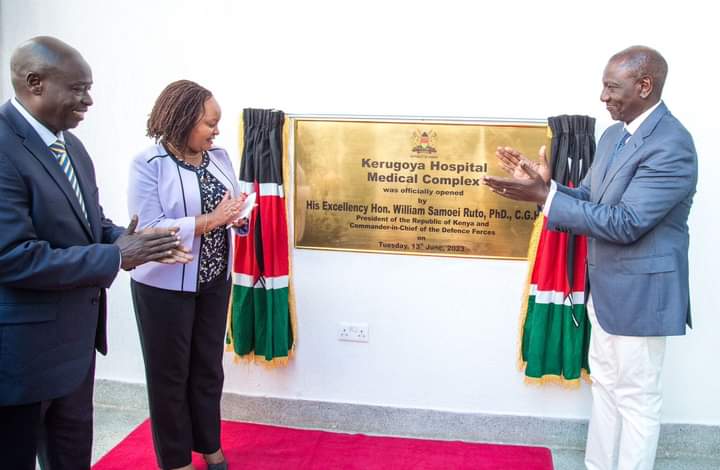
    President William Ruto Tuesday opened the largest medical complex in Kirinyaga County elevating Kerugoya County Referral Hospital from a Level 4 to a Level 5 health facility.

    The state-of-the-art Medical Complex that was opened on Tuesday takes the county’s medical care a notch higher by offering a full spectrum of specialized services for which residents would earlier be referred to facilities outside the county.

    The President who was accompanied by his Deputy Rigathi Gachagua congratulated Kirinyaga Governor Anne Waiguru for implementing a project that he termed as iconic and one that has demonstrated that healthcare is better delivered by county governments.

    “The healthcare function will and has been better managed by the county governments and if anyone needs a testimony and confirmation of the same, they should see the hospital that has been built by the County Government of Kirinyaga”, said the president.

    He said that even though the project had faced a lot of opposition at the initial stages, Waiguru’s determination and bravery made it possible to get it accomplished. “A good thing cannot be seen at once but you need a long term vision to accomplish it”. He noted.

    At the same time, President Ruto assured Kenyans that the national government has no interest in taking over the health function from counties. He said that it will instead support the county governments to deliver quality and affordable healthcare to the people. “We have a comprehensive plan on how better to address issues surrounding the welfare of medics and we want to have a seamless intergovernmental working relationship that will enable us implement various reforms in the health sector”. Ruto said.

    Some of the areas in which the president said the two levels of government will collaborate include equipping of hospitals, formulation of policy and financing framework involving the Facility Improvement Fund and capacity building and remuneration of Community Health Promoters.

    He also said that they will form an advisory council that will deal with matters of counties medical workers.

    Governor Waiguru said that the hospital project that has been fully funded by the County Government was part of fulfilling the county’s development blueprint-The Mountain Cities 2032 which designates Kirinyaga Central constituency as the Wellness City.

    She added that it was the culmination of her administration’s effort to improve accessibility and affordability to quality healthcare services to residents of Kirinyaga County.

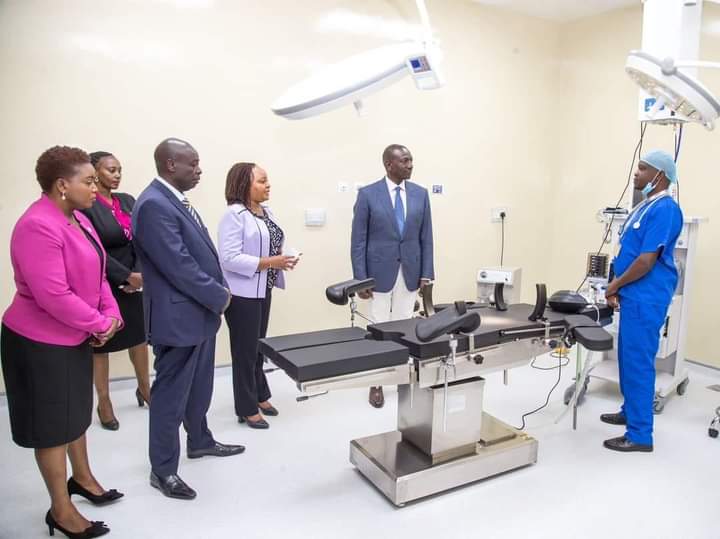
    Some the services offered at the 341 bed capacity hospital include specialist consultancy in pediatrics, ENT, oncology, dermatology, orthopedics, medical outpatient clinic, surgical outpatient, neuro-pediatric clinic, obstetrics and gynecology. The hospital also has a 12 bed ICU and a 12 HDU and has all its beds fitted with oxygen.

    After touring the hospital, the president promised to support governor Waiguru by deploying five critical care nurses to work at the new Intensive Care Unit and also help in additional equipment.

    Deputy President Rigathi Gachagua on his part said that governor Waiguru had not let down the people of Kirinyaga and has lived to her promise of transforming the county. “She does many things but the hospital will be a lasting legacy in her leadership in Kirinyaga County”. Said the DP.

    Governor Waiguru said that the accomplishment of the project is a demonstration that devolution works and if adequately supported, counties will be able to provide affordable and accessible healthcare to the citizens.

    “As the Chairperson of the Council of Governors, I can assure you that the devolution of healthcare services has had a significant impact. For the last ten years, County Governments have invested heavily in healthcare service delivery, human resource development, equipment of health facilities as well as health infrastructure development. Consequently, over 90% of Kenyan population currently live within five kilometers or one-hour travel time to a health facility”, she said.

    Waiguru thanked the national government for support in terms of technical advice noting that the intergovernmental approach had contributed to the overall delivery of high-quality healthcare facility. She also thanked the project implementation team that included the county departments of public works, health and finance.

    The Cabinet Secretary for Health, Dr. Nakumicha Wafula, said that she was very proud of Governor Waiguru not just because she is a woman but because she has demonstrated that women can work. “My sister Anne, I salute you”, she said.

    She added that the hospital had been assessed and had met all the requirements for elevation to a level five facility. A Level Five Certificate was issued to Governor Waiguru.

    Dr. Nakumicha observed that many health projects are started but they stall after sometime but the Kirinyaga one had been completed and well equipped to serve the public.

    Other leaders present at the function hailed the governor for successfully implementing a project of such a magnitude. I have not seen a leader who works as hard as Waiguru. She is visionary, resilient, determined and focused” Said Nairobi Governor Johnson Sakaja, noting that even Nairobi County doesn’t have a public health facility with such high standards.

    His sentiments were echoed by Tharaka Nithi Governor Muthomi Njuki who is also the Chair of the Health Committee at the Council of Governors (COG). “We came to Kirinyaga today to witness that devolution works”, he said pointing out that Waiguru’s leadership capability is what made governors elect her to lead the COG.

    Ndia and Kirinyaga Central Members of Parliament George Kariuki and Gachoki Gitari respectively congratulated the governor for the hospital project saying that county residents will now stop being medical tourists to other counties.

    The function was also attended by Members of the County Assembly and thousands of Kirinyaga residents.

  • Bolt: Confirm driver, car details before boarding, riders urged

    Bolt: Confirm driver, car details before boarding, riders urged

    Bolt has urged its clients not to use vehicles that do not match the details on their platform. 

    This follows an incident where two girls, one of them being the daughter of renowned journalist Shiku Muiruri, were kidnapped last week on 4th June 2023.

    In a statement, Bolt condemned the incident noting that they proactively collaborated with the authorities to provide pertinent information regarding this case that supported the conclusion of the investigation.

    “We are aware of the recent safety incident and deeply appreciate the local authorities’ efforts to ensure that the two young girls were found and safely reunited with their families,” Bolt said.

    To avoid such situations, Bolt explained that their platform shows riders the driver and car verification details when they request a ride. 

    Riders are encouraged to confirm that the driver and car registration details during their pickup match those on the app.

    “To address this,we show riders the driver and car verification details when they request a ride. Riders are encouraged to confirm that the driver and car registration details during their pickup match those on the opp.” Bolt said.

    Adding that: “We immediately block drivers that exhibit such behaviour. We also introduced the driver selfie check feature on the platform to enhance safety and prevent driver impersonation and account sharing.”

    Similarly, Bolt says that their drivers and rider apps also have an SOS emergency button that can be used to alert, seek security and first-response medical assistance at any time during an active trip.

    The e-taxi company has urged users to continue reporting incidents to its Customer Support team.

    “The safety of our drivers and riders remains our highest priority. This is why we strongly encourage all riders and drivers to report any incidents to our Customer Support team through our in-app support feature accessible from the Bolt application menu or via kenya@bolt.eu,” Bolt said.

    On Sunday, 11th June 2023,  the two women, Erica Gachoka aged 26 and her friend Shanice Agose, 27 were rescued in an operation conducted by a joint team of detectives drawn from the Crime Research and Intelligence Bureau and the Operations branch.

    According to a statement by the Director of Criminal Investigations (DCI), on June 4 2023, went missing after attending a house party in Nairobi’s Westlands area.

    After the party, the two requested a ride to Kilimani, via the bolt taxi application.

    But when the ride arrived along Rhapta road in Westlands and they got in, the driver threatened them using a hammer before speeding off towards Thika.

    Investigations into the abduction were immediately launched as the detectives trailed the suspects who operated between Nairobi, Thika, Ruiru and Witeithie in Kiambu County.

    The abductors demanded for a ransom of Ksh250,000 from each of the two, in order to release them.

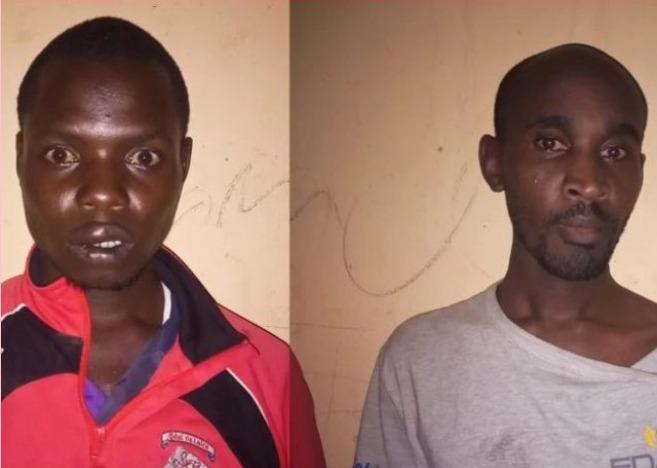
    On Sunday, the officers raided a house in Ngoigwa area in Thika, where two suspects Timothy Kiragu, 34 and Samuel Kipkurui, 33 were arrested.

    After a brief interview, the duo led detectives to Gatukuyu in Mang’u, Kiambu County, where the two women were rescued.

    Assorted crude weapons and fake motor vehicle number plates were recovered from the suspects.

  • Government committed to ensuring universal broadband availability countrywide

    Government committed to ensuring universal broadband availability countrywide

    The Government of Kenya will ensure universal broadband availability through the roll-out of connectivity throughout the country over the next 5 years.

    According to Cabinet Secretary, Ministry of Co-operatives and Micro, Small and Medium Enterprises( MSMEs) Simon Chelungui, government has prioritised the digital superhighway and the creative economy, which will be enablers of transformation, productivity and overall competitiveness.

    This the CS says will spur the uptake of ICT services hence not only create job opportunities for individuals in the ICT space but also enable the growth of MSMEs in the ICT sector.

    The Digital connectivity will also spur online trade hence expand the market outreach of MSMEs across all sectors especially leveraging on Ecommerce as well as social media.

    Speaking during During the Kenya Jobs and Inclusive Growth Forum organised by the World Bank at a Nairobi Hotel, CS Chelungui said the Digital space especially with the massive growth of social media has also created opportunities for income generation through creative content creation.

    “This space creates a huge potential for the youth hence the focus by the Government through the Talanta Hela Programme that aims to identify, recruit, nurture, market, and monetise talent.” CS Chelungui said.

    Consequently, the CS noted that another key priority for the Government to create more productive and sustainable jobs is in the housing sector particularly on Affordable Housing.
    Through the project, CS Chelungui says the Government is targeting to construct 200,000 housing units annually through collaboration between the National government, County Governments and the private sector.
    “This project will create jobs annually for skilled personnel (architects, quantity surveyors, plumbers, masons, electricians etc) across the construction sector as well as facilitate the MSME Associations in the Manufacturing sector (commonly refered to as juakali) as suppliers of over 75 products including doors, frames, windows among others to support construction of these units.” He noted.
  • Detectives rescue two women, arrest two kidnappers

    Detectives rescue two women, arrest two kidnappers

    Two women who were abducted a week ago were rescued Sunday, following an operation conducted by a joint team of detectives drawn from the Crime Research and Intelligence Bureau and the Operations branch.

    According to a statement by the Director of Criminal Investigations (DCI), on June 4, daughter of media personality Ciku Muiruri, Erica Gachoka aged 26 and her friend Shanice Agose, 27 went missing after attending a house party in Nairobi’s Westlands area.

    After the party, the two requested a ride to Kilimani, via the bolt taxi application.

    But when the ride arrived along Rhapta road in Westlands and they got in, the driver threatened them using a hammer before speeding off towards Thika.

    Investigations into the abduction were immediately launched as the detectives trailed the suspects who operated between Nairobi, Thika, Ruiru and Witeithie in Kiambu County.

    The abductors demanded for a ransom of Sh250,000 from each of the two, in order to release them.

    On Sunday, the officers raided a house in Ngoigwa area in Thika, where two suspects Timothy Kiragu, 34 and Samuel Kipkurui, 33 were arrested.

    After a brief interview, the duo led detectives to Gatukuyu in Mang’u, Kiambu County, where the two women were rescued.

    Assorted crude weapons and fake motor vehicle number plates were recovered from the suspects.

    Meanwhile, the visibly weak and shaken victims who were found in a one-roomed house where they had been locked up have since been reunited with their families.

  • DCI arrest three in Ksh 34M fake gold scam

    DCI arrest three in Ksh 34M fake gold scam

    Three suspects are in police custody after they were nabbed by Directorate of Criminal Investigation officers for having swindled a foreigner 183,600 US dollars equivalent to 34 million shillings in a fake gold deal.

    The trio obtained the money in a warehouse along Mombasa Road near Mlolongo after pretending they could sell 6,264 kilogrammes of gold to the foreigner who in turn sought the DCI’s assistance after doubting them.

    The trio , Anthony Ombui Ondiek who is the director Kelot logistics and storage, Henry Onyango Ogeya and Henry Momanyi Nyabuti who operate from the stores are believed to be working with some senior politicians in the fake gold deals.

    Ondiek said he had only provided storage services to them when the 14 boxes consignment was delivered to him via an international logistics company three months ago.

    The DCI officers are still in pursuit of the other suspects who are still at large.

  • Activists, faith based organisations urged to bridge information gap on political parties

    Activists, faith based organisations urged to bridge information gap on political parties

    The Office of the Registrar of Political Parties has urged civil society organisations as well as faith based organisations to be proactive in their role of bridging the information gap concerning political parties welfare.

    ORPP Administrative Director Ezekiel Obonyo says the activists should consider membership positions amongst the various 48 political parties, a move that will authenticate their voices in political matters.

    Speaking in Mombasa during a two days workshop with the society’s watch dogs, Obonyo further called on the vulnerable groups to be at the forefront in embracing leadership positions in the parties, affirming more funds to cater for their needs.

    As they welcomed the sentiments, the CSOs called on the office to heighten efforts in dispute resolutions before and after the electioneering period.