Author: Beth Nyaga

  • Sexual and Gender-Based Violence Court launched in Siaya County

    Sexual and Gender-Based Violence Court launched in Siaya County

    Chief Justice Martha Koome has today launched the second specialized Sexual and Gender-Based Violence (SGBV) Court in Siaya County. This becomes the second SGBV court after Shanzu in Mombasa.

    While speaking at an event to inaugurate the new Siaya Law Courts building that will also house the SGBV Court and a Small Claims Court, CJ  Koome observed that ‘’We are not merely unveiling a building made of brick and mortar. Instead, we are unveiling a beacon of hope, a symbol of justice, and a testament to our unwavering commitment to bring the justice system closer to our people.”

    While designating the Siaya SGBV Court, the Chief Justice noted that justice is not homogenous but instead must be tailored to meet the unique needs of different members of our society, especially the most vulnerable. ‘’Today we make a significant stride in addressing one of our society’s most daunting challenges – Sexual and Gender-Based Violence. A clear demonstration of our unwavering commitment to eradicate such atrocities from our society.’’

    She noted that SGBV court forms part of the new strategies under her Social Transformation through Access to Justice Vision ‘’to dismantle formal, informal, and systemic barriers that prevent victims of sexual and gender-based violence from accessing justice and to protect the vulnerable.’’

    During the function, CJ Koome also designated a Small Claims Court in Siaya noting that “the pillar of any thriving economy is the ease and swiftness with which commercial disputes are resolved.” She referred to the court  that deals with matters of value below Ksh. 1 Million as  “a critical cog in our drive to create an enabling environment for businesses to thrive and to spur economic growth in Siaya County and beyond.’’

    Governor of Siaya County, James Orengo, who is also a Senior Counsel called on the Judiciary to remain independent and ensure there is no clawback on the gains made so far. “We should never lose the battle for a free and independent Judiciary. It cost many lives to get here.” Adding that an independent Judiciary fosters peace and secures the workings of all other institutions.

    Siaya County’s First Lady, Betty Murungi Orengo, lauded the establishment of the SGBV Court in Siaya saying  it is in harmony with ‘’the County’s plans to establish shelters to take care of victims of sexual and gender-based violence and provide victim-friendly services.’’

    Lady Justice Agnes Murgor, who is the President of the International Association of Women Judges, Kenya Chapter said sexual and gender-based violence has escalated to pandemic proportions noting that “An effective SGBV Court will be deterrent to the continued increase in violence against women and children.”

    The Chief Registrar of the Judiciary, Anne Amadi observed that Siaya is the birthplace of many leading lawyers. She counted 20 eminent jurists including Argwings-Kodhek who was the first East African to be admitted to practice law in Kenya and Chief Justice Emeritus Bernard Chunga.

    In the Judiciary, those who hail from the County include Justice William Ouko of the Supreme Court, Justice George Odunga of the Court of Appeal, Justice Eric Ogola, Principal Judge of the High Court, and the Chief Registrar of the Judiciary, Anne Amadi.


  • Roysambu Assistant County Commissioner arrested over Ksh 50K bribe

    Roysambu Assistant County Commissioner arrested over Ksh 50K bribe

    Roysambu Assistant County Commissioner Mercy Kavoi has been arrested by the Ethics and Anti-Corruption Commission (EACC) over alleged bribery.

    According to the authority, Kavoi demanded a Ksh 50,000 bribe from a Mathare resident in order to return his construction materials taken away after demolishing the complainant’s 3-roomed mabati house she said was on a road reserve.

    The Assistant County Commissioner was on Wednesday arrested alongside her agent David Musyoki, to whom she had ordered the complainant to deliver the money.

    “Musyoki took to his heels towards Mathare slum but detectives outran and re-arrested him. At this point, he threw the money to members of the public,” says EACC.

    David Musyoki
    David Musyoki

    Upon arrest, the Assistant County Commissioner and her graft partner were escorted to EACC Integrity Centre Police Station where they were interviewed and later released on police bail pending finalization of the remaining aspects of the investigation.

    EACC urges members of the public not to at any time succumb to bribe demands from public officials but always report such matters.

    “At the same time, citizens should develop a culture of obeying the laws that govern our society,” the authority notes.


  • Budget 2023: Treasury decreases health care budget to Ksh 141B

    Budget 2023: Treasury decreases health care budget to Ksh 141B

    Treasury has allocated Ksh 141.2 billion to cater for health care services in the 2023/2024 budget a decrease from Ksh 146.8 billion in the previous financial year.

    While delivering the budget for the 2023/2024 Financial Year in Parliament on Thursday, Cabinet Secretary Njuguna Ndung’u said the allocation will promote access to quality and affordable healthcare through the universal healthcare coverage program.

    He noted that the Kenya Kwanza administration is committed to realizing the constitutional right to health by delivering a universal healthcare coverage system.

    “I propose to the National Assembly to effect the budget allocation of Ksh 141.2 billion to the health sector to support various programs aimed at supporting the Universal Health Care coverage,” said the Treasury CS.

    Of the amount, Ksh 18.4 billion will go towards Universal Health Coverage in the 2023-24 Financial Year and Ksh 3.7 billion for the Kenya Covid-19 Emergency Response Project.

    The other budget proposals include; Ksh 4.1 billion for free maternity health care, and Ksh 5.9 billion for Managed Equipment Services.

    CS Ndung’u also proposed to the National Assembly to set aside Ksh 1.7 billion to provide medical cover to the elderly and severely disabled persons in society.

    In the new financial year, the government has also set aside Ksh 24.8 billion to lower the cases of HIV/AIDS, Malaria, and Tuberculosis under the Global Fund and set a further Ksh 4.6 billion to enhance vaccines and immunization programs.

    Additionally, the State has also proposed a total of Ksh 1.9 billion for the Construction of a Cancer Centre at Kisii Level 5 Hospital

    The Treasury boss said it will help promote early diagnosis and management of cancer and reduce the burden of treatment among Kenyans.

    He also proposed Ksh 500 million for strengthening Cancer Centre Management at Kenyatta National Hospital; and an additional Ksh 155 million for the establishment of Regional Cancer Centres.

  • Treasury allocates education docket Ksh 628.6B to address inequities

    Treasury allocates education docket Ksh 628.6B to address inequities

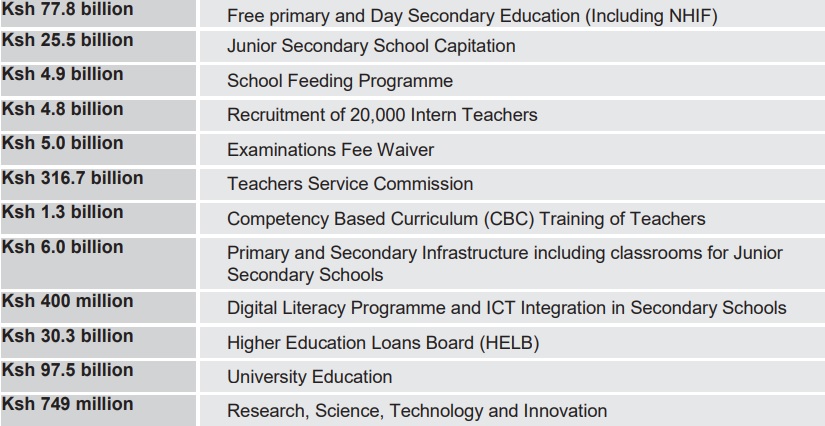
    To improve educational outcomes in the country, Ksh 628.6 billion has been allocated in FY 2023/24.

    This is according to the National Treasury CS Prof. Njuguna Ndung’u who says the Kenya Kwanza Government aims to address inequities in the Kenyan education system.

    Ndung’u in addition noted that with the allocation, the playing field for all children irrespective of their background would be leveled.

    “The ultimate means of ensuring an equitable society is through investment in education, as part of human capital development. For this reason, we have allocated it a Ksh 628.6 billion,” he said.

    Here is the breakdown of the educational budget:

  • Jane Marriott appointed British High Commissioner to Pakistan

    Jane Marriott appointed British High Commissioner to Pakistan

    Jane Marriott has been appointed British High Commissioner to the Islamic Republic of Pakistan in succession to Dr Christian Turner CMG who has transferred to another Diplomatic Service appointment.

    Marriott will take up her appointment in July 2023.

    Taking to her official social media accounts, Marriott said that her tenure is coming to an end in one week’s time.

    In addition, she said that she hoped that Kenyan’s especially on Twitter would give her successor Desmond Patrick Neil Wigan a warm welcome like they did her.

    Wigan has been serving as the Ambassador to Tell Aviv since 2019.

    Marriott boasts over 20 years in the public service having first joined UK’s Cabinet Office and Home Office in 1998.

    She has also held key roles in other Middle East nations including Afghanistan, Iraq and Baghdad, and has also served in America and Africa.


  • Kilifi County Assembly adjourns to protest pay cuts

    Kilifi County Assembly adjourns to protest pay cuts

    Kilifi County Assembly on Tuesday adjourned indefinitely to protest at a decision by the Salaries and Remuneration Commission (SRC) to reduce the remuneration of Members of County Assemblies.

    The MCAs unanimously endorsed a motion moved by Deputy Majority Leader Martha Koki seeking a sine die adjournment of plenary sittings until the commission rescinds its decision and reinstate their allowances.

    Speaking to journalists after successfully moving the motion, Koki also called for the reinstatement of sitting allowances that the SRC removed from their perks.

    “We have adjourned sittings indefinitely until our cry is heard. We are now going to the grassroots to be with the electorate until our grievances are addressed,” said Koki.

    Koki said MCAs were passing through difficult times since the reduction of their perks from Ksh 144,000 to Ksh 86,000 per month.

    “By the grace of God, I was in the second county assembly when an MCA was earning Ksh 144,000 monthly, but now we are earning Ksh 86,000. Legally, are salaries supposed to be increased or decreased?” she posed.

    She dismissed claims that the MCAs are selfish in seeking for better remuneration, saying that the money they are seeking is aimed at serving the electorate better since they (MCAs) are in daily contact with the people at the grassroots.

    Ganze Ward MCA Karisa Ngirani said it was discriminatory for the SRC to remove the sitting allowances of MCAs while retaining those of Members of the National Assembly and Senators.

    “They withdrew the allowances for MCAs but we are aware that Members of the National Assembly and Senate are receiving them. What is the difference between us and the two other houses of Parliament?” He quipped.

    He said the removal of sitting allowances was discouraging members from attending sessions since they find it useless to attend assembly sittings which have no monetary value.

    He also said the MCAs were agitating for the enactment of a Ward Development Fund law to ensure that wards receive funds for development without relying on the goodwill of governors.

    “We want a law like the one that formed the National Government Constituency Development Fund so that the MCAs do not have to dance to the tunes of the governors for them to receive funds to develop their respective areas,” he said.


  • Pastor Dorcas visists convicts at Kiambu GK Prison

    Pastor Dorcas visists convicts at Kiambu GK Prison

    Pastor Dorcas Rigathi Wednesday visited convicts and those remanded at the Kiambu GK Prison and shared a meal with them.

    In the spirit of leaving no one behind, Pastor Dorcas visited the male prison, which is among 87 others in the country that are correctional facilities for men. Kenya has a total of 134 prisons.

    “Every mother wants to see their son get the best in life. And every mother cries for her sons,” she told the inmates, in an effort to show the inmates the need to reform and change their lives.

    She sympathized with their situation, saying, “It is sad to see the future going into the grave. You are the economic drivers of this nation, and we must put an end to this satanic agenda that is destroying your destiny.”

    She also acknowledged the lack of jobs but said that through the boy child program, she envisioned the skilling of the beneficiaries through TVETs and college training.

    The boy child program under the office of the spouse of the Deputy President has rehabilitated 65 men from Mathira Constituency, and 24 from other parts of Kenya.

    The target by the end of this year is to rehabilitate 12,000 of those addicted to different substances through inpatient and outpatient facilities.

    Pastor Dorcas, who embraces feeding programs as a way of reaching out and evangelizing, helped serve the inmates with a meal of chapati, rice, stew, vegetables, ugali, and soft drinks.

    Deputy Commissioner General Florence Omundi also called on the inmates, once free, to make a firm resolve never to be imprisoned again.

    “We are here to do the right that we did not do out there, and reconnect with our destiny,” she said.

    Also present were County Police Commander Kioi Muchangi, Officer in Charge of Kiambu Prison Christine Mutisya, Kiambu Town MP Machua Waithaka, Nacada Director Rev. Fredrick Ngugi, Chaplains Timothy Maina (Administration Police), Father John (Kenya Police), and Rev. James Kiiru (Kenya Prison).

    MP Machua told the inmates to take their imprisonment as a blessing in disguise and take time to reflect and rebuild their lives.

    He also said that the constituency had 11 acres of land, which would be used to develop a recovery and rehabilitation centre to rescue the boys and men lost in alcohol, drug, and substance abuse.


  • AGRA unveils strategy to boost food security in Kenya

    AGRA unveils strategy to boost food security in Kenya

    AGRA has launched its Kenya Strategy to support the country’s efforts to enhance food security and build the resilience of smallholder farmers by strengthening market systems.

    The 5-year strategy aligns with Kenya’s Vision 2030 blueprint for long-term development, which aims to transform the country into a newly industrializing, middle-income nation.  The strategy builds on the achievements and lessons from Agra 2.0 strategy.

    Speaking during the unveiling of the new strategy in Nairobi, Kenya, AGRA President Dr. Agnes Kalibata noted that the strategy focuses on addressing key challenges facing the agricultural sector, such as the need to assess the impact of climate change and its shocks, prioritize disease monitoring, and focus on building markets to pull sustainable farming practices.

    “Our delivery model will continue to scale and leverage proven approaches to deliver a competitive and inclusive agricultural transformation in Kenya. We are committed to working closely with smallholder farmers, the private sector, and other stakeholders to enhance food security and build the resilience of the agricultural sector,” Dr. Kalibata said.

    In Kenya, the agricultural sector has traditionally, played a crucial role in ensuring food security, job creation, income generation, foreign exchange earnings, and linkages with other sectors of the economy.   Over the years, successive governments have prioritized agriculture through digitizing the subsidies program and loan commercialization; despite these efforts, the sector remains characterized by weak vertical integration as a result of unpredictable weather patterns and recurrence of insecurity particularly in the ASALs.  Some of the many challenges facing the sector remain major threats to national economic progress.

    “The Kenya Kwanza Government is keen on strengthening longer-term resilience and increasing agricultural capacity investments to boost domestic food production. Public-private partnerships have the potential to revolutionize food security in Kenya by combining the strengths of both sectors to create sustainable solutions that benefit the entire population,” said Hon Mithinka Linturi, Cabinet Secretary Ministry of Agriculture and Livestock Development

    The Ministry of Agriculture and Livestock Development will implement various programs to improve agricultural productivity, food and nutrition security, value chain development, market access and trade, climate change, and the policy and legal framework. The ultimate goal is to ensure 100% food and nutrition security and contribute to income and employment creation in a secure environment.

    In recognition of the wide-ranging nature and complexity of the challenges facing smallholder farmers in Africa, AGRA sees strategic partnerships as a key pillar of its strategy.  These partnerships support the creation of alignment between government priorities and private sector interests, for improving impact at the smallholder farmer level and for mobilizing private sector investment to scale.

    As such, The Partnership for Inclusive Agricultural Transformation in Africa (PIATA) was launched in 2017 as a vehicle of mobilizing strategic partnerships for transforming agricultural systems. This is being achieved by driving integrated delivery within agro-economic zones and across value chains, for enhancing in-country coordination and for deepening engagements with the private sector to transition African agriculture from subsistence to sustainable business occupations.


  • Duale implores NA to approve the National Peace Support Operations Fund

    Duale implores NA to approve the National Peace Support Operations Fund

    Defence Cabinet Secretary Hon. Aden Duale has implored the National Assembly to approve the National Peace Support Operations Fund Regulations by delinking it from the Ministry’s budget to enable the Kenya Defence Forces (KDF) to participate in Peace Support Operations (PSOs).

    He disclosed that Kenya has participated in numerous PSOs since 1978 as a leading Troop Contributing Country (TCC) but there has never been a special Fund for this activity adding that the military has been using the Ministry’s budget leaving it heavily constrained.

    The CS maintained that if passed, the Fund shall be critical in financing the maintenance of the Contingent Owned Equipment and other assets as well as enhancing KDF’s capability to attain the appropriate levels at the United Nations peacekeeping capability.

    Hon. Duale made the remarks on Tuesday 13 June 2023 when he presented the amended Public Finance Management (National Peace Support Operations Fund) Regulations 2023 before the National Assembly Committee on Delegated Legislation at Parliament buildings, Nairobi.

    The CS maintained that the Fund shall further help promote capacity-building programs to enhance Force generation and Force posture of the KDF.

    He informed the Committee chaired by Ainabkoi Member of Parliament Hon. Samuel Chepkonga that previously, Kenya was a ranking partner in peacekeeping operations globally but has since been overtaken by other countries over the years due to inadequate financing for the operations.

    “When we go for peace support operations, we portray the image of our Defence Forces and our capability as a country. We believe that Kenya is safe when our neighbours are at peace and that’s why we go to any lengths to promote peace in our region and beyond,” said the CS.

    The CS added, “Kenya participates in PSOs to secure her national interests, preserve the territorial integrity, promote regional peace and security, advance economic prosperity, and project her image in fulfilment of international obligations.”

    He said that Kenya continues to position herself as an anchor State in the region as a home of international organizations including the United Nations.
    If the regulations sail through, the Fund shall help in financing research and evaluation of activities related to peace and shall be under the management of the Defence Council and administered by the Principal Secretary for Defence.

    As the Chair of the Defence Council, the CS committed to having the money utilized in a prudent way by having a review of the performance of the fund after 10 years after the enactment of the regulations.

  • Lessons for Africa from China’s ‘desertification miracle’

    Lessons for Africa from China’s ‘desertification miracle’

    Deforestation is a growing man-made disaster. More than 47,000 km2 of forest is lost worldwide every year, with 17 percent of the Amazon rainforest destroyed in the last quarter century. According to the United Nations Environment Program (UNEP), forests absorb 30 percent of emissions from industry and fossil fuels, yet 10 million hectares of forest are lost worldwide every year. Deforestation and forest degradation are responsible for 11 percent of carbon emissions.

    Although different environmental authorities have different estimates of the percentage of Africa that is perennially dry, it can safely be assumed that at least a third of the continent is desert. Of significance is that about half of Africans live in arid, semi-arid, dry sub-humid and hyper-arid areas.

    According to the UNEP, about 45 percent of Africa’s land surface is affected by desertification, and 55 percent of this area is at high or very high risk of further degradation. The global environmental body also estimates that around 20 percent of Africa’s land surface, equivalent to 6.6 million km2, has been degraded by soil erosion, salinity, pollution, and loss of vegetation or soil fertility.

    Desertification in Africa has adversely affected millions of livelihoods. This has also reduced the continent’s socioeconomic growth since the arid lands are virtually unproductive, and even gobble up resources with scant returns. Moreover, increasing desertification seriously hampers food security in the continent as arable land decreases tremendously every year.

    But the continent does not have to keep suffering the vagaries of desertification if it is ready to learn and apply best practices from countries around the world that have overcome and turned around this phenomenon. While acknowledging that desertification has also had a profound effect on China, President Xi Jinping recently hailed and outlined the country’s efforts in combating desertification along its northern border.

    China’s “three-North,” comprising the northwest, north, and northeast regions, is home to deserts, including the Gobi, the sixth largest desert in the world. The country launched the “three-North Shelterbelt Forest Program” project in 1978, which was the same time as the country’s “Reform and Opening Up”, which is credited with birthing China so-called economic miracle. By 2050, this so-called Great Green Wall will create a 2,783 miles forest belt covering a total of 35.6 million hectares.

    The construction of major ecological projects like forest farms in the region has created an “ecological security barrier” and an “indestructible green wall of the northern border.” This has stopped the escalation of the desert and secured the gains made in rehabilitating the hitherto perennially scorched earth.

    Between 1990 and 2015, China planted the newest forest of any country. In 2015, the amount of forest planted in China was 79 million hectares, an area more than three times that of ​​the United Kingdom. Since the 1990s, China has invested more than $100 billion in afforestation programs and planted more than 35 billion trees in 12 Chinese provinces.

    President Xi underscored the role of leadership in implementing the foregoing strategies and attributed their success to the commitment of the Communist Party of China. Many African countries are indeed following this example as their presidents or prime ministers lead from the front in environmental restoration. Strong leadership shows the full commitment of the government.

    Public officials and other authorities will take cue from the commitment shown by leadership. During his tour, Xi also visited Wuliangsu Lake, a rare large grassland lake in the desert area where public officials are credited with restoring the lake’s ecological functions by curbing its pollution by urban sewage and industrial wastewater.

    Efforts in fighting desertification should be pursued as part of the global initiative to green the planet. Just like China’s eradication of poverty contributed to the massive reduction of global poverty, the country’s greening campaign has contributed to a quarter of global efforts in the fight against desertification.

    A 2019 study published in Nature Sustainability found that at least 25 percent of global foliage propagation has come from China since the early 2000s. Moreover, 2018 data showed that the Three-North Shelterbelt Forest Program had increased the forest area by 30.14 million hectares since its inception in 1978.

    China is first among equals in fighting desertification, through reforestation. Other countries with similar best practices for rehabilitating deserts include India, Chile, Vietnam, Turkey, Romania, Italy, and Australia. This shows that reforestation is not a developed country affair, but something that any country can invest its time and resources in through focus and determination.

    Africa can learn crucial lessons from China’s eco-civilization which embodies harmonious living between man and nature. The continent understands the value of nature, or its lack thereof, in sustaining life. Indeed, the continent has experienced grave human suffering from desertification and is desperate for environmental technologies that curb the problem. Africa urgently and desperately needs a substantial increase in forests to mitigate not only against climate change but also to help in its transition to green development.