Author: Christine Muchira/Release

  • Former President Kenyatta eulogizes late German President Horst Köhler

    Former President Kenyatta eulogizes late German President Horst Köhler

    Former President Uhuru Kenyatta delivered a heartfelt eulogy at the State Funeral service for the late German President Horst Köhler, held at the Berlin Cathedral.

    In his speech, Kenyatta paid tribute to Köhler’s remarkable leadership, dedication to global affairs, and unwavering commitment to Africa’s development.

    “President Köhler’s legacy is defined not just by his time as the Federal President of Germany, but by the incredible heart and vision he brought to global affairs,” Kenyatta stated. “He saw the potential for sustainable progress in Africa, not merely as a theoretical ambition but as a practical and achievable goal.”

    Kenyatta recalled Köhler’s pivotal visits across the African continent, where he met with leaders at both national and community levels, emblematic of his belief in the strength of partnerships between Germany and Africa. “In Kenya, he focused on advancing sustainable development goals, highlighting the importance of wildlife conservation, which is vital to our country,” he added.

    The former Kenyan president also emphasized Köhler’s dedication to equitable development. “What stood out most during that visit was his commitment to ensuring that the benefits of development were shared equitably—always with an eye toward empowering local communities,” Kenyatta noted.

    Kenyatta praised Köhler’s vision for Africa’s future, which he believed lay in its institutions, youth, and capacity for innovation. “He knew that to bridge the divide between continents, there needed to be collaboration, respect, and mutual benefit,” Kenyatta said. “He was a tireless advocate for using education and technical training as the building blocks for lasting change.”

    In closing, Kenyatta encouraged attendees to celebrate Köhler’s life and legacy rather than solely mourn his passing. He highlighted Köhler’s lasting influence on countless lives and emphasized his efforts to create a future built on international collaboration to effectively address global challenges.

    Former President Kenyatta eulogizes late German President Horst Köhler

    The funeral service was a poignant reminder of Horst Köhler’s enduring impact on global affairs and his dedication to fostering international cooperation and sustainable development.

    Besides Kenyatta, Frank-Walter Steinmeier, the Federal President of Germany, Dr. Heinz Fischerthe former Federal President of Austria, and Theodor Waigel also delivered eulogies at the ceremony.

    Köhler, who served as head of state from 2004 to 2010, died at the age of 81 earlier this month in Berlin after a short illness.

  • Kenya Breweries wins prestigious Sustainability Award for water recovery project

    Kenya Breweries wins prestigious Sustainability Award for water recovery project

    Kenya Breweries Limited has been awarded the 2024 Solenis Sustainability Award for its ground-breaking water recovery project at its Kisumu Brewery, which has significantly improved the facility’s efficiency.

    The award was given in collaboration with Diversey, which provides cleaning and hygiene products and helped eliminate the products used in the water recovery project by half.

    The award recognizes Kenya Breweries Limited’s efforts to reduce water and energy consumption in production. The project achieved sustainability benefits, including an annual water savings of 624,000 liters, and a reduction in energy consumption by 780 kWh. Additionally, by minimising the handling and packaging of chemicals, the initiative has improved workplace safety and contributed to a lower carbon footprint.

    With an outstanding 97 percent recovery rate, the water recovery project aligns with Kenya Breweries’ sustainability strategy by optimising raw material utilisation, reducing waste, and enhancing overall operational efficiency. The plant improves resource optimisation, ensuring that water, energy, and raw materials are used efficiently to reduce waste and improve productivity.

    “Sustainability is at the heart of our operations at Kenya Breweries. This recognition underscores our commitment to innovative solutions that drive efficiency while protecting our environment,” said Mark Ocitti, Managing Director, Kenya Breweries Limited.

    The water recovery project improves on the previous multi-step Clean-In-Place (CIP) process through the implementation of a single-stage Clean-In-Place (CIP) system using OSA-N (Biocidal Acid). This innovation eliminates the need for separate acid and disinfectant steps while maintaining product quality and safety standards.

    The Solenis Sustainability Award is an annual recognition program that honors companies for implementing innovative projects yielding significant, measurable sustainability outcomes.

  • WHO launches groundbreaking Ebola vaccination trial in Uganda

    WHO launches groundbreaking Ebola vaccination trial in Uganda

    The World Health Organization (WHO), in collaboration with Uganda’s Ministry of Health and global health partners, has launched the first-ever clinical trial for a vaccine targeting the Ebola Sudan virus species.

    This trial aims to evaluate the effectiveness of a vaccine against this deadly virus, representing a significant advancement in global pandemic preparedness.

    The principal investigators from Makerere University and the Uganda Virus Research Institute (UVRI), with support from WHO and other partners, have worked tirelessly to get the trial ready in four days since the outbreak was confirmed on 30 January. It is the first trial to assess the clinical efficacy of a vaccine against Ebola disease due to Sudan virus.

    The speed was achieved through advanced research preparedness, while ensuring full compliance with national and international regulatory and ethical requirements.

    The candidate vaccine was donated by IAVI, with financial support from WHO, the Coalition for Epidemic Preparedness Innovations (CEPI), Canada’s International Development Research Centre (IDRC), and the European Commission’s Health Emergency Preparedness and Response Authority (HERA) and support from the Africa Centres for Disease Control and Prevention (Africa CDC).

    “This is a critical achievement towards better pandemic preparedness, and saving lives when outbreaks occur,” said Dr Tedros Adhanom Ghebreyesus, WHO’s Director-General.  “This is possible because of the dedication of Uganda’s health workers, the involvement of communities, the Ministry of Health of Uganda, Makerere University and UVRI, and research efforts led by WHO involving hundreds of scientists through our research and development Filoviruses network. We thank our partners for their dedication and cooperation, from IAVI for donating the vaccine, to CEPI, EU HERA and Canada’s IDRC for funding, and Africa CDC for further support. This massive achievement would simply not be possible without them.”

    In 2022, during the previous outbreak of Ebola disease (also from the Sudan species of the virus) in Uganda, a randomized protocol for candidate vaccines was developed.

    Principal investigators were designated under the leadership of the Minister of Health, and teams were trained to allow such a trial to take place during an active outbreak.

    The randomized vaccine trial to assess the recombinant vesicular stomatitis virus (rVSV) candidate vaccine was launched at a ceremony in Kampala today by the Minister of Health of Uganda. WHO is co-sponsoring the trial.

    WHO was represented by Dr Mike Ryan, Executive Director of WHO’s Health Emergencies Programme and Deputy Director-General, and the WHO representative to Uganda Dr Kasonde Mwinga, along with other colleagues.

    Three vaccination rings were defined today. The first ring involves about 40 contacts and contacts of contacts of the first reported and confirmed case, a health worker who has died.

    Although several promising candidate medical countermeasures are progressing through clinical development, as of now, there is no licensed vaccine available to effectively combat a potential future outbreak of Ebola disease from the Sudan species of the virus.

    Licensed vaccines exist only for the disease caused by Ebola virus, formerly known as Zaïre ebolavirus. Likewise for treatments, approved treatments are only available for Ebola virus.

    The vaccine for the trial was recommended by the independent WHO candidate vaccine prioritization working group. If the candidate vaccine is effective, it can contribute to controlling this outbreak and generate data for vaccine licensure.

    In 2022, the research teams were trained in good clinical practice (GCP) and standard operating procedures for such trials. They completed refresher training in recent days. WHO colleagues experienced in trials and in ring vaccination arrived in Uganda over the weekend to support the trial implementation and GCP compliance.

    The vaccine doses were pre-positioned in the country. WHO worked with the principal investigators and national authorities and the vaccine developer to review cold chain documentation and ensure the doses were stored correctly over the previous years.

    As part of the signed agreement with the Ministry of Health, WHO has a signed agreement with IAVI for additional doses of the candidate vaccine to be made available shortly.

  • WHO strengthens support for Uganda’s response to Sudan Virus outbreak

    WHO strengthens support for Uganda’s response to Sudan Virus outbreak

    The World Health Organization (WHO) and its partners have intensified their support for Uganda in response to the outbreak of the Sudan Virus Disease (SVD), a lethal strain of the Ebola virus family.

    As part of this intervention, WHO has provided access to a candidate vaccine and experimental treatments.

    The first 2,160 doses have already been prepositioned in Kampala to help accelerate efforts to contain the outbreak.

    This swift response highlights global efforts to combat the spread of the virus and protect public health.

    The vaccine trial processes underway include orientation of the research teams on the trial procedures, and logistics arrangements.

    Research teams have been deployed to the field to work along with the surveillance teams as approvals are awaited.

    The candidate vaccine and the candidate treatments (a monoclonal antibody and an antiviral) are being made available through clinical trial protocols, which will make it possible to further document their efficacy and safety.

    As of 30 January, there was one confirmed case and 45 contacts who are being followed up.

    Uganda has experienced five previous SVD outbreaks. The last one was declared in September 2022 and ended in January 2023, with 164 cases and 77 deaths.

    During that outbreak, a WHO committee of external experts evaluated candidate vaccines and provided recommendations on their suitability for evaluation in Uganda, as part of a clinical trial against the SVD virus.

    WHO is working with the Ministry of Health of Uganda and its designated Ugandan Principal Investigators and their teams from Makerere University Lung Institute and the Ugandan Virus Research Institute, as well as worldwide filovirus and trial experts and regulators, to initiate the trials.

    The trials were designed via a global collaborative effort coordinated by WHO, that included developers, academic institutions, regulatory authorities, other experts and researchers from Uganda and other countries at risk of filoviruses outbreaks.

    The aim of the vaccine trial is to evaluate a potentially efficacious candidate vaccine, and if efficacious, to possibly contribute to ending the ongoing outbreak and protect populations at risk in the future.

    Those eligible to join the trial are those at highest risk of SVD, i.e. close contacts of a person who has been confirmed to have had SVD or who has died from the disease. The study sites will therefore be the locations where contacts of the case or cases reside.

    Study teams will be mobile and able to rapidly move to these areas to do their work using the ring vaccination approach.

    WHO is working with the Ministry of Health and with Makerere University Lung Institute and the Ugandan Virus Research Institute, who will lead the trials’ implementation.

    The development of the protocols and research priorities has been done via the MARVAC Consortium and the Collaborative Open Research Consortium (CORC) for the Filoviridae Family, and numerous developers facilitated the availability of the candidate vaccine and treatments: IAVI provided their candidate Sudan vaccine, Gilead provided remdesivir, an antiviral.

    Among those supporting the trials’ implementation are the Coalition for Epidemic Preparedness Innovations (CEPI), the Africa Centres for Disease Control and Prevention, Canada’s International Development Research Centre, the European Commission’s Health Emergency Preparedness and Response Authority (HERA) and WHO.

    This rapid action is the result of tireless efforts to build international cooperation on research, innovation and evaluation and deployment of countermeasures in the face of dangerous pathogens.

    While outbreaks of SVD are controllable without vaccines, control can be achieved more quickly using safe and effective vaccines.

    In the meantime, a comprehensive outbreak response is underway in Uganda to rapidly halt transmission, identify contacts and carry out epidemiological investigations, while enhancing community awareness.

    WHO has allocated US$ 1 million from its Contingency Fund for Emergencies to help accelerate outbreak control efforts.

    Sudan virus disease is a severe, often fatal illness affecting humans and other primates that is due to Orthoebolavirus sudanense (Sudan virus), a viral species belonging to the same genus of the virus causing Ebola virus disease.

    Case fatality rates of Sudan virus disease have varied from 41% to 100% in past outbreaks.

    There are no approved treatments or vaccines for Sudan virus, but early initiation of supportive treatment has been shown to significantly reduce deaths from Sudan virus disease.

  • EAC supports efforts to contain Marburg Virus Disease outbreak in North-Western Tanzania

    EAC supports efforts to contain Marburg Virus Disease outbreak in North-Western Tanzania

    The East African Community (EAC) has expressed solidarity with Tanzania and other stakeholders following the confirmation of a Marburg Virus Disease (MVD) outbreak in the Kagera Region, north-western Tanzania.

    With two confirmed cases and 18 suspected cases reported, this marks Tanzania’s second encounter with the deadly virus since the 2023 outbreak in the same region.

    The EAC Deputy Secretary General in charge of Infrastructure, Productive, Social, and Political Sectors, Andrea Aguer Ariik Malueth, praised Tanzania’s leadership and the invaluable support provided by global partners in addressing the outbreak.

    He emphasized that such collaboration underscores the significance of unity and shared responsibility among nations during health crises.

    “This outbreak highlights the importance of regional solidarity and swift action,” said Ariik, acknowledging the critical role of coordinated efforts in mitigating the impact of health emergencies.

    Ariik further reaffirmed the EAC’s commitment to standing with Tanzania and all EAC Partner States in managing the current health emergency. He stressed that the EAC would continue to prioritize enhancing regional capacities to respond to such crises while strengthening collective preparedness for future threats.

    Tanzania’s experience in managing the 2023 outbreak in Bukoba District, which resulted in nine cases and six fatalities, has equipped the country with critical expertise in outbreak containment.

    The EAC Secretariat is encouraging Partner States to share best practices and technical expertise to enhance the regional response to this outbreak.

    In collaboration with partners such as the German Government through GIZ and KfW, the EAC Secretariat is advancing efforts to contain MVD and Mpox outbreaks while reinforcing pandemic preparedness.

    Key interventions include the deployment of mobile laboratories and the establishment of a Rapidly Deployable Experts (RDE) pool to ensure swift expert response in outbreak areas.

    Additional measures include strengthening Risk Communication and Community Engagement (RCCE), establishment of 43 Water, Sanitation, and Hygiene (WASH) facilities in border areas and training of border staff, health workers and community leaders.

    The EAC Secretariat has prioritized strengthening Tanzania’s capacities to respond to the current outbreak by deploying a mobile laboratory where MVD testing is actively being conducted. Additionally, the EAC has donated two testing kits, each capable of performing 96 tests, to support diagnostic efforts.

    In collaboration with the Bernhard Nocht Institute for Tropical Medicine (BNITM), the EAC Secretariat is also providing technical guidance to laboratory experts.

    Further plans are underway to enhance regional surveillance through additional field missions.

    Marburg virus is a severe zoonotic disease, similar to Ebola, and is associated with a high fatality rate varied from 24% to 88% depending on virus strain and case management.

    Transmission occurs through direct contact with bodily fluids of infected individuals or contaminated surfaces. As there is no specific vaccine or treatment, supportive care remains the main form of medical intervention.

    Symptoms of Marburg Virus Disease typically include fever (often high), severe headache, muscle aches and pains, fatigue and weakness. Gastrointestinal symptoms such as severe diarrhoea, abdominal pain, nausea, vomiting and bleeding from various parts of the body (in later stages of the disease).

    To reduce the risk of contracting Marburg, members of the public are advised to: Practice proper hand hygiene using soap and water or alcohol-based hand sanitisers, avoid contact with fruit bats and their excretions, as these are considered the natural hosts of the virus.

    The public is also advised to practice safe burial practices to minimize exposure to bodily fluids of individuals who have died from MVD, wear personal protective equipment (PPE) when caring for infected individuals or handling animals that may be reservoirs of the virus. These as well as avoid contact with nonhuman primates in endemic areas, as these can also transmit the virus.

    Individuals suspecting that they may have contracted Marburg should seek medical care immediately as early supportive treatment is crucial to improve survival chances.

    They should also isolate themselves to prevent spreading the virus to others and notify local health authorities or go to the nearest healthcare facility for assessment.

    And also avoid contact with others, particularly through bodily fluids, until the suspicion of Marburg infection is ruled out.

    The EAC reaffirms its commitment to safeguarding regional health security through proactive measures, collaborative partnerships, and robust preparedness systems.

    Together, these efforts aim to mitigate the impact of Marburg virus and strengthen the region’s resilience to health emergencies.

  • Ethiopia, UNOPS partner on $3.28 M vaccine development project

    Ethiopia, UNOPS partner on $3.28 M vaccine development project

    The United Nations Office for Project Services (UNOPS) and Ethiopia’s Ministry of Health have launched a $3.28 million initiative aimed at bolstering the nation’s capacity for sustainable vaccine research and development.

    The agreement, signed Friday, represents a significant step toward reducing Ethiopia’s dependency on imported vaccines while enhancing its ability to meet public health challenges with local solutions.

    According to a statement, the project seeks to empower Ethiopia with the tools and expertise necessary for local vaccine production, addressing urgent public health needs and laying the groundwork for long-term healthcare resilience.

    This initiative is also expected to expedite health crisis responses, foster scientific innovation, and create industrial growth opportunities in the region.

    To achieve its goals, the project will concentrate on two key components experience-sharing visit for benchmarking, where Ethiopian officials and scientists plan to visit leading global vaccine manufacturing facilities to study best practices in vaccine research, development, and production. This experience will guide the development of Ethiopia’s vaccine manufacturing infrastructure.

    The other component is capacity building for staff, where there will be tailored training programs that will equip local experts with advanced skills in vaccine production. This will help establish a highly skilled workforce, ensuring the sustainability of vaccine manufacturing in Ethiopia.

    Worknesh Mekonnen, Director of the Ethiopia Multi-Country Office of UNOPS and Representative to the African Union, emphasized the transformative potential of the project, stating: “This initiative will contribute toward building a robust framework for vaccine production in Ethiopia, empowering the country to address public health challenges with increased autonomy and resilience.”

    She said, the project aligns with Ethiopia’s broader vision of advancing its healthcare sector, improving the well-being of its citizens, and positioning itself as a leader in vaccine production and public health in Africa.

    By developing local manufacturing capabilities, Ethiopia can reduce reliance on foreign suppliers, respond more effectively to health crises, and build a resilient healthcare infrastructure capable of addressing future needs.

    This partnership further underscores the importance of self-sufficiency in public health and marks a milestone in Ethiopia’s journey toward becoming a hub for vaccine innovation and production on the African continent.


  • ‘Pay up or humanity will pay the price’, Guterres warns at COP29 climate summit

    ‘Pay up or humanity will pay the price’, Guterres warns at COP29 climate summit

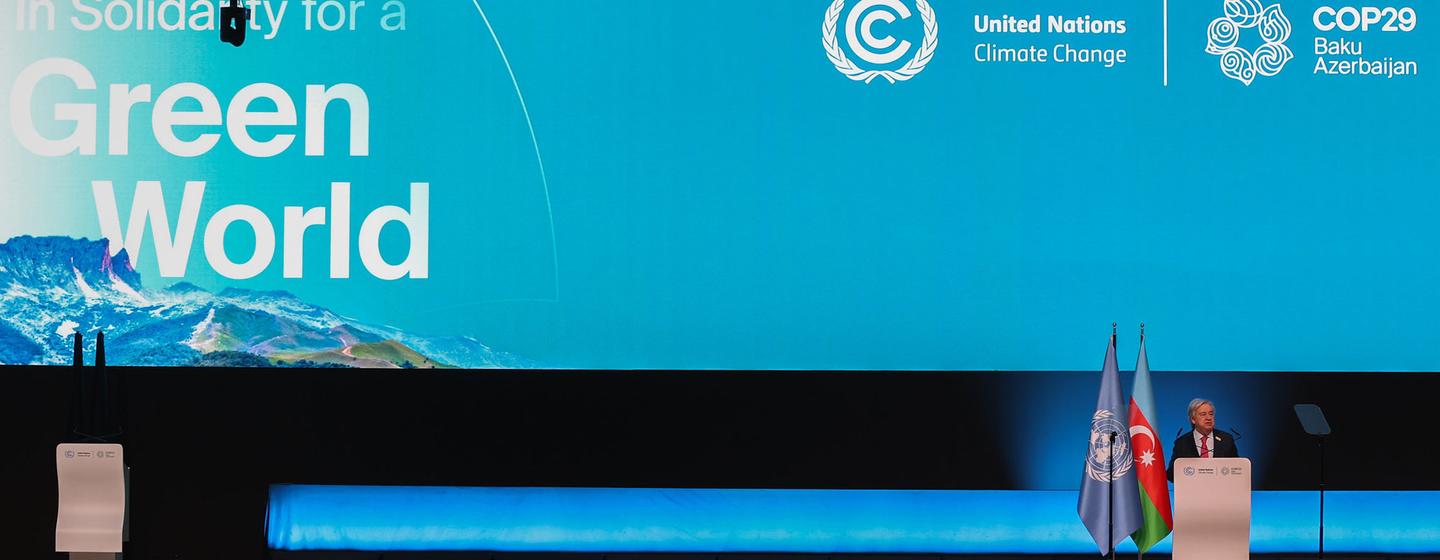
    UN Secretary-General António Guterres delivers remarks at the opening of the World Leaders Climate Action Summit at COP29 in Baku, Azerbaijan.
    UNFCCC/Kiara Worth   UN Secretary-General António Guterres delivers remarks at the opening of the World Leaders Climate Action Summit at COP29 in Baku, Azerbaijan.

    UN Secretary-General António Guterres said on Tuesday that leaders gathered in Baku for the COP29 Climate Action Summit must take immediate steps to cut emissions, safeguard people from climate chaos, and “tear down the walls to climate finance” in response to the “masterclass in climate destruction” that the world has witnessed in 2024.

    The sound you hear is the ticking clock. We are in the final countdown to limit global temperature rise to 1.5 degrees Celsius. And time is not on our side,” he warned.

    In his opening remarks to the World Leaders Climate Action Summit, the ministerial-level segment of COP29, which officially opened on Tuesday in the Azerbaijan capital of Baku, Mr. Guterres pointed to the proof, noting that 2024 is almost certain to be the hottest year ever recorded.

    Meanwhile, “no country is spared” from climate destruction ranging from hurricanes to boiling seas, drought ravaged crops, and more, all being supercharged by human-made climate change.

    In the global economy, supply chain shocks raise costs – everywhere: Decimated harvests push up global food prices; destroyed homes increase all insurance premiums.

    “This is a story of avoidable injustice: The rich cause the problem, the poor pay the highest price,” stated the UN chief, noting that Oxfam has found that the richest billionaires emit more carbon in an hour and a half than the average person does in a lifetime.

    “Unless emissions plummet and adaptation soars,” he emphasized that “every economy will face far greater fury.”

    ‘Reason to hope’

    But there is every reason to hope, the Secretary-General continued, pointing to the solid steps that had been taken last year at COP28 in the United Arab Emirates.

    In the UAE, all countries had agreed to move away from fossil fuels; to accelerate net zero energy systems, setting milestones to get there; to boost climate adaptation; and to align the next round of economy-wide national climate plans – or NDCs – with the 1.5-degree limit set at Paris.

    “It’s time to deliver,” he said stressing that a poll by the University of Oxford and the United Nations Development Programme (UNDP) had found that eighty percent of people around the world want more climate action. In addition, “scientists, activists, and young people are demanding change – they must be heard, not silenced.”

    The UN chief went on to note that last year – for the first time – the amount invested in grids and renewables overtook the amount spent on fossil fuels and today, almost everywhere, solar and wind are the cheapest source of new electricity.

    “Doubling down on fossil fuels is absurd. The clean energy revolution is here. No group, no business, and no government can stop it. But you can and must ensure it is fair, and fast enough to limit global temperature rise to 1.5 degrees Celsius” he explained.

    Three focus priorities

    With all this in mind, Guterres said, “developing countries must not leave Baku empty-handed” and urged world leaders at COP29 to focus on three areas for immediate action:

    1. Make emergency emissions reductions – cutting emissions by nine per cent every year towards 43 per cent of 2019 levels by 2030. This is the clearest pat to limiting global temperature rise to 1.5 degrees Celsius.
    2. Do more to protect people from the ravages of the climate crisis. The gap between adaptation needs and finance could reach up to $359 billion a year by 2030. The missing dollars are not abstractions on a balance sheet: they are lives taken, harvests lost, and development denied.
    3. Tear down the walls to climate finance by agreeing a new finance goal that contains a significant increase in concessional public finance; a clear indication of how public finance will mobilise the trillions of dollars developing countries need; taps innovative sources; sets out a framework for greater accessibility, transparency, and accountability; and boosts lending capacity for bigger and bolder multilateral development banks.
    ‘Pay up or pay the price’

    “On climate finance, the world must pay up, or humanity will pay the price,” emphasized the UN chief telling world leaders that “you and your governments must be guided by a clear truth: Climate finance is not charity, it’s an investment; climate action is not optional, it’s imperative.”

    ‘Strong standards’ agreed for centralised carbon market

    There was progress late on Monday at COP29 when parties adopted strong new standards for a centralised carbon market under the auspices of the UN, a mechanism highlighted just last week by UN Trade and Development body UNCTAD.

    UN Climate Change Executive Secretary Simon Stiell said the agreement was “a good start” following 10 years of negotiations.

    “When operational, these carbon markets will help countries implement their climate plans faster and cheaper, driving down emissions,” he said, adding that “we are a long way from halving emissions this decade, but wins on carbon markets here at COP29 will help us get back in that race.”

    The UNFCCC chief said it was essential to ensure that developing countries benefit from the new financial flows unlocked through the UN carbon market, where credits will be bought and sold to boost development.

    Climate finance is global inflation insurance’

    In his remarks to the leaders’ summit, UN climate chief Simon Stiell echoed many of the same themes, warning that the climate crisis is fast becoming an economy-killer.

    “Climate impacts are carving up to 5 per cent off GDP in many countries,” underscoring that the climate crisis is a cost-of-living crisis because climate-driven disasters are driving up costs for households and businesses.

    “Worsening climate impacts will put inflation on steroids unless every country can take bolder climate action,” said Mr. Stiell, who is the Executive Secretary of the UN Framework Convention on Climate Change (UNFCCC), which convenes the annual COP meetings.

    He urged the leaders to learn the lessons from the pandemic – when billions suffered because collective action wasn’t taken fast enough when supply chains were smashed.

    “Let’s not make that mistake again. Climate finance is global inflation insurance. Rampant climate costs should be public enemy number one,” he stated.

    He went on to stress that bolder climate action can drive economic opportunity and abundance everywhere. Cheap, clean energy can be the bedrock many economies. It means more jobs, more growth, less pollution choking cities, healthier citizens and stronger businesses.

    “Billions of people simply cannot afford for their government to leave COP29 without a global climate finance goal,” Stiell said told leaders to make it clear that they expected a strong set of outcomes in Baku.

    “Tell your negotiators – skip the posturing – and move directly to finding common ground. Bring those positions together.”

  • South Sudan: Postponing long-awaited elections ‘a regrettable development’

    South Sudan: Postponing long-awaited elections ‘a regrettable development’

    The decision to extend the transition period in South Sudan once again and postpone long-awaited elections cannot be “business as usual”, the UN Special Representative for the country told the Security Council on Thursday. 

    Nicholas Haysom updated ambassadors on developments in the world’s youngest country, which was due to hold its first-ever general elections next month.

    Since his last briefing in August, the transitional period was extended until February 2027, pushing back the timetable for the vote to December 2026.

    “This was inevitable but a regrettable development given the deep frustration and fatigue felt by the South Sudanese people at the apparent political paralysis and inaction of their leaders to implement the peace agreement and deliver the long awaited democratic transition,” he said.

    Steps towards peace 

    South Sudan gained independence in 2011 but two years later, fighting broke out between forces loyal to President Salva Kiir and his rival, Vice-President Riek Machar, which left killed hundreds of thousands dead. The 2018 peace deal, known as the Revitalized Agreement, ended the war.

    In September, the parties announced that the elections would be postponed to December 2026, and the transition period agreed under the accord would be extended by another two years to February 2027.

    Appeal for compromise 

    In the interim, Haysom, who also heads the UN Mission in South Sudan (UNMISS), has been holding intensive discussions with political leaders, civil society, faith-based representatives, youth leaders, women’s coalitions, and international partners.

    “This has left me in no doubt that, as the Secretary-General has stated, that the only way forward is for South Sudan’s leaders to urgently find the compromises, modes of implementation and take decisive steps required to achieve a critical mass of the key benchmarks set out in the Revitalised Peace Agreement,” he said.

    He noted, however, that since the latest extension, implementation of the accord and a 2022 roadmap “has yet again been relegated to the back burner while political interests play out at the national level.”

    Furthermore, a Kenya-led dialogue process aimed at getting non-signatory opposition groups to join the peace agreement also appears to have stalled, though apparently will resume.

    The clock is ticking 

    “UNMISS has been clear. The clock on South Sudan’s fourth extension has started ticking. It doesn’t reset in February next year when the extended transition begins, it begins now. Otherwise, we could find ourselves in the same predicament in December 2026,” he warned.

    “This cannot be business as usual for the parties to the peace agreement, the political elite, the guarantors of the peace agreement, or the international community. We must take this opportunity to make this extension the last and deliver the peace and democracy that the people of South Sudan deserve.”

    The UN Mission has identified six achievable benchmarks which the parties can address immediately. Issues covered include deployment of the Necessary Unified Forces (NUF), civic education, preparatory work for voter registration, and developing a code of conduct between political parties, civil society and the media.

    The envoy recently met with President Kiir to discuss the urgent need for progress, and he also urged the international community to “rally around these immediate tasks.”

    UN support for elections 

    He said UNMISS is moving ahead with assistance to the National Elections Commission while also “driving initiatives to enhance the civic and political space”. It is also collaborating with 200 civil society organizations across the country to build monitoring alliances and boost civic education and participation in elections observation.

    “I need to underscore that our efforts and the current momentum is a product of the strong desire of the South Sudanese people to contribute to their own nation-building project,” he added.

    “After all, these are not ‘UN elections’ or ‘foreign elections’ – these are South Sudan’s first sovereign, post-independence elections.”

    Violence, flooding and humanitarian needs

    Turning to other matters, Haysom reported on the spike violence at a local level that is emerging as the rainy season ends. The number of civilian casualties during separate incidents in three states – Upper Nile, Central Equatoria and Warrap – is alarming, he said.

    Ongoing violence and flooding also continue to cause immense harm and disrupt opportunities for recovery and durable solutions in South Sudan, he added. Although aid partners have reached nearly four million people this year, obstacles persist including limited resources, and the $1.8 billion 2024 humanitarian plan is roughly 57 per cent funded.

    Meanwhile, the conflict in neighbouring Sudan continues to exacerbate such challenges.

    South Sudan has received over 830,000 refugees and returnees since the war erupted in April 2023 – equivalent to over seven per cent of its population. This comes amid rising hunger and a cholera outbreak that began at the northern border with cases arriving from Sudan.

  • Adapt or perish: UN calls for urgent action at COP29 climate summit

    Adapt or perish: UN calls for urgent action at COP29 climate summit

    Come hell or high water, nations must urgently scale up climate adaptation efforts, the UN Environment Programme (UNEP) warned Thursday, starting with a commitment to boost adaptation financing at the upcoming COP29 summit.

    In its Adaptation Gap Report 2024: Come Hell and High Water, UNEP warned that vulnerable communities are already bearing the brunt of climate change impacts through extreme weather and disasters.

    “Climate change is already devastating communities across the world, particularly the most poor and vulnerable. Raging storms are flattening homes, wildfires are wiping out forests, and land degradation and drought are degrading landscapes,” said Inger Andersen, Executive Director of UNEP.

    “People, their livelihoods and the nature upon which they depend are in real danger from the consequences of climate change. Without action, this is a preview of what our future holds and why there simply is no excuse for the world not to get serious about adaptation, now.”

    UNEP stressed that without immediate action, the world will likely exceed 1.5°C of warming soon and could even reach a catastrophic rise of 2.6-3.1°C above pre-industrial levels by the end of the century.

    Kicking off on 11 November in Baku, Azerbaijan, the 29th session of the Conference of the Parties to the UN Framework Convention on Climate Change (COP29) will see delegations from all corners of the world joining top UN officials, civil society and other key sectors to measure progress and negotiate the best ways to address climate change.

    Climate crisis is here

    “The climate crisis is here,” declared UN Secretary-General António Guterres, emphasizing the urgency of immediate action as the world faces an onslaught of extreme-weather events.

    He highlighted the “human tragedy” behind these disasters, which are “hammering health, widening inequalities, harming sustainable development and rocking the foundations of peace”.

    In a video message at the report’s launch, Mr. Guterres called for action in key areas, including integrating adaptation into national climate plans, implementing effective early warning systems and rapidly scaling up finances for adaptation.

    Additionally, countries must “strike at the heart of the crisis: greenhouse gases,” he said.

    The climate crisis is here. We can’t postpone protection. We must adapt – now.

    New common goal

    The report highlighted the widening gap between the funds needed for adaptation – the adjustments needed to slow the rate of global warming – and current levels of public investment.

    While international adaptation finance for developing countries rose to $28 billion in 2022, it is still far below what is required, with estimates suggesting that between $187 and $359 billion annually will be required for overcoming the adaptation finance gap.

    Against this backdrop, UNEP called for a “new collective quantified goal” for climate finance at COP29 and including stronger adaptation components in their next round of climate pledges due early next year ahead of COP30 in Belém, Brazil.

    Shift focus

    Alongside, it also urged countries to make substantial commitments at COP29 and beyond, including on increased financing as well as shifting the nature of adaptation funding from short-term project-based initiatives, to strategic, anticipatory investments.

    This would help address long-term resilience, especially for vulnerable regions most affected by climate change.

    UNEP suggested “enabling factors” that could unlock both public and private sector funding, such as the creation of creation of funds and financing facilities, climate fiscal planning and climate budget tagging, and adaptation investment planning.

    Support innovations
    The report also highlighted the role of multilateral development banks in scaling up financing and supporting innovative financial solutions.
    For the private sector, UNEP advocated for risk-reducing mechanisms, to attract more investment in adaptation.
    Finance alone is not sufficient, it added, calling on nations to strengthen capacity-building and technology transfers to enhance adaptation efforts in key areas of water, food and agriculture.
  • Radisson Hotel Group appoints Sandra Kneubuhler as MD for Sub Sahara Africa

    Radisson Hotel Group appoints Sandra Kneubuhler as MD for Sub Sahara Africa

    Sandra Kneubuhler has been announced as Radisson Hotel Group Managing Director for Sub Sahara Africa.

    Based in Johannesburg, Sandra will now oversees the Group’s operations across English-speaking African countries, continuing to build on its strong presence and success across the continent.

    Since joining Radisson Hotel Group in February 2019, Sandra has demonstrated exceptional leadership and a commitment to excellence.

    Previously serving as Country Director of Sales and District Director for South Africa, Sandra played an instrumental role in developing and leading the company’s Cluster Sales Team in South Africa, further establishing Radisson Hotel Group as a leader in the region.

    Under her guidance, Radisson saw impressive growth, including an 11pc increase in corporate revenue during her first year.

    Sandra’s strategic focus and ability to cultivate high-performing teams have positioned her as a driving force in the Group’s success in South Africa.

    In addition, she led the commercial and operational teams in South Africa with a focus on delivering long-term, strategic value for all stakeholders. Her holistic approach resulted in strong performances across all key performance indicators such as market share, profitability, guest satisfaction, and employee engagement.

    In a statement, Sandra’s appointment will now lead operations across Radisson Hotel Group’s English-speaking markets in Africa.

    “This appointment reflects the Group’s commitment to investing in regional talent and strengthening its footprint across Africa, one of its key growth markets.” The statement read.

    Sandra’s extensive experience in the African hospitality sector and her expertise in strategic revenue growth, team development, and operational excellence uniquely equip her to oversee the Group’s operations across this dynamic region.

    Commenting on Sandra’s appointment, Tim Cordon, Chief Operating Officer, Middle East, Africa and South East Asia Pacific at Radisson Hotel Group said, “We are thrilled to have Sandra step into this vital role as Managing Director for Africa. Her leadership and achievements within South Africa have set a new benchmark, and we are confident that she will continue to bring success to our wider operations in Africa. Sandra’s extensive knowledge of the African market and her dedication to operational excellence make her the ideal candidate to drive excellence across the continent.”

    Sandra’s career in hospitality spans over two decades, with extensive experience at Hyatt Hotels Corporation prior to joining Radisson Hotel Group.

    Her roles at Hyatt included Global Sales Director for Africa, where she successfully launched new global sales offices, generating a 30pc revenue increase within two years. She has also held leadership positions in Qatar and South Africa, including Acting General Manager and Director of Sales and Marketing, where her financial acumen and strategic insight led to significant profitability improvements.

    Sandra’s journey with Radisson reflects her commitment to exceptional service and growth, both for her teams and the brand. “I am honored to take on this new role and to lead our talented teams across Africa,” said Sandra Kneubuhler. “Radisson Hotel Group’s dedication to innovation and excellence resonates deeply with me, and I look forward to driving continued growth and success across our markets in Africa.”

    Sandra’s promotion to Managing Director for Africa underscores Radisson Hotel Group’s commitment to empowering experienced leaders who understand the unique dynamics of local markets and are passionate about delivering exceptional guest experiences.

    Sandra Kneubuhler Photo by Xavier