Tag: Radio

  • Social media overtakes traditional media as Kenyans’ top news source

    Social media overtakes traditional media as Kenyans’ top news source

    Digital platforms have overtaken traditional broadcasting as the primary source of news for Kenyans.

    According to the latest 2025 State of Media Report by the Media Council of Kenya, the gap between digital and legacy media continues to widen from 2024, with social media leading as the primary source of news at 39 per cent.

    Television follows at 31 per cent, while radio has seen a significant decline from 26 per cent in 2024 to 21 per cent in 2025. Family, friends and colleagues account for 3 per cent, online news websites 2 per cent, and print newspaper readership trails at just 1 per cent.

    Notably, national television viewership continues to experience a sharp decline, with 43 per cent of the population moving away from watching TV daily, opting instead to access video content on alternative platforms.

    The survey, which covered all 47 counties across Kenya’s eight regions, also highlights peak media consumption between 7pm and 10pm, with 73 per cent of respondents reporting heavy TV viewing during this period.

    “ Daytime fragmentation completely disappears at night. Prime time is the undisputed monolithic anchor of the Kenyan broadcast landscape”, the report reads.

    Radio daily listenership has also dropped from 57 per cent to 41 per cent, with a majority (55 per cent) preferring early morning hours between 6 am and 10 am.

    Additionally, the print audience has shrunk by 7 per cent to 13 per cent in 2025, with circulation concentrated in the Rift Valley and Nyanza regions.

    KBC ranks among the top five most-watched TV stations, with Citizen TV leading.

    Public Trust

    Despite these shifts in consumption, public trust in the media is showing signs of recovery, with a growing number of people viewing government coverage as increasingly fair

    KBC still retains its position as the most trusted media outlet, based on key indicators including content relevance and public interest, timeliness and delivery, credibility, experience, professionalism, quality of journalism, as well as editorial independence and integrity.

    However, the report highlights a critical literacy gap, noting that a majority of the population 63pc struggle to identify AI-generated content, which heightens fears regarding the spread of misinformation.

    Most used digital platforms

    WhatsApp and Facebook are the most widely used social media platforms, followed by TikTok, YouTube, Instagram and X.
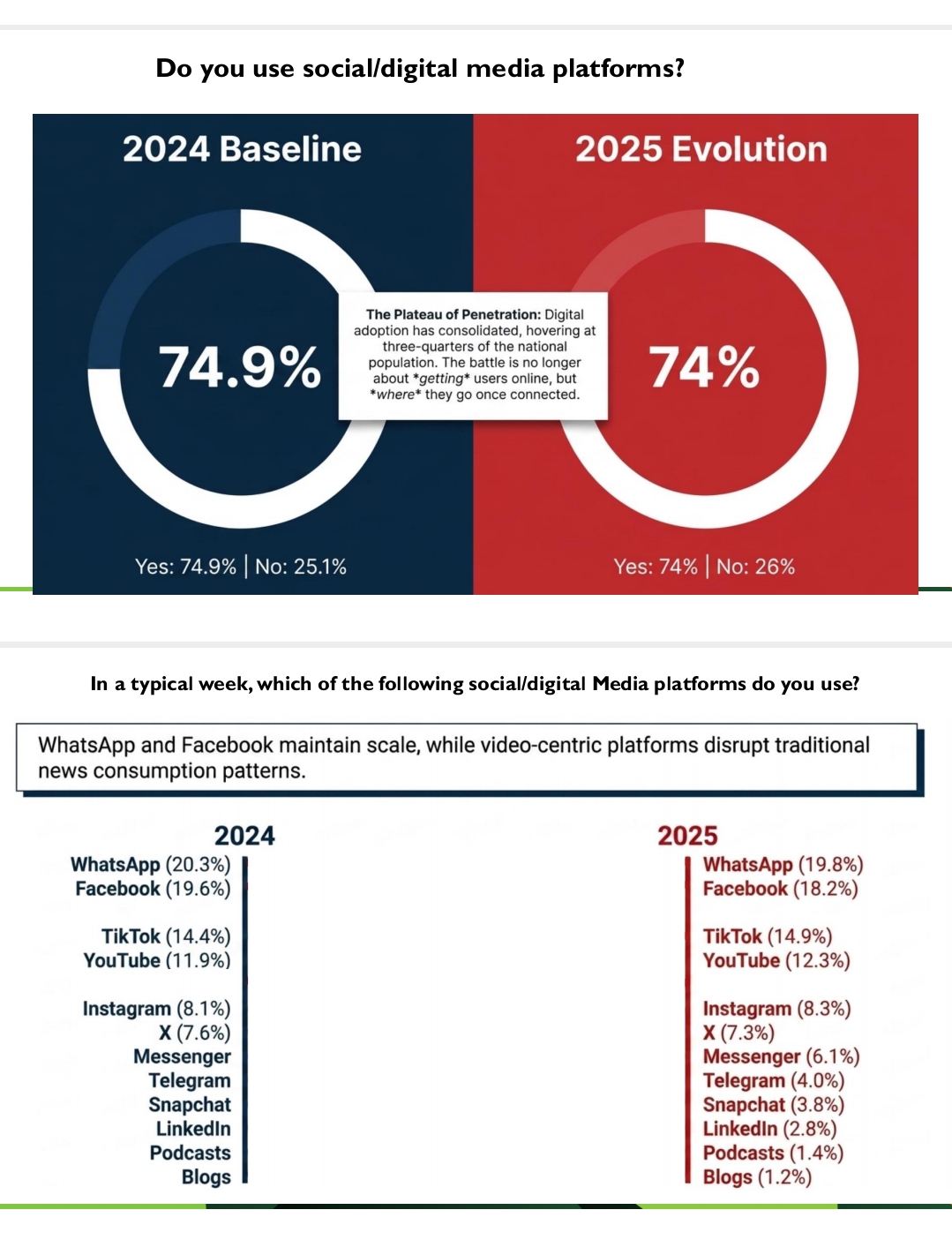
    Data was collected through Computer-Assisted Personal Interviewing (CAPI). The survey targeted Kenyan residents aged 15 years and above, with a sample size of 3,774 respondents.

    The report was released by MCK, which hosted the World Press Freedom Day 2026 commemoration at Srathmore University.



  • Kenya switches on first Digital Sound Broadcasting trial, signals new era for radio

    Kenya switches on first Digital Sound Broadcasting trial, signals new era for radio

    The Communications Authority of Kenya (CA) has facilitated the activation of Kenya’s first trial Digital Sound Broadcasting (DSB) for radio services in Nairobi, marking a major step towards the future of radio as the world celebrates World Radio Day 2026.

    In a statement, the Authority noted that it shall conduct monitoring and evaluation of the network over the 12-month trial deployment period to ensure adequate signal coverage, good quality of service, affordable receivers, and public education to drive voluntary uptake.

    “The DSB technology will initially complement, not replace, existing FM services.” the statement read.

    “No analogue switchoff date has been set, ensuring continuity for all listeners while digital platforms are rolled out in phases, beginning with the Mombasa–Nairobi–Kisumu corridor and major population centres,” it added.

    According to CA, sound broadcasting remains one of the country’s most important media platforms, reaching about 98pc of homes and supporting 300 licensed broadcast services.

    However, FM frequencies in VHF Band II (87.5–108.0 MHz) are saturated in major coverage areas, leaving little room for new broadcasters, increased interference, and relatively poor audio quality.

    In 2023, the Authority developed a framework for Digital Sound Broadcasting, primarily focusing on Digital Audio Broadcasting in VHF Band III (174–230 MHz) and on Digital Radio Mondiale in the HF band (30 MHz).

    The framework was subjected to stakeholder engagement, with input from broadcasters, signal distributors, equipment vendors, government agencies, and industry associations.

    Further, in 2025, the Authority granted Authorisation to two (2) licensees: Signet Signal Distributors Ltd and Mast Rental Services Ltd, to deploy Trial Networks for Digital Sound Broadcasting. In January 2026, Mast Rental became the first operator to deploy a DAB+ trial network and currently carries 14 radio programmes within the Nairobi coverage area.

    The activation of the Digital Sound Broadcasting Signal marks a key milestone for sound broadcasting in Kenya.

    Broadcasters and investors stand to gain from wider coverage, lower barriers to entry and new revenue opportunities.

    By separating content provision from signal distribution, broadcasters can focus on compelling content to serve the diverse needs of consumers.

    The ability to carry multiple services on a single channel is expected to lower transmission costs and create space for new entrants, including community broadcasters, by providing reserved capacity at nominal carriage costs.

    For consumers, digital radio will mean clearer sound, reduced harmful interference, and a wider choice of programming. Listeners will benefit from increased content diversity, including niche, regional and thematic services, as well as potential value-added data services such as programme and station information.

    Over time, through the framework, the Authority aims to substantially expand the number and variety of services, including digital-only stations serving diverse communities.

    With this deployment, Kenya joins a growing community of countries adopting or conducting digital radio trials as the next frontier in sound broadcasting and will work with regional bodies to support harmonised approaches that enhance interoperability and investment.

  • ” AI will not replace the human heart of radio” says KBC MD to mark World Radio Week

    ” AI will not replace the human heart of radio” says KBC MD to mark World Radio Week

    KBC MD emphasises the importance of humanity as KBC embraces new technologies such as AI


    On Wednesday, the spotlight turned to the future of radio at the Kenya Broadcasting Corporation on the third day of World Radio Week.

    The broadcast house has been celebrating the oldest form of broadcast since February 9 with a Sundowner event expected to close the festivities on Friday, February 13, the day recognised as World Radio Day by UNESCO and marked by all 11-member states.

    Attended by KBC’s Managing Director, Agnes Kalekye Nguna, KBC Radio convened a panel discussion themed “How is Artificial Intelligence Transforming Radio?”

    The conversation comes just as media houses globally deal with the rise of Artificial Intelligence and what it means for newsrooms and editorial functions.

    In her speech, Ms Nguna said that while the corporation was ready to embrace new technology, it would do so ethically.

    “At KBC, we answer not with fear but with clarity. AI will not replace the human heart of radio, it will amplify it,” she said, framing AI not as a threat, but as an enabler. “We see AI not as a disruptor but as the next wave transmitter, a tool to fulfil our oldest promises in new ways.”

    The event, hosted at Broadcasting House on Harry Thuku road is aimed at recognising and honouring KBC’s broadcast history, which started in 1928 as the East African Broadcasting Corporation (EABC) when Kenya was a British colony.

    Since then, KBC has grown into a multimedia broadcast service providing news and programming in over 20 languages.

    While honouring KBC radio history, Ms Nguna emphasised that AI is less about technology replacing people and more about technology serving people.

    “No matter how the world changes, our mission does not, to ensure that no Kenyan is left in the dark and every Kenyan voice can find the light,” she said.

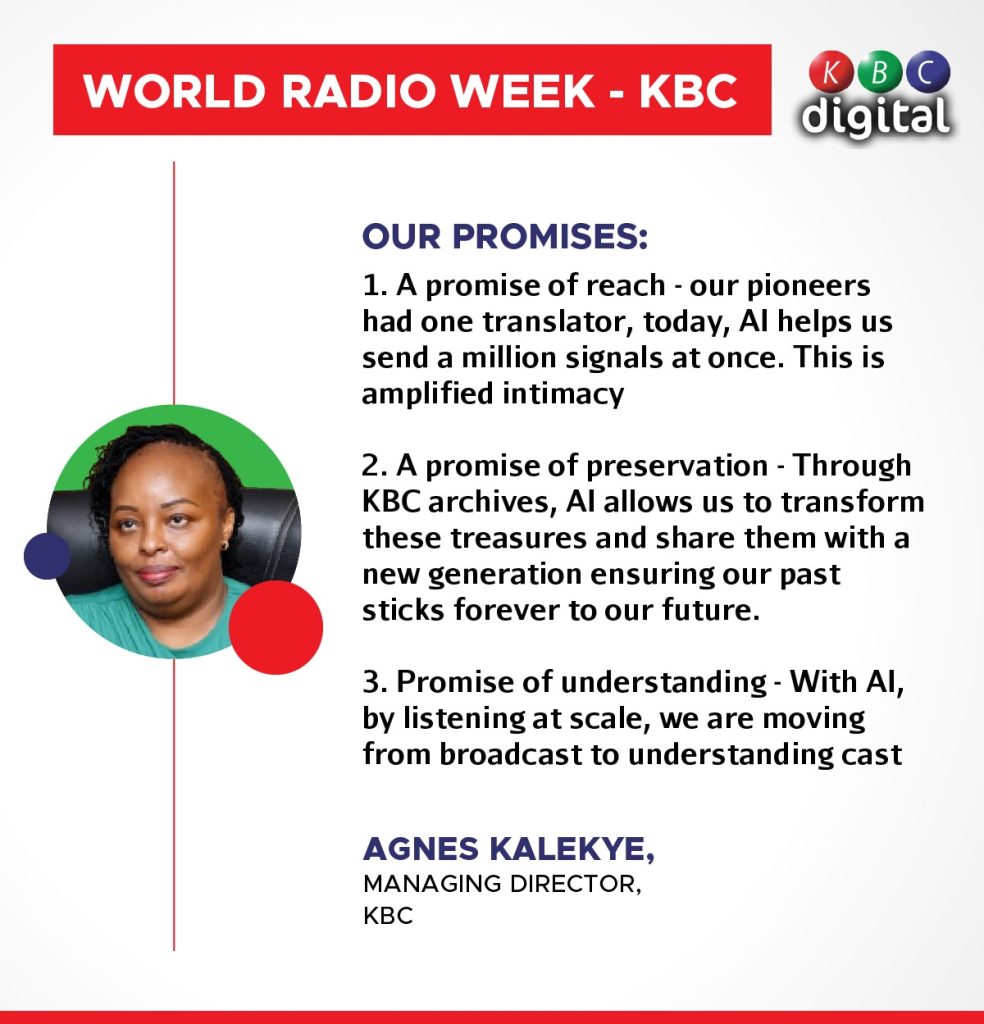
    She also reiterated three key promises that would be enhanced by the ethical use of AI: reach, preservation and understanding.

    However, she emphasised that the human element would remain at the heart of broadcasting at KBC.

    “As pioneers and a public broadcaster, we navigate this new frontier (AI) with a guardian principle, ‘Human Trust First,” she said.

    Adding, “In our studios, no algorithm will ever sit in our editorial chair. No synthetic voice will ever deliver news in a moment of national crisis. That’s why we have our journalists, that sacred duty remains with people, our journalists, our producers and our editors.”

    Follow the full panel conversation about AI below.

    The event also carried a celebratory tone. Staff were encouraged by the radio team to swap formal wear for sports jerseys and jeans as entertainment on Wednesday, led by musician Mike Rua, before the Gor Mahia choir stormed in with spirited chants that drew staff into energetic participation.