Tag: Kala-azar

  • Wajir steps up Kala-azar fight as recoveries surpass new cases

    Wajir steps up Kala-azar fight as recoveries surpass new cases

    Wajir County has recorded steady progress in its fight against the Kala-azar outbreak, with more patients being discharged from local health facilities than those being admitted, Governor Ahmed Abdullahi has said.

    Speaking during a health intervention event held on Thursday in Wajir Town, Governor Abdullahi attributed the gains to strengthened collaboration between county and national health agencies, which has led to improved case management and rapid response.

    “Today, we are seeing signs of hope. The number of patients being treated and discharged has surpassed new admissions, a strong indication that our efforts are bearing fruit,” said Governor Abdullahi.

    During the event, the county received a blood testing machine from the Kenya Blood and Transplant Services (KBTS) to enhance diagnostic accuracy for Kala-azar patients.

    The equipment is expected to assist doctors in identifying precise treatment protocols, thereby reducing delays and complications.

    The Governor also highlighted the establishment of a satellite blood bank in Wajir, terming it a game-changer in the county’s public health response.

    “Access to blood and timely testing has been one of our greatest challenges. With this new facility and equipment, our health teams are better equipped to manage Kala-azar,” he noted.

    Since the onset of the outbreak in September last year, over 600 people have been infected, and the disease has so far claimed 29 lives. The most affected areas include Eldas and Wajir West sub-counties, where a majority of the 106 active cases are currently receiving treatment.

    The Ministry of Health has deployed three mobile laboratories to patrol the worst-hit areas. These units, fitted with modern diagnostic tools, are helping to reach patients who would otherwise struggle to access care due to the vastness and poor infrastructure in the region.

    Mamo Umoro, Head of Blood Services at KBTS, handed over the equipment during the event, reaffirming the government’s commitment to strengthening regional health systems.

    In addition to clinical interventions, the Wajir County Health Department has launched a 10-day vector control campaign targeting more than 6,000 households.

    The campaign involves fumigation and spraying exercises aimed at curbing the spread of sandflies, which transmit the disease.

    Kala-azar, also known as visceral leishmaniosis, primarily affects children under five and the elderly. It presents with symptoms such as prolonged fever, weight loss, and loss of appetite. Experts have linked the spike in infections to recent flooding, which has created ideal breeding conditions for sandflies.

    The disease is classified as a neglected tropical illness and is endemic in Kenya’s arid and semi-arid regions, including Wajir, Turkana, Garissa, and Baringo.

    Governor Abdullahi reiterated the county’s commitment to eliminating the disease, noting that while challenges remain, the current interventions are a strong step toward defeating the outbreak and safeguarding public health.

  • Wajir Kala-azar death toll hits 25

    Wajir Kala-azar death toll hits 25

    The death toll from Kala-azar, a disease that has ravaged Wajir county since September last year, has risen to 25.

    A total of 600 infections have been reported, with children being the most affected, even as the National Government intensifies efforts to curb the further spread of the disease.

    Reports indicate that 106 people are currently receiving treatment across various healthcare facilities in Wajir County, with the County’s Level 4 Hospital being the hardest hit.

    Due to the overwhelming number of cases, most medical operations have been moved to other facilities.

    Speaking on Friday, Public Health and Professional Standards PS Mary Muthoni highlighted that the National Government is releasing funds through the National Treasury to support the fight against Kala-azar.

    This funding comes at a time when the Wajir County Government has acknowledged being overwhelmed by the increasing number of cases.

    As part of the response, mobile laboratories have been deployed to Wajir to facilitate early diagnosis and intervention. PS Muthoni emphasized the importance of these mobile units, especially since many patients had previously only sought treatment when their condition had worsened significantly.

    The mobile labs are expected to enhance early detection, which could prevent further complications and deaths.

    Additionally, County Executive Committee Member for Health, Habiba Ali, noted last week that the healthcare system is facing serious challenges, including a shortage of wards to accommodate the rising number of patients.

    PS Muthoni reiterated that the government is committed to controlling the outbreak in Wajir to prevent its spread to other regions, particularly those in the Rift Valley.

    What is visceral leishmaniasis?

    Kala-azar is a neglected tropical disease common in Baringo, Isiolo, Marsabit, Turkana, Wajir and West Pokot counties in Kenya.

    Visceral leishmaniasis, the most severe form of leishmaniasis, also known as kala-azar, is a life-threatening disease caused by Leishmania parasites, which are transmitted by female sandflies.

    Visceral leishmaniasis causes fever, weight loss, spleen and liver enlargement, and, if not treated, death.

  • Researchers discover new effective treatment for PKDL patients

    Researchers discover new effective treatment for PKDL patients

    A clinical trial conducted in Eastern Africa has discovered a shorter, safer, and more effective treatment for post-kala-azar dermal leishmaniasis (PKDL), a stigmatizing skin disease.

    According to researchers, the new treatment which reduces both hospitalization days by over 50pc and the safety risks associated with long antimonial therapy (injectables) is child-friendly.

    PKDL can develop after someone has been treated for visceral leishmaniasis (VL), also known as kala-azar or black fever which is a life-threatening disease.

    Most common in Eastern Africa and South Asia, the condition starts with a rash around the mouth and can spread to the arms and upper body, and eventually to the entire body, depending on severity.

    In Sudan, nearly 20pc of VL patients will develop PKDL within six months post-treatment, the highest rate worldwide.

    The trial was conducted in Sudan by the non-profit medical research organization Drugs for Neglected Diseases Initiative (DNDi) and the Institute of Endemic Diseases at the University of Khartoum, whose results were published in PLOS Neglected Tropical Diseases.

    Phase II trial

    The Phase II trial, testing two treatment arms, began in 2018 in Doka, Sudan, with nearly 90% of participants being 12 years or younger. Arm 1 received a combination of oral miltefosine and injectable paromomycin (MF+PM) for 42 days.

    However, they only needed to stay in the hospital for 14 days during the PM treatment while starting the oral miltefosine simultaneously with the injectable.

    After leaving the hospital, they continued with the oral treatment at home. At the 12-month follow-up visit, 98% of the participants had achieved a complete cure, including those with moderate and mild PKDL.

    Arm 2 received a regimen of miltefosine and injectable liposomal amphotericin B (MF+LAmB) for 28 days, staying in the hospital for only 7 days until the LAmB treatment ended and continuing the oral treatment at home after hospital discharge.

    “This group had an 80% cure rate, with MF+LAmB proving to be a good treatment alternative,” DNDi said in a statement.

    Currently, the standard treatment for PKDL is sodium stibogluconate (SSG), an injectable drug given for a lengthy 60-90 days that carries life-threatening toxicity when used for an extended period and requires hospital admission as it must be administered under close supervision.

    “Treatment for PKDL in Sudan is currently only recommended for patients with severe or persistent disease, mainly because SSG is prolonged, toxic, and expensive,”,  said Professor Ahmed Musa, Senior Investigator for Leishmaniasis from the Institute of Endemic Diseases, University of Khartoum.

    “But we have now found a safer and better treatment option where patients only need to be admitted to hospital for 14 days and then complete the oral treatment at home. This makes it more patient-friendly, which is important since most people affected by this terrible disease are children” he added.

    World Health Organization insists detecting and treating PKDL is crucial for eliminating VL as a public health problem.

    People treated for PKDL can help prevent new cases since the sandflies that transmit VL get infected when they feed on PKDL lesions.

    One of the targets in the recently launched VL elimination framework for Eastern Africa is to ensure that all PKDL cases are detected, reported, and managed by 2030. The results of the clinical trial led in Sudan therefore support VL elimination efforts in the region.

    ‘For a long time, patients with PKDL in Eastern Africa have been left behind by medical research because the disease is not considered life-threatening. Many have had to endure not only stigma but expensive, lengthy treatments exposing them to toxicity,’ said Dr Fabiana Alves, Director of the Leishmaniasis Cluster at DNDi. ‘But this new, shorter, and better treatment will improve the lives of these neglected patients and also help reduce VL transmission on our road to elimination.’

    The results of this study will provide evidence for policymakers to guide recommendations for new and more patient-friendly treatments, allowing people with PKDL to benefit from these findings.

    Financial support for this study was provided by the World Health Organization – Special Programme for Research and Training in Tropical Diseases (WHO-TDR); the French Development Agency (AFD); Médecins Sans Frontières; the UK International Development; and the Swiss Agency for Development and Cooperation (SDC).

  • Clinical trial for oral treatment against Kala-azar enters phase II

    Clinical trial for oral treatment against Kala-azar enters phase II

    A new drug to treat visceral leishmaniasis commonly known as Kala-azar has entered Phase II clinical development.

    The trial of the innovative, safer, simpler, patient-friendly oral medicine is being conducted in Ethiopia by the research organization Drugs for Neglected Diseases Initiative (DNDi) and its partners.

    Also known as kala-azar, visceral leishmaniasis is the world’s deadliest parasitic killer after malaria. It causes fever, weight loss, spleen and liver enlargement, and, if not treated, death. It is transmitted by the bite of infected sandflies and is endemic in 80 countries, mainly in Eastern Africa, South Asia, and Latin America.

    One billion people are at risk globally and Eastern Africa currently has the highest number of cases. As for other vector-borne diseases, climate change is changing the epidemiology of leishmaniasis and could lead to its expansion to new areas.

    An estimated 50,000 to 90,000 new cases occur worldwide annually, and half are children under 15.

    In Africa, the current treatment for visceral leishmaniasis includes painful injections given at the hospital daily for 17 days, a treatment that may also present rare but life-threatening side effects, including to the heart, liver, and pancreas.

    In contrast, the new molecule under study in Ethiopia, called LXE408, is administered in the form of oral pills and is expected to be safer than the current treatment.

    “This is very significant that Ethiopia, an endemic country, is conducting a Phase II clinical trial on a new chemical entity — a novel molecule with the potential to safely and effectively treat visceral leishmaniasis,” said Dr Eleni Ayele, co-principal Investigator of the clinical trial at the Leishmaniasis Research and Treatment Center (LRTC), University of Gondar, Ethiopia.

    “Current treatment options in Ethiopia have severe limitations: they are potentially toxic, necessitate injections and cold-chain supplies, and require our patients to travel to faraway hospitals and be hospitalized for long periods” he noted.

    “Our hope is that this new oral treatment will be efficacious and less toxic and can be given to patients at the primary healthcare level, close to their homes. This would help them access treatment earlier, which could significantly decrease morbidity and transmission. If the trial is successful, it could go a long way toward enabling the sustainable elimination of this terrible disease” said Dr Eleni Ayele.

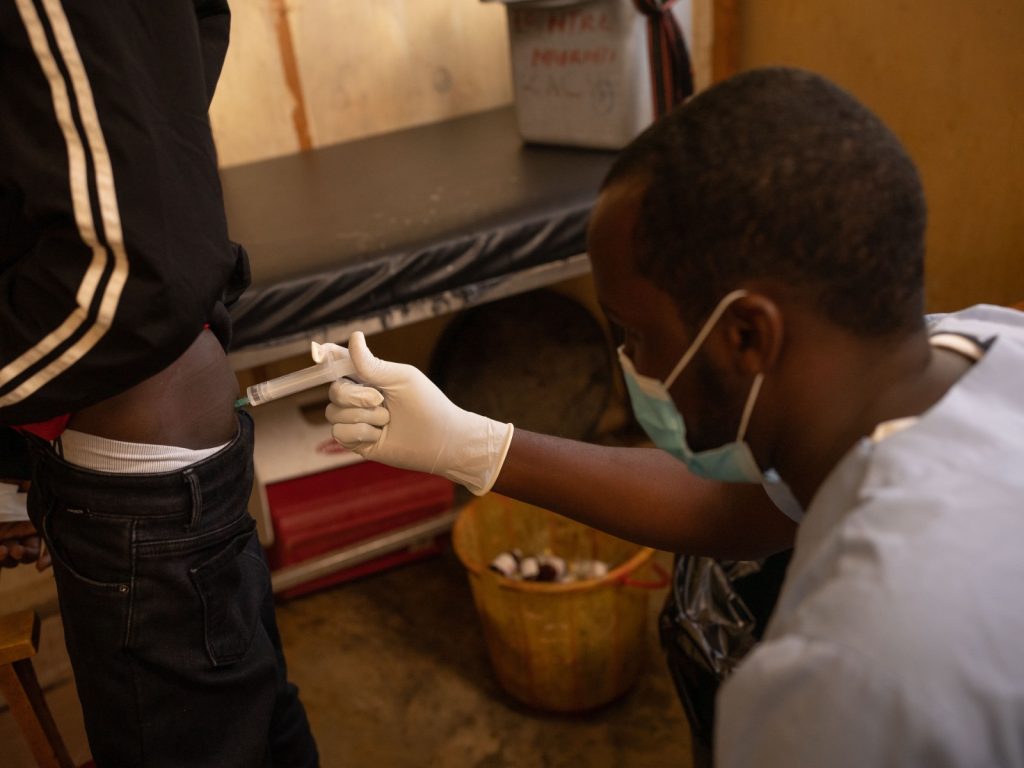
    Nurse Ali Abdi administers treatment to a kala-azar patient at the Kacheliba Sub County Hospital in Kenya

    Phase 11 trial

    The molecule is tested alongside the standard of care in Ethiopia (a combination of daily injections of sodium stibogluconate and paromomycin administered for 17 days); 52 adults from 18 to 44 years will join the study.

    A similar Phase II trial to test LXE408 alongside the standard of care is also being conducted in India. Patients in Eastern Africa and South Asia may respond differently to treatments, which is one of the reasons why finding new medicines is particularly difficult and why studies on both continents are necessary.

    “We are moving towards a new generation of treatments for leishmaniasis. Finding new treatments is key if we want to sustainably eliminate visceral leishmaniasis in all parts of the world, including in African countries where the burden remains high. We need medical innovation,’ said Dr Fabiana Alves, Director of Leishmaniasis programme at DNDi.

    “We hope this new clinical trial will contribute to deliver better, patient-friendly, effective medicines that are accessible to everyone, with no exception” he stated.

    LXE408 was initially discovered by Novartis. DNDi and Novartis initiated a collaboration and licence agreement in early 2020 to jointly develop LXE408.

    Novartis was responsible for completing pre-clinical development and a Phase I study, is in charge of chemical manufacturing and control, will drive regulatory submissions, and – if trial results are positive and if the new treatment is approved for market use – has committed to distributing the drug on an affordable basis worldwide, with a focus on maximizing access in endemic countries.

    Discovery of LXE408 and preparatory work to advance LXE408 to clinical evaluation in kala-azar patients were financially supported by Wellcome.

    The clinical trial in Ethiopia is financially supported by the European and Developing Countries Clinical Trials Partnership (EDCTP) as part of the VL-INNO project, bringing together a wide range of partners.

    Eastern African countries are currently laying out plans to eliminate visceral leishmaniasis sustainably, a disease that can potentially resurgence due to climate and environmental changes.

    Achieving and sustaining elimination also hinges on the development of better treatments. If proven to be effective, LXE408 could, therefore, contribute significantly to these elimination goals.

    ‘Visceral leishmaniasis is a severe and potentially fatal disease that primarily impacts vulnerable groups such as children. We urgently need to eliminate it, which would greatly help lift affected communities out of poverty, said Dr Saurabh Jain, Scientist and Focal Point for Visceral Leishmaniasis at the World Health Organization (WHO).

    One of the targets in the roadmap for neglected tropical diseases is the elimination of visceral leishmaniasis as a public health problem by 2030.