Tag: IFC

  • IFC, StanChart partner on supply chain finance to support African businesses

    IFC, StanChart partner on supply chain finance to support African businesses

    The World Bank Group, through its private sector arm the International Finance Corporation (IFC) and Standard Chartered has announced a new risk sharing facility aimed at strengthening supply chains and boosting business growth across Africa.

    In a statement, this partnership will introduce supply chain finance solutions in eight markets Côte d’Ivoire, Egypt, Ghana, Kenya, Nigeria, South Africa, Tanzania, and Zambia supporting companies in key sectors such as agriculture, healthcare, and manufacturing.

    By doing so, the facility will help ensure their suppliers get faster payments, freeing up the working capital they need to improve production, pay wages, and hire.

    The risk-sharing facility will cover up to $300 million in supply chain and trade finance assets originated by Standard Chartered in Africa.

    It comprises a range of underlying supply chain financing instruments  such as payables finance, receivables discounting, and pre-shipment finance programs which can help smaller businesses get paid earlier, reduce the cost of working capital, and invest in growth.

    This strengthens linkages between buyers and suppliers, improves delivery reliability, and ultimately supports job creation throughout the value chain.

    IFC will provide guarantees for up to $150 million from its own account, with $100 million committed as the first tranche under the program, to support transactions in both U.S. dollars and selected local currencies.

    Over the next three years, the partnership is projected to enable about $1.9 billion in supply chain finance transactions, providing access to finance for businesses across Africa.

    It aims to support more than 500 suppliers, including small and medium enterprises (SMEs), in both domestic and global value chains, with the potential to indirectly benefit over 1 million farmers.

    “Supply chain finance is among the fastest ways to narrow the growing finance gap that businesses, particularly small and medium enterprises, are facing in emerging economies,” said Mohamed Gouled, IFC’s Vice President, Products & Clients.

    Adding that: “By partnering with Standard Chartered to support companies at the center of strategic value chains, we can unlock much-needed working capital at scale for businesses across Africa, including smaller firms and farmers, making supply chains more competitive and boosting job creation.”

    Dalu Ajene, Chief Executive and Head of Coverage, Standard Chartered Africa, said: “This $300 million facility with IFC underscores our shared commitment to strengthening Africa’s supply chains and enabling sustainable business growth. As a super-connector bank with deep expertise across key trade corridors linking Africa to Europe, Asia, the Middle East and the Americas, we are uniquely positioned to channel capital and innovation into the real economy. By expanding access to supply chain finance, we are helping African companies unlock liquidity, manage risk, and invest with confidence. Our collaboration unites Standard Chartered’s cross-border expertise with IFC’s development mandate to empower businesses from major corporations to smaller local suppliers to engage more actively in regional and global trade, fostering job creation and promoting inclusive growth.”

    Global demand for supply chain finance has surged in 2025, the estimated volume reached about $2.7 trillion, showing an 8% increase year-on-year.

    Yet supply chain finance has not scaled at the same pace in emerging markets, especially in lower income and fragile contexts, largely because commercial banks tend to focus on developed markets.

    This facility aims to mitigate risk in portfolios of short-term trade and supply chain assets, expanding access in markets where capital is scarce.

    This is IFC’s first project under the Global Supply Chain Finance Program and the Africa Trade and Supply Chain Recovery Initiative supported by the International Development Association (IDA) Private Sector Window Blended Finance Facility.
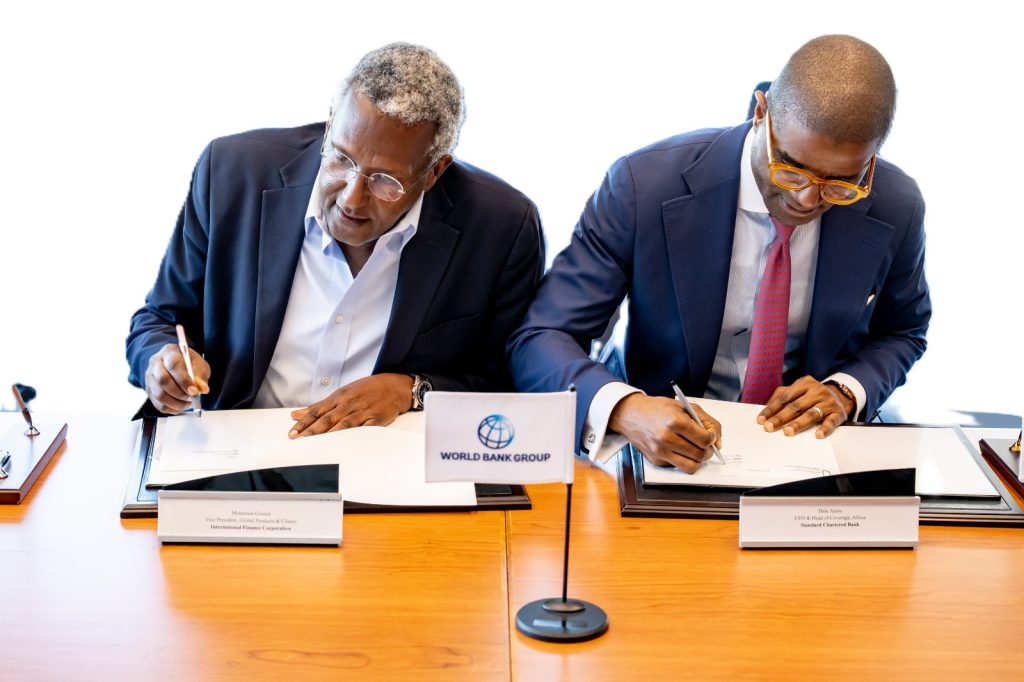
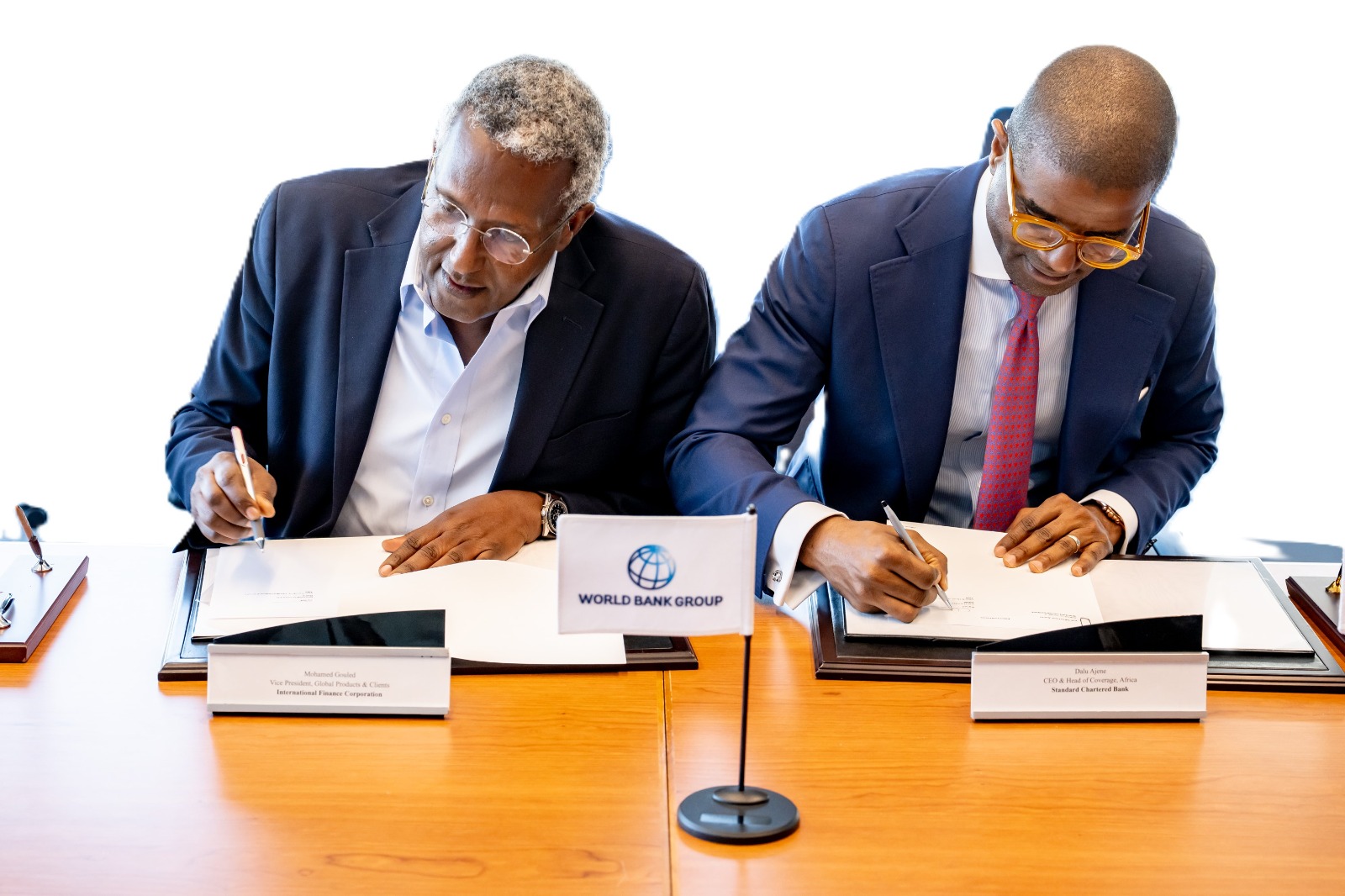
    IFC’s Vice President, Products and Clients Mohamed Gouled and Standard Chartered Africa Chief Executive and Head of Coverage Dalu Ajene, at the USD$300m risk-sharing facility signing ceremony in Washington, DC.


  • KNCCI, IFC partner to empower women-led enterprises through SHE GROWS Programme

    KNCCI, IFC partner to empower women-led enterprises through SHE GROWS Programme

    The Kenya National Chamber of Commerce and Industry (KNCCI) has signed a landmark partnership with the International Finance Corporation (IFC) to support the growth and competitiveness of women-led small and medium enterprises (WSMEs) in Kenya.

    The partnership was formalized during the launch of the SHE GROWS Programme in Nairobi.

    The agreement was signed by Dr. Erick Rutto, President of KNCCI, and Marieme Niang, Africa Regional Gender Lead at IFC.

    This collaboration marks a significant milestone in advancing inclusive economic growth by addressing systemic barriers that limit women entrepreneurs’ participation in the economy.

    The SHE GROWS Programme, implemented under IFC’s Gender and Economic Inclusion Department (GEID), aims to unlock access to finance for women-owned businesses with an annual turnover of at least one million US dollars while strengthening their governance, operational capacity, and investment readiness.

    Through this partnership, IFC will provide technical advisory support, capacity building, and mentorship to women-led SMEs, while KNCCI will mobilize participants, facilitate stakeholder engagements, and amplify programme visibility through its extensive national network.

    The collaboration will equip women-led enterprises with the skills and tools needed to scale operations.

    This as well as facilitate access to finance and investment opportunities, targeting over USD 50 million in mobilized capital.

    Similarly, the partnership aims to support at least 50 WSMEs through tailored business advisory and diagnostic services and create or sustain over 5,000 jobs, with a focus on women and youth.

    Speaking at the signing, Dr. Erick Rutto noted, “This partnership reflects KNCCI’s commitment to ensuring that women are not just participants but drivers of Kenya’s economic transformation. By combining IFC’s technical expertise with KNCCI’s business networks, we are creating a pathway for sustainable growth and empowerment.” Marieme Niang added.

    “IFC is proud to collaborate with KNCCI to advance gender-inclusive growth in Kenya. The SHE GROWS initiative will strengthen women entrepreneurs’ ability to access finance, attract investment, and integrate into regional and global value chains.”

    Other than just in Kenya, IFC plans to pilot a similar project in Mozambique.

    The partnership is a testament to the shared vision by KNCCI and IFC to foster inclusive prosperity by empowering women entrepreneurs to scale their businesses, contribute to job creation, and drive Kenya’s long-term economic development.

  • Kenya hails World Bank, IFC for opening regional offices in Nairobi

    Kenya hails World Bank, IFC for opening regional offices in Nairobi

    The government has welcomed the decision by the World Bank and the International Finance Corporation (IFC) to have some of their regional heads based in Nairobi.

    President William Ruto stated that the move positions Kenya as a central hub for the region and the entire African continent.

    He was speaking when he met World Bank Vice-President for Eastern and Southern Africa, Victoria Kwakwa, at State House, Nairobi. She was accompanied by the bank’s Country Director for Kenya Qiamiao Fan.

    “The government, therefore, welcomes the decision that the World Bank and International Finance Corporation Regional vice-presidents for Eastern and Southern Africa be based in Nairobi. This will make our capital city a central hub in our region and Africa, and a huge World Bank community of 870 staff”, he stated.

    Additionally, he praised the World Bank as a dependable financial partner of Kenya for over 50 years.

    “ It has been supporting our country’s journey to becoming an upper middle-income country by 2030 through initiatives to reduce poverty and promote shared prosperity”, he noted.

  • Equity Group emerges top global climate financier 

    Equity Group emerges top global climate financier 

    Equity Group has emerged as the top financial institution globally with the highest number of transactions for climate-related financing.

    During the International Finance Corporation (IFC) 2023 Climate Assessment for Financial Institutions (CAFI) Awards for Climate Reporting, the giant lender was awarded for having supported a total of 47,593 households and businesses in adopting adaptive and mitigating solutions to address the negative impacts of climate change.

    The support included availing climate loan facilities to for households to purchase energy-efficient cookstoves in the retail sector as well as loans funding of renewable energy distribution from renewable sources, including hydro, geothermal, and wind.

    “Equity is committed to playing a significant role in climate change mitigation and adaptation by providing appropriate financing and capacity development that helps the region decarbonize and build resilience,” said Dr James Mwangi, Equity Group Managing Director.

    In ten months of the year to October this year, Equity Group said it had disbursed Ksh 24.7 billion worth of climate financing to various projects out of which, climate adaptation and water efficiency accounted for 66pc, energy efficiency and transport 28pc and renewable energy 6pc.

    “By being recognized as the Bank with the most transactions, Equity is creating a broader impact and reach for local communities and businesses. The Bank continues to work towards supporting Kenya’s goal of combating climate change by reducing its carbon emissions by 32% by 2030 and building resilience, as outlined in the National Determined Contribution,” added Dr Mwangi.

    A significant proportion of the funding was also used to support climate-smart agriculture, building resilience for farmers and farming ecosystems.

    Equity Bank Kenya entered into a partnership with the IFC in 2019 for a Ksh 15.3 billion ($100m) facility for onward lending to climate-related projects. The bank matched the IFC facility which it says demonstrates its commitment to climate finance.

    CAFI is a tool developed by the IFC to enable its clients and partners across 210 countries to report on their financing activities for climate-related projects.

    “IFC’s work with banks and other financial institutions helps scale up climate finance activities and measure investments earmarked for climate, vital for our clients to realize their climate impact,” added Tomasz Telma, Global Director IFC Financial Institution Group.

    As of June 2023, IFC had committed $15.2 billion to climate-related projects through more than 210 emerging market financial institution partners, leveraging an additional $5.8 billion.

  • World-leading economists set out crucial next steps to reform international climate finance

    World-leading economists set out crucial next steps to reform international climate finance

    A two-day meeting of world leading economists and finance leaders convened by the COP28 Presidency has delivered consensus on the key next steps needed to establish a new framework for international climate finance and to drive progress at COP28 and beyond to COP29 and COP30.

    World-leading economists from the Independent High-Level Expert Group (IHLEG) met with figures from leading global institutions including the World Bank, IMF, ECF and IFC, the COP28 and COP27 Presidencies and UN Climate Change High-Level Champions for two days of talks in Abu Dhabi from 15-16 August.

    Those assembled agreed that they will come to COP28 with recommendations on a new framework for international climate finance, as well as a definitive roadmap on how to implement the recommendations.

    Particular areas of focus for the new framework will include addressing debt distress in vulnerable countries, and the role of the private sector in delivering increased finance. Here, the group recognised that although private finance flows are growing, they need to grow much faster to meet the $2.4 trillion USD total investment estimated to be needed annually by 2030 to address climate change in emerging markets and developing economies.

    The roadmap will be designed to guide all institutions – UN agencies, the IMF, WB, regional MDBs, national governments and the private sector – around short and long-term plans to achieve the Paris Agreement. Agreement on the roadmap at COP28 will allow leaders across the public, private and third sectors to drive forward a clear plan of action on international climate finance.

    All those in the meetings were unanimous in their agreement that finance is fundamental to enabling the delivery of solutions to enable the transition to a net zero, climate-resilient future. They also agreed that the primary focus of their work would be to rapidly increase international climate finance between now and the end of the decade to support emerging markets and developing economies mitigation and adaptation initiatives.

    The COP-28 President-Designate Dr Sultan Al Jaber opened the meetings with a clear call to action for those attending to deliver “a detailed action-oriented framework and tangible recommendations that lead to real results.”

    Following the meeting, he commented: “For too long, climate finance has divided the international community and held back progress in tackling climate change and supporting countries most impacted by it. But climate finance is the issue that lies at the core of the COP28 agenda because finance is how we transform goals into reality.

    “The time for action is right now. I would like to thank everyone who attended the IHLEG meetings, and for their focus and determination in developing a new framework for climate finance. This new framework needs to be comprehensive. It needs to cover both adaptation and mitigation. And it needs to unlock a supercharged stream of private capital. All forms of finance must be made more available, more accessible, and more affordable. MDBs must be adequately capitalized and provide much more concessional finance to lower risk and bring more private capital to the table. And we need to explore innovative new mechanisms for managing currency risk. I am confident that the assembled experts who have devoted their time to this effort, will find solutions to unlock climate finance.”

    Lord Nicholas Stern, co-chair of the IHLEG, said: “These meetings have proved to be very fruitful, in large measure due to the leadership of Dr Sultan and the support from his team. We are all in no doubt of the urgency of the challenges, of the scale of the problems that we must tackle, and of the global action necessary to rise to these challenges. This is a moment where all stakeholders must step up, including the MDBs, their shareholders, and the private sector. We will continue to work with the COP28 Presidency to drive forward in the weeks ahead.”

    Dr Vera Songwe, co-chair of the IHLEG, also noted: “Over the last few months every corner of the world has been hit by a climate event. We must act fast, collectively and at scale to turn these climate disruptions into a growth opportunity for people and planet. The IHLEG group, the COP28 president and all the esteemed colleagues gathered here agree that raising the $2.4 trillion will not be sufficient if we do not accelerate implementation. I look forward to a COP28 that will deliver impact.”

    Kristalina Georgieva, Managing Director of the International Monetary and also in attendance, stated: “The IMF is committed to ensuring climate policy support and finance are reaching those most in need, and I am thankful to the leadership of COP28 for convening this important meeting today. We look forward to partnering with all stakeholders in the lead up to COP28 and working to drive stronger partnerships between the public and private sector for climate success.”

    The IHLEG meetings in Abu Dhabi were attended by a host of cross-sector senior leaders and actors in international climate finance including:

    • H.H. Sheikha Shamma, President and Chief Executive Officer, UAE Independent Climate Change Accelerators (UICCA)
    • Larry Summers, economist and former US Treasury Secretary
    • Mark Carney, economist and former governor of the Bank of England
    • Todd Stern, United States’ chief negotiator at the 2015 Paris Climate Agreement
    • NK Singh, prominent Indian economist, academician, and policymaker
    • Tubiana Laurence, CEO of the European Climate Foundation (ECF)
    • Makhtar Diop, managing director of the International Finance Corporation
    • Rachel Kyte, 14th dean of The Fletcher School at Tufts University
    • Mark Gallogly, investor and climate change activist
    • Rania Al-Mashat, Minister of International Cooperation, Egypt
    • Mahmoud Mohieldin, Climate Champion, COP27
    • Nigel Topping, UN Climate Change High-Level Champion at COP26
    • Alain Ebobissé, CEO, Africa50
    • Harry Boyd-Carpenter, Managing Director Green Economy and Climate Action, EBRD
    • Hamad Sayah Al Mazrouei, CEO, ADGM Registration Authority

    The IHLEG develops and presents policy options and recommendations to enable the public and private investment necessary for delivery of the ambitions of the Paris Climate Agreement. Its ultimate goal is to advance a holistic financial framework for resource mobilization to deliver an equitable and efficient climate finance system, as set out in the Paris Agreement and Glasgow Pact and start its implementation.

    The COP28 UAE Presidency has named “fixing climate finance” one of its four priority action pillars for COP28, alongside fast-tracking the energy transition, ensuring full inclusivity, addressing lives and livelihoods.

    Enabling the energy transition in Emerging Markets and Developing Economies, as well as supporting countries most impacted by climate change, is fundamental to the COP28 Presidency’s ambition.

    Alongside its work with IHLEG, it is working with the G20 High Level expert group on international climate finance and with Germany and Canada to progress the delivery of the 100 billion dollar commitment. The COP28 presidency is also seeking to make substantial progress on the doubling of adaptation finance by 2025, deliver a strong replenishment of the Green Climate Fund and see agreement on the funding arrangements for loss and damage at COP28.

    SOURCE COP28