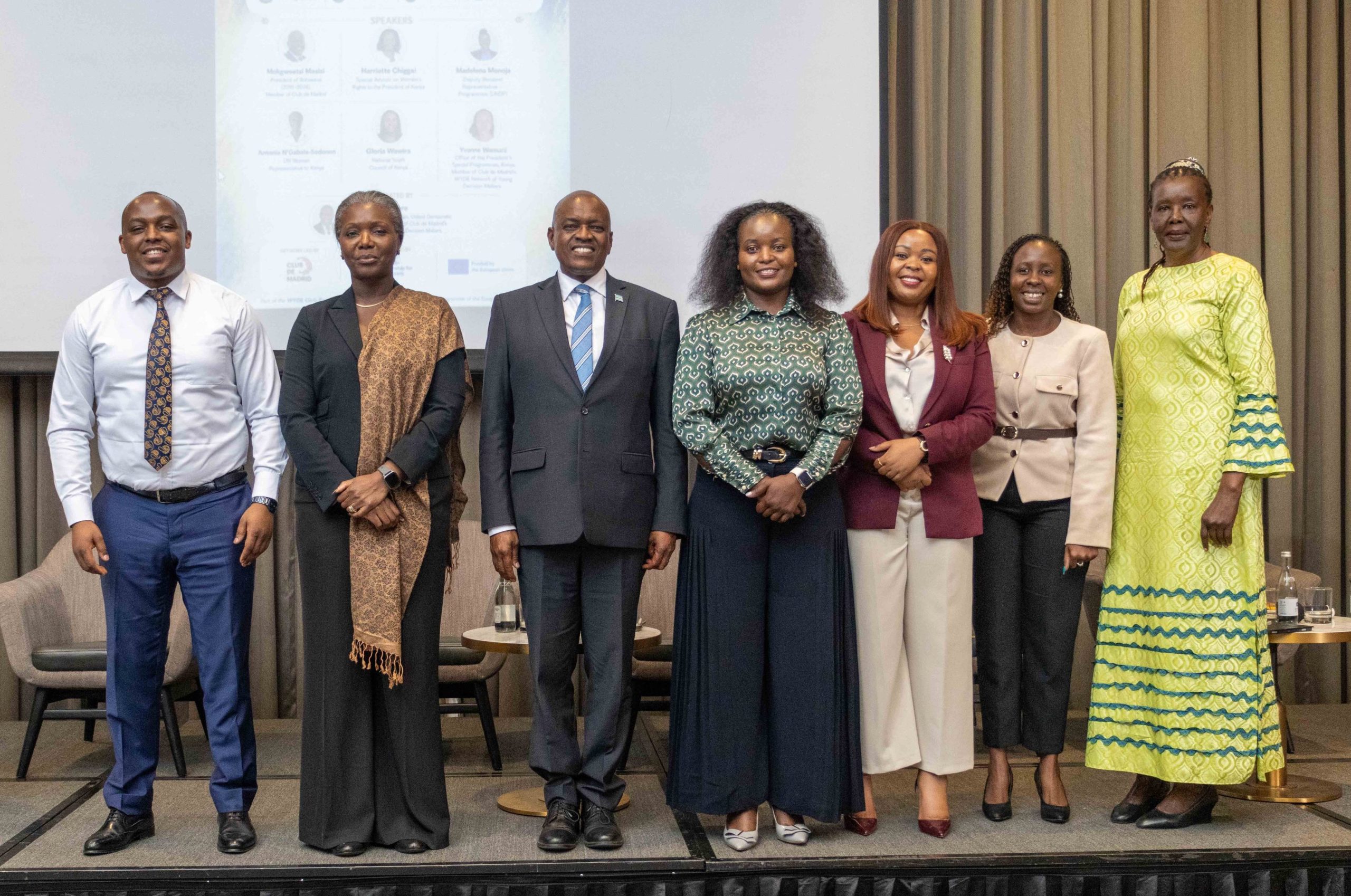
Concerns over the limited influence of youth in governance and the continued exclusion of young women from decision-making spaces dominated discussions during a high-level dialogue on Youth Leadership as Drivers of Gender Equality in Kenya, held in Nairobi.
Participants at the forum agreed that achieving meaningful youth political participation and gender equality requires stronger implementation of existing laws, increased mentorship, civic education, financial empowerment, and the deliberate inclusion of young women in leadership and governance processes.
The dialogue, convened by Club de Madrid, Nuru Trust Network, and the SDGs Kenya Forum under the WYDE Civic Engagement project supported by the European Commission, brought together youth leaders, government officials, development partners, and former heads of state to examine barriers limiting young women’s participation in leadership and governance.
Speakers noted that although Kenya has made progress through frameworks such as the constitutional Two-Thirds Gender Rule, the National Policy on Women’s Economic Empowerment, and the National Care Policy, implementation gaps continue to undermine meaningful inclusion.
Former Botswana President and Club de Madrid member Mokgweetsi Masisi stated that governments and institutions must move beyond symbolic commitments and actively create opportunities for young people through education, skills development, and participation in decision-making.
“Young people should be viewed as a resource rather than a problem. Governments must create environments that encourage multi-generational conversations and support young people to grow through experience,” he said.
Masisi emphasised that institutions have a responsibility to support young women leaders by creating opportunities, mentorship pathways, networks, and safe spaces for participation.
“Institutions can do much to support young women leaders. They can provide opportunities, budgets, spaces, networks, and mentorship pathways,” he added.
According to Masisi, institutions should also champion the protection and inclusion of women, particularly against gender-based violence, marginalisation, and intimidation, including online abuse through digital media, even as he cautioned against reducing policy interventions to mere symbolic gestures.
“Policies affecting young people must go beyond simply passing laws. Policies are living instruments that must continuously be implemented, reviewed, and shaped by those they affect,” he stated.
Special Advisor on Women’s Rights in the Office of the President, Harriette Chiggai, acknowledged the gains made under the current administration in appointing more women and young women to leadership positions but maintained that deep-rooted patriarchy continues to hinder progress.
“We need to promote inclusivity and equality from a societal perspective. Young people, especially young women, often face discrimination because of their age. People dismiss them before even assessing their qualifications or capabilities,” she said.
Chiggai emphasised mentorship, civic responsibility, and economic empowerment as key pillars in advancing women’s leadership.
“Holding someone else’s hand does not diminish your position. It strengthens succession planning and leadership continuity,” she remarked.
She further observed that many young leaders struggle with limited financial resources and a lack of confidence.
“We must move away from silo mentalities that suppress emerging leaders. Many young leaders lack financial resources and confidence, which limits their progress. Education and awareness remain critical equalisers,” she said.
Chiggai, however, criticised what she described as a growing “tokenism mentality” among some youth.
“Young people must move beyond this mentality and understand that they can influence leadership without financial inducements,” she said.
On the implementation of the two-thirds gender principle, Chiggai argued that Parliament remains the biggest challenge, as elective politics still disadvantage women candidates.
UN Women Kenya Country Representative Antonia Sodonon highlighted that while Kenya possesses robust frameworks, and that the primary challenge lies in effectively translating these into practice. She pointed out that the issue stems from weak enforcement and a lack of accountability.
Regarding the Two-Thirds Gender Rule, she explained that it signifies a deeper concern with power sharing and representation, rather than merely meeting a legal requirement. She characterised the ongoing failure to fulfil gender equality commitments as a form of institutional resistance to the redistribution of power.
“When discussing the two-thirds gender rule, the fundamental issue is sharing political power and representation. Honest conversations are necessary. While some view it as political gatekeeping, it is more accurately understood as persistent institutional resistance to redistributing power in practice,” she stated.
Sodonon further emphasised that youth leadership is essential for fostering accountability, changing social norms, and accelerating gender equality commitments for women and girls in Kenya.
“Achieving this requires stronger accountability, financing, and youth-led action,” she added.
UNDP Kenya Deputy Resident Representative Madalena Monoja stated that weak implementation continues to impede progress on gender equality, despite existing constitutional and legal frameworks.
“Despite the progress in the constitution with the provision of the two-third gender rule, the speed of implementation is very slow,” she said.
Monoja noted that UNDP and its partners are supporting women’s participation through governance programmes, grassroots capacity building, and inclusion in county planning and budgeting processes.
She highlighted that support from UNDP and partners contributed to an increase in the number of women elected to county assemblies during the 2022 General Election, alongside the election of seven women governors.
“The road can be difficult and discouraging, but there is no contribution that is too small,” she said.
National Youth Council CEO Gloria Wawira stated that discussions at the forum focused on ensuring that women’s representation translates into tangible economic and political empowerment.
“The NYC is a primary pathway through which young people, and young women in particular, can enter leadership and be mentored into wider representation positions across the country,” she said.
Wawira added that while Kenya has made progress in increasing women’s representation within the judiciary and executive, more effort is still needed in Parliament and elective politics.
Nuru Trust Network CEO Mary-Yvonne Ododah highlighted the high cost of campaigns and limited access to resources as major barriers preventing young people from participating in politics.
“There are already spaces and opportunities, but there are so many barriers and obstacles,” she said.
Ododah explained that the dialogue aimed to identify practical solutions to help young people access leadership opportunities.
“Together with Club de Madrid and the SDGs Kenya Forum, we convened this dialogue to highlight practical solutions and opportunities that can help young people take up leadership roles,” she said.
She encouraged young people to seek mentorship, build strong community support systems, and leverage technology to identify opportunities.
“Funding remains a major challenge across the continent, but if you want to pursue leadership, start with your community, as those are the people who believe in your vision. No dream is impossible. Reach for the stars and connect with the right people,” she said.

