President William Ruto Tuesday evening chaired a virtual meeting of facilitators of the merged Luanda-Nairobi peace process.
The meeting is on the crisis in the Eastern DR-Congo. The facilitators including Kenya’s former President Uhuru Kenyatta were appointed by the East Africa Community (EAC) and the Southern African Community (SADC) Heads of State.
Others are former Presidents Olusegun Obasanjo of Nigeria, Sahle-Work Zewde (Ethiopia) and Catherine Samba-Panza of the Central African Republic.
The eastern DRC continues to face instability due to the M23 rebel group, which has been advancing and seizing large areas of territory.
Five former Presidents have been appointed to spearhead peace efforts in Eastern Democratic Republic of Congo.
The five were appointed during a joint virtual meeting of presidents from the East African Community (EAC) and the southern African development community.
President William Ruto co-chairing the meeting with President Emmerson Mnangagwa warned the ongoing conflict has the potential to spill over into neighboring countries and destabilize the region if not swiftly addressed
Those appointed to the expanded panel of peace negotiators include former presidents Olusegun Obasanjo (Nigeria), Uhuru Kenyatta (Kenya), Kgalema Motlanthe (South Africa), Catherine Samba Panza (Central African Republic) and Sahle-Work Zewde (Ethiopia).
The Summit also adopted the report on the outcomes of the joint EAC-SADC meeting of ministers held on March 17, 2025 in Harare.
Wiper Democratic Movement Party leader Kalonzo Musyoka has come under fire from the government over his comments regarding the ongoing crisis in the Democratic Republic of Congo (DRC).
Prime Cabinet Secretary Musalia Mudavadi has dismissed Musyoka’s remarks as reckless and part of a “witch hunt,” following claims that Kenya is to blame for the volatile situation in DRC.
In a strongly worded statement, Mudavadi, who also serves as the Cabinet Secretary for Foreign and Diaspora Affairs, clarified that Kenya has no involvement in the crisis and that the situation in the DRC is unrelated to Kenya or its leadership.
He further emphasized that the government has no hidden interests in the conflict.
“We do not share borders nor do we have any interest in DRC other than peace, stability, and prosperity for its people. It is therefore regrettable that Wiper Leader Kalonzo Musyoka in a clip doing rounds in social media insinuates that President William Ruto is part of the problem in the crisis in DRC” Mudavadi said.
He added “Kalonzo’s attempt to seek to link President Ruto with the issues in DRC is not only an attempt to overstretch his political witch hunt for the Head of State but also reckless, especially for a leader who served for a long time as a Minister of Foreign Affairs and was supposed to understand better the DRC dynamics”.
Additionally, Mudavadi explained that issues affecting DRC are agelong and historical and have been canvassed by the previous leaders in the region since the 1960s to date.
President Ruto, who chairs the East African Community Heads of State Summit, is leading efforts to restore peace in eastern DRC.
Last week, he convened a meeting in Nairobi, Kenya, and this week, a joint EAC-SADC summit on the DRC conflict will be held in Tanzania.
The president of the crisis-hit Democratic Republic of Congo was set to meet his Rwandan counterpart at an emergency summit on Wednesday, as fighters backed by Kigali appeared on the brink of seizing the key city of Goma.
The M23 armed group took control of Goma’s airport on Tuesday, a security source said, following days of intense clashes that killed more than 100 people and wounded nearly 1,000, according to an AFP tally of tolls from the city’s overflowing hospitals.
It remained unclear how much of the provincial capital was under the control of Congolese forces versus the Rwandan-backed M23, which claimed it had taken the city on Sunday.
But as fighting eased on Tuesday night, only M23 fighters and Rwandan forces were visible on the streets, according to AFP journalists.
The security source said “more than 1,200 Congolese soldiers have surrendered and are confined” to the airport base of the UN’s mission in the DRC.
Congolese leader Felix Tshisekedi was to meet Wednesday with Rwandan President Paul Kagame at an “extraordinary” summit of the East African Community hosted by Kenya, its president said.
The M23’s lightning offensive marks a major escalation in the DRC’s troubled east, haunted by the legacy of the 1994 Rwanda genocide and plagued by fighting between armed groups backed by regional rivals in its aftermath.
It has also triggered a spiralling humanitarian crisis, with the UN warning of hundreds of thousands forced from their homes, serious food shortages, looted aid, overwhelmed hospitals and the potential spread of disease.
Destin Jamaica Kela, who fled across the border to Rwanda as fighting raged in Goma, told AFP that “things changed very fast”.
“Bombs were falling and killing other people everywhere, we saw dead bodies,” the 24-year-old said.
Protesters attack embassies
On the other side of the country, roughly the size of Western Europe, protesters in the capital Kinshasa attacked the embassies of various nations — angered that they had not stepped in to halt the chaos in the east.
The missions of France, Belgium, the United States, Kenya, Uganda and South Africa were among those targeted, with demonstrators torching tyres outside several.
Protesters also attacked the Rwandan embassy in Kinshasa.
The US embassy told its citizens to leave the country following the attacks while the European Union’s foreign policy chief Kaja Kallas branded them as “unacceptable” and “deeply troubling”.
The International Committee of the Red Cross said it was striving to help respond to a massive influx of wounded to Goma’s “overwhelmed” hospitals, warning that some patients were “lying on the floor due to lack of space”.
It also warned there could be “unimaginable consequences” if samples of Ebola and other pathogens held at a local laboratory in Goma were allowed to spread amid the fighting.
The violence in the mineral-rich North Kivu province around Goma has forced half a million people from their homes since the start of the year, according to the UN refugee agency.
African Union
At a UN Security Council meeting on the crisis on Tuesday, the world body’s peacekeeping force in the DRC warned that the fighting risked reigniting ethnic conflicts dating to the Rwandan genocide and beyond.
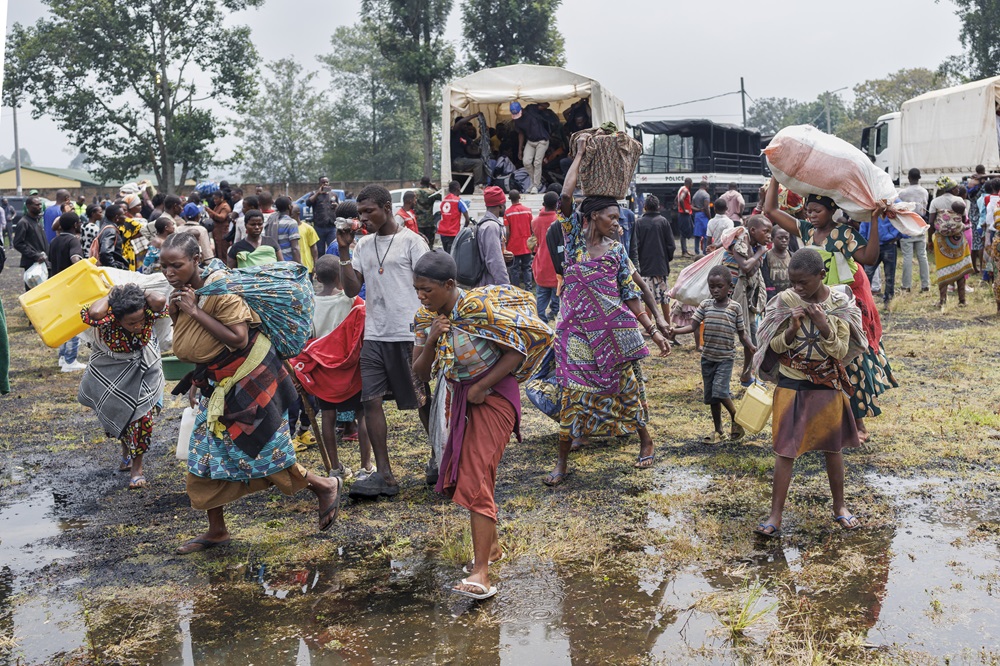
Congolese refugees fleeing ongoing clashes in eastern Democratic Republic of Congo carry their belongings as they arrive at the Rugerero transit camp in Gisenyi on January 28, 2025 (Photo by Tony KARUMBA / AFP)
“In the past four days, the Human Rights Office has documented at least one case of ethnically motivated lynching in a (displaced persons) site in Goma,” Vivian van de Perre of the UN’s DRC mission MONUSCO said.
After a previous meeting of the council on Sunday, the Congolese government expressed “dismay” at its “vague” statement, which stopped short of naming Rwanda.
At an emergency meeting on Tuesday, the African Union called on the M23 to “lay down arms”, also without naming Rwanda.
The DRC has accused Rwanda of wanting to profit from the region’s abundant minerals — which include gold, coltan, copper and cobalt — and has called for stronger UN action.
Rwanda has denied the claims, saying its aim is to tackle an armed group called the FDLR, created by former Hutu leaders of the 1994 genocide in Rwanda who massacred Tutsis.
In a call with Kagame Tuesday, US Secretary of State Marco Rubio “urged an immediate ceasefire in the region, and for all parties to respect sovereign territorial integrity”.
Also on Tuesday, China’s ambassador to the UN, Fu Cong, urged Rwanda to heed international calls to “stop military support” for the M23.
At least 17 peacekeepers from a southern African regional force and the UN’s DRC mission have been killed in the fighting.
The M23 briefly occupied Goma at the end of 2012 and was defeated by Congolese forces and the UN the following year.
The group re-emerged in late 2021 and started seizing large swathes of North Kivu province.
A UN expert report in July said up to 4,000 Rwandan soldiers were fighting alongside M23 and that Rwanda had “de facto control” of the group’s operations.
A ceasefire in August failed to keep the peace and Angola-mediated talks were abruptly cancelled last month.
As the conflict in some areas of the Democratic Republic of the Congo intensifies and more people are killed by the country’s atrocities, Collectif of Lawyers, a group of attorneys representing the Hema of Ituri Province, the Banyamulenge of South Kivu Province, and the Tutsi of North Kivu Province in the eastern Democratic Republic of the Congo, has criticised the Congolese army for failing to step in and ensure the safety of its citizens.
During a seminar that was immersed in controversy, one of the collectif’s solicitors, Benard Maingain, said, “We don’t ask for declarations; we want action; they have to give a guarantee of peace and security for each civil person, and our victims have rights to peace and security.”the victims’ harrowing accounts of the atrocities they endured at the hands of the rebels were accompanied by a dismal atmosphere.
The three-day seminar will feature testimonies from the victims who will be recorded and given to the International Criminal Court. It was held in Nairobi because of its proximity to the victims and because Kenya has been a major player in peace negotiations in the DRC.
Due to the constant politicisation of the conflict and its effects on the Congolese people, the conference also aims to give the victims a platform to share their stories and to inform the world of the horrors that take place there.According to Jean Paul Shaka, a member of the New York bar, participants in the armed organisations are responsible for the ongoing conflict in the Democratic Republic of the Congo.
Jean went on to say that victims should be the focus of the Congo peace conference rather than armed groups, and their voices should be heard and given a chance to be heard. “It is without a doubt acceptable to bring people with blood on their hands, house them here, and pay them while they wreck havoc back home.” As a result, it has become necessary to hear from the victims about their experiences.
The attorneys have also urged the UN general secretary to look into the behaviour of the During massacres, the MONUSCO stabilisation mission of the United Nations. MONUSCO has been accused of being complacent recently, with local authorities charging that despite being a part of the UN peacekeeping force, it had done little to affect the country’s protracted civil war.
In addition to lawyers from Brussels and the New York City Bar Association, the Collectif of Lawyers is made up of lawyers who are members of the bar associations in Bunia, Goma, Bukavu, and Kinshasa. The lawyers’ pursuit of justice for the war victims began three years ago when a group from Banyamulenge requested legal assistance.
The Collectif observes that the voices of the victims of these atrocities are sometimes disregarded or even unheard, which is why they are often .The victims are now hoping that they will find justice and be restored.