The Independent Electoral and Boundaries Commission (IEBC) has called on residents of Isiolo South Constituency to turn out in large numbers and exercise their right to choose leaders of their choice through the power of the ballot.
The Commission says it has put in place elaborate measures to ensure the by-election slated for Thursday is conducted in a transparent and credible manner.
IEBC Commissioner Dr. Alutalala Mukhwana has also called on security personnel to work round the clock to ensure the mini-poll is conducted in a secure environment.
“IEBC depends on you to provide adequate security and acknowledges the role played by all security officers in guaranteeing a peaceful election,” he stated.
Speaking while accompanied by fellow Commissioner Hassan Noor Hassan when they toured the constituency to oversee final preparations, Dr. Alutalala expressed confidence in the personnel deployed, noting that they understand the terrain and are well positioned to safeguard the electoral integrity.
The Commissioners urged voters to maintain peace throughout the election period to enable everyone exercise their democratic right and choose leaders of their choice.
During the Thursday by-election, residents of Isiolo South Constituency will head to the polls to pick their new Member of National Assembly following the demise of former area lawmaker Mohamed Tubi Bidu in November last year.
Isiolo South Parliamentary race has turned out to be a sibling rivalry pitting UDA party candidate Tubi Mohamed Tubi against his Sister Bina Tubi who is contesting on a Jubilee party ticket.
The two are children of the former area MP.
The UDA candidate got a major boost after the National Economic Development Party (NEDP) candidate Isaack Abduba Fayo withdrew from the race in his favour.
Polling stations will open at 6:00am and close at 5:00pm. In cases where opening is delayed due to unforeseen circumstances, the Commission says time lost will be compensated.
IEBC says all eligible voters in the certified Register of Voters for the respective by-election areas will be identified using the KIEMS kits.
The Register of Voters has been displayed at each polling station for public verification.
Residents of West Kabras Ward in Malava Constituency, and Muminji and Evurore Wards in Mbeere North Constituency will also cast their ballots to choose their new Members of County Assembly.
The Independent Electoral and Boundaries Commission (IEBC) says all preparations for this Thursday’s mini-polls are on course.
In the by-elections, residents of Isiolo South Constituency will head to the polls to pick their new Member of National Assembly following the demise of former area lawmaker Mohamed Tubi Bidu in November last year.
Residents of West Kabras Ward in Malava Constituency, and Muminji and Evurore Wards in Mbeere North Constituency will also cast their ballots to choose their new Members of County Assembly.
IEBC Chairman Erastus Ethekon says several critical milestones have so far been achieved ahead of the polls.
They include completion of procurement of election materials, gazettement of nominated candidates, polling stations, and tallying centres.
Also finalized is the servicing, testing, configuration and readiness of the Kenya Integrated Election Management System (KIEMS) kits for deployment.
“All eligible voters in the certified Register of Voters for the respective by-election areas will be identified using the KIEMS kits. The Register of Voters has been displayed at each polling station for public verification,” the statement by IEBC Chairperson reads in part.
Polling stations will open at 6:00am and close at 5:00pm. In cases where opening is delayed due to unforeseen circumstances, the Commission says the time lost will be compensated.
Ethekon has called on voters to follow instructions issued by polling officials to facilitate an orderly voting process.
With only few hours remaining ahead of the polls – the second to be managed by the Ethekon-led electoral body – candidates have been warned that any form of campaigning or engagement of voters for electoral purposes will not be permissible forthwith.
Campaigns officially closed Monday, February 23rd at 6pm in line with the gazetted election timelines.
Isiolo South Parliamentary race has turned out to be a sibling rivalry pitting UDA party candidate Tubi Mohamed Tubi against his Sister Bina Tubi who is contesting on a Jubilee party ticket.
The two are children of the former area MP Mohamed Tubi Bidu.
The UDA candidate got a major boost after the National Economic Development Party (NEDP) candidate Isaack Abduba Fayo withdrew from the race in his favour.
The Independent Electoral and Boundaries Commission (IEBC) has moved to assure the country that the voter register is safely under its custody.
The Commission’s Chairperson Eratus Ethekon has termed as inaccurate accusations by the Democratic Party (DP) over its engagement with the National Registration Bureau in relation to voter registration data and identity verification.
“The register of voters remains exclusively under the custody and control of the Commission, as provided for under the Constitution and the Election Act. IEBC reiterates that personal data of voters is safeguarded in strict compliance with The Constitution of Kenya; The Elections Act, 2011; The Elections (Registration of Voters) Regulations, 2012; and The Data protection Act, 2019,” Ethekon says in a statement.
“The Commission calls upon all stakeholders and partners to continue supporting lawful processes aimed at strengthening the accuracy and integrity of the register of voters, which is a fundamental pillar of democratic elections. We urge stakeholders, especially the political actors, to refrain from uncorroborated, inflammatory, and divisive statements that only undermine the integrity of electoral processes, but also the independence of the Commission.”
The assurance comes amid heightened political alignments and realignments ahead of the high stake general elections slated for August 2027.
In the run up to the polls, Opposition leaders have been at the forefront in calling on the electoral body to put its house in order especially as regards the technology to be used in managing the elections, warning that they will not accept any monkey business whatsoever.
National Assembly Speaker Moses Wetang’ula has reaffirmed Parliament’s commitment to safeguarding the National Government Constituencies Development Fund (NG-CDF) describing it as a protected public resource that directly responds to the needs of the citizens.
Speaking as Chief Guest during the Prize-Giving Day ceremony at Pate Girls Secondary School on Pate Island on Monday, the Speaker said the National Assembly fully supports and will continue to protect the NG-CDF citing its transformative impact on grassroots development across the country.
“We fully support and will continue to protect the NG-CDF. We also back the Appellate Court’s decision affirming that the Fund does not compete with county governments,” Wetang’ula said.
The Speaker emphasized that the Fund complements rather than duplicates the work of county administrations by focusing on community-identified priorities, particularly in education, infrastructure and social amenities.
He noted that NG-CDF remains protected public money specifically designed to benefit ordinary citizens at the constituency level.
Unlike other funding frameworks, he said, the NG-CDF model empowers local communities to take part in decision-making.
“Under the Fund, it is the people themselves who determine and prioritise projects in each financial year, ensuring that development reflects the real needs of the community,” he said.
Wetang’ula pointed to the impact of NG-CDF in supporting schools such as Pate Girls Secondary School through classroom construction, bursaries and improvement of learning facilities interventions that have contributed to improved academic performance in national examinations.
The Speaker lauded the school’s outstanding results in last year’s national examinations, describing education as the most powerful equaliser for marginalised and remote regions such as Pate Island.
He urged leaders to remain united in defending initiatives that directly uplift learners and vulnerable families.
He reiterated Parliament’s role in oversight and legislation to ensure public funds are utilised transparently and efficiently for the benefit of citizens.
I met a man from Bungoma last Tuesday who has listened to KBC every single morning since 1969. In our interactions, he averred that he hadn’t missed a single KBC morning broadcast since he was 23 years old. Not one.
He used to listen to the broadcast with his wife. Unfortunately, she passed on two years ago. Nevertheless, he still tunes in everyday because the voices make him feel the deceased is still in the room.
I don’t have a spreadsheet for that. No data point. It will not appear in any board justification or strategic plan. But it’s the truest thing I have come to know about public radio.
We broadcast in 23 languages
Some of them don’t have spell checks on any computer. Some are spoken in communities you cannot reach by tarmac. But we found a way to put them on air, because that is what a national broadcaster does. Fifteen stations, from the coast to the lake, from the city to the cattle camps. Not because its profitable but because it’s necessary.
This week, we opened our doors for the first time to the public and let Kenyans into our studios. A girl from Kibera stood in our newsroom and said she wants to tell stories about her home. A farmer called to say that our agricultural programme changed how he plants – his harvests have doubled. A blind listener thanked us for being the only station that remembers to describe what others cannot see.
None of this is going to make headlines. It is not designed to. It is just us here at KBC, doing what we do, letting people see it. We do not share these moments to impress you. We share them because they are the evidence that public radio is not a relic. It is a lifeline.
But here is what keeps me up
I watch young producers, talented, idealistic, could work anywhere, walk our doors because we cannot pay them what private media pays. I watch engineers keep fifty-year-old transmitters and spare parts with ingenuity. I watch our archives, decades of Kenyan voices, slowly fading on magnetic tapes while we wait for digitization funds that never quite arrive. This same week we are celebrating radio; I approved yet another request to defer capital expenditure. We cannot afford to fully digitize our archives; we cannot afford to train our staff on AI tool reshaping global broadcasting . We cannot afford to market ourselves the way private companies do. Yet…
Our producers don’t want to leave. They show up. They serve. They believe in public radio. They want to translate emergency broadcast into every mother tongue. They want to build and archive so a student in 2050 can hear how Kenyans spoke and dreamed. They want to prove that radio is not dying. It is just waiting for a generation to reinvent it.
They just need the tools
To our beloved Government. Public radio is infrastructure. As vital as roads, as water, as the electricity that powers those transmitters. When we broadcast vaccination campaigns, children live. When we air market prices, farmers get fair deals. When we teach literacy over the airwaves, grown men and women learn to write their own names. When the country faces a moment that requires calm, accurate information; we become the firewall in this era of misinformation.
Not every home has data. Not every village has 4G. But radio finds the last mile. Radio speaks 23 languages. Radio costs nothing to receive.
We are grateful for the support we receive, and we are hopeful that as Kenya grows, its public broadcaster will grow too. Not for our sake, but for the millions who still depend on radio as their only primary source of information.
Imagine a national broadcaster with the mandate fully funded. Not just surviving but thriving. Studios where young Kenyans learn digital production for free. Archives preserved for future generations, not crumbling with humidity. Regional stations producing content in every mother tongue because language is dignity. AI translating emergency broadcast instantly. Investigative journalism that holds power accountable without fear of advertiser’s retaliation. This is not a dream, this is possible. This is what national public broadcaster looks like.
To the public. We have not told our own story well. We assumed our work would speak for itself. But in an era where everyone is shouting, even good work must raise its voice.
So, if you are reading this and you’ve never really thought about what goes into public broadcasting or if you are one of the people who assume we’re stuck in the past, this week is a good time to check for yourself.
Visit our websites. Follow our social media platforms. Call in and tell us what we are missing. What you want more of. Tell your MP that KBC matters to you and it’s not a line item to be minimized. Tell your children that radio is not their grandfathers’ medium. It is a platform waiting for them to reinvent it.
Radio survived television, it survived the internet, it survived podcast and streaming and the thousand obituaries written for it over ninety years. What it cannot survive is indifference. When citizens engage, institutions improve, when people stop paying attention, institutions fade. We do not want to fade.
As radio week ends, the work continues. Tomorrow morning, the man from 1969 will turn on his radio. A mother in Garissa will learn about child nutrition in Somali. A teacher in a remote primary school will tune in to our educational programming because text books are scarce but airwaves are free.
We will be there; we have always been there
Not because we are the loudest or the most modern. Because we are yours!
Radio isn’t dying . It’s just learning to speak differently and we want you in the conversation.
I believe in it. The thousand plus people who report to work at KBC every morning believe in it. The twelve-year-old from Kibera who wants to tell stories about her home – she believes in it too.
Kisumu County is a perennial net importer of foodstuffs from other parts of the country despite it being well endowed with arable land, strategically hosting Lake Victoria, Africa’s largest freshwater lake, and a gateway to larger Eastern Africa countries.
Despite availability of these natural resources, the county is facing a serious deficit in food production compromising food security and basic food nutrition leaving its populace with a gap to feed its hungry households throughout the year.
Interventions by Awuoth Women’s Group
It is against this background that Awuoth Widows and Orphans Group, a Community Based Organization (CBO) established in 1997 at Nyamasiria, 4 kilometres from the city center, has ventured into indigenous vegetable farming as a way of promoting food nutrition as well as a source of income to its five hundred members.
Yuanita Anyango Hongo is the group’s founder and the current Chairlady. Herself a widow, she started the organization as a means to support to orphans scourged by the HIV/AIDS pandemic that claimed thousands of lives in the early nineties in the community, depriving most children access to education.
‘’ It was a devastating era, women and children were vulnerable. I had to do something to sustain their lives’’, she explains.
Through her efforts, the CBO has leased lands in surrounding areas of Kolwa, Chiga and Gesoko which are adjacent to River Nyamasaria to supplement farming where farmers produce local vegetables such as cow peas (kunde), spider plant (sagheti), blacknight shade (osuga), kales (sukuma wiki) and spinach.
She informs us that the group has embraced purely organic farming where manure generated from a compost pit ensures that the veggies grow free from any chemicals in form of pesticides.
Harvesting, preservation and storage
Harvesting is usually done after every six weeks with at least a tonne of leafy vegetables produced by the group every quarter of a year. The members who run an aggregation center at an eighth piece of land donated by the founder hosts an office space, a cooler and a solar dryer that ensures that the day’s collection is measured and weighed. Thereafter, members collaborate and pluck leaves from the main stems.
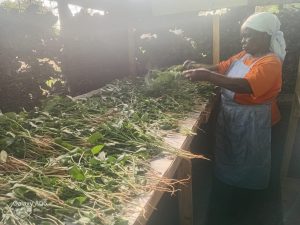
Millicent Atieno Odongo who has been a member since inception tells us that after the weighing process, the veggies are spread in a special aluminum table where they remove all the unnecessary weeds. It is then washed and cut into small proportions.
The next process is boiling the produce by adding salt and measuring required amount of water for at least seven minutes (blanching) then spread to the metallic table and squeeze out any water for excretion. Blanching is important because it helps to preserve color, nutrients and extend shelf life.
The workers transfer the pre-boiled veggies to the solar dryer ready to undergo the whole drying process where different varieties, for instance the cow peas, take the least time to dry usually after two hours whereas kales, spinach and managu use more time to ensure they dry evenly.
It is after drying that the freshly dried veggies are taken to a cooling chamber that has an inbuilt charcoal wall fenced to freeze the produce cooled by pipes that intersect on the roof dripping water at the walls that provide a cold environment regulated by nature.
“We have adequate supply of vegetables all year round and we meet demands of our clients here in Kisumu and even beyond Kenya through the use of solar,” she says.
After cooling that lasts about ten to twenty minutes, the product is packed, graded, labeled and stored ready to hit the markets with most of their clients drawn from abroad. They supply the product to individuals, families, as well as corporates drawn from as afar as Australia, the U.S, Denmark, Middle East and Canada.
“Our women are now able to gain good profits and sustain their livelihoods because of zero post-harvest losses and value addition,” she notes.
Food nutrition and security
Indigenous vegetables are known to be rich in key minerals like iron, calcium, magnesium, potassium and zinc that boost blood levels, improve immune system, bones health and serves as an antioxidant that is necessary for body nutrition.
According to Yuanita, the vegetables play a big role in bridging food and nutrition gaps especially in Kisumu where food insecurity and micronutrient deficiencies are common.
Since many households in the county lack vegetables and experience moderate or severe nutrition with food diets often dominated by starchy staples such as ugali and rice, there are numerous cases of weakened immunity, stunted growth and limited dietary diversity.
Her call to the youth is to embrace agriculture and help increase food availability by ensuring communities have access to sufficient and food system and help reduce hunger and malnutrition.
Challenges
Among challenges that the group face include weather dependence especially during rainy seasons, high humidity or cloudy days that could slow up drying process. However, Awuoth Widow’s Group has built a special jiko that is ceramic lined stove that provides heat through a fume chamber fitted with raised racks that ensure there is no disruption even during wet seasons.
Yuanita adds that this technology ensures warm air circulates around the veggies reducing excess moisture and hence enabling the group to preserve surplus indigenous veggies.
Another setback is vandalism at the cooling facility by the virtue that it primarily uses charcoal. Women and children creep at night to steal the coal well, while replacing it has become more expensive. This has forced the members to procure security services to protect their produce.
“It is costly to have an extra person who is dependent on your budget but we have no alternative,” Yuanita laments.
A bigger challenge now lies with transport of the vegetables that is on a high demand in entire Kisumu town. But with the entrance of E SAFIRI, a transport firm that sales electric motorcycle and tuktuk, the farmers have sub-contracted a driver to supply foodstuffs to their customers.
Use of solar energy in fish waste value addition
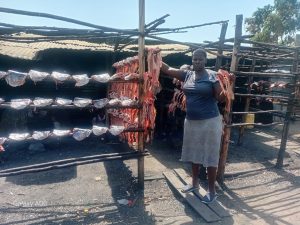
Solar energy has played a critical role in fish waste preservation at Obunga Pap Mbuta fish market that has directly employed two hundred and fifty women and youth providing them livelihoods. The market, which was built in early 50s, has been relying on fish waste such as fish fins, fish intestines, fish skin and the famous mgongo wazi.
Rael Sama, a trader who has been in mgongo wazi business since 2004, attributes the profits accrued from her business from the solar cooler installed eight months ago. She says it has offered her a place to store and preserve her products before reaching the market.
She admits that previously, the cooler used to deep fry mgongo to ensure it does not rot incurring costs in firewood and cooking oil.
“I almost quit my business. My profit margins were very low, I could hardly sustain myself’’, she recalls.
Now she is at liberty to store her products for at least three days without unnecessary concerns and supply her stocks to far away towns in Kitale, Eldoret, Nakuru and Kakamega.
Sentiments echoed by Remjius Odhiambo, the secretary at the market who added that the impact in preservation has ensured they have ready market and minimized wastage.
“Traders now have a clean and hygienic space to store their stock using solar as an enabler in sustainability”, he explains.
He says that Chloride Exide who built and installed the facility at the market has trained the traders on how to embrace and use the technology and also do follow-ups on the functioning of the system, offering support in case of breakdowns.
Solar irrigation and aquaculture
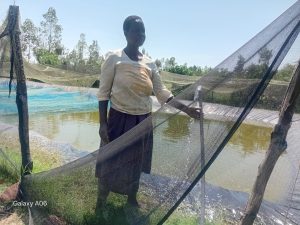
Away from the city, we meet Hellen Adhiambo, a small scale farmer in Kasida village in Ahero who has made significant strides at her one-acre farm, integrating fish pond and other crops primarily using solar.
A teacher by profession and a mother of three, her interest in agriculture has seen her capitalize on the opportunity in an area classified as dry plains where scarcity of water is the norm.
As a member of Ahero CBO, the knowledge gained has enabled her embark on planting various varieties of crops including bananas, fruits, vegetables and fish that has helped her acquire income to sustain her family.
“When I started, the public was skeptical that nothing can grow out of my farm being an area that has black cotton clay soil. Many dismissed my venture,” she recalls.
“But Sunculture firm, a local solar company came and installed a solar system that pumps water directly to my farm enabling me to produce a sizeable amount of crops that have ensured my family is food secure. I no longer rely on rice, I have different varieties to choose from.’’
Adhiambo also rears fish at her farm through the support of Aquaburn, a development agency based in Nairobi that provided infrastructure of the pond and currently has three thousand tilapia fish which are at different stages.
Solar has enabled her to pump thousands of litres to her pond thus sustaining her ventures and promoting her business.
“In this area I am called Mama Samaki, a nickname I got because I am the only one supplying fish to the locals enabled by solar,’’ she adds, jokingly.
Her medium-sized solar panel voltage ensures minimum disruption when it rains thus enabling her irrigation to continue uninterrupted.
Embracing solar technology
Nick Omondi who is a solar technician and expert in Kisumu has been doing solar installation across the county. He is among the few who is utilizing the opportunity to make significant change to farmers.
He explains that solar uptake has been on an upward trajectory primarily driven by reliability, sustainability and cost-effective energy solutions. He has specialized in designing, installing, and maintaining photovoltile system.
Using off grid reliance, farmers have been able to diversify in agricultural production, increased income streams, reduced operational costs by combining agrivoltaics that involves combining crops and livestock using solar panels, maximizing land utility and reducing water wastage.
However, the main challenge that the technician face is spare parts which have various components from different companies. This has resulted in technical constraints in maintenance and operations.
Renewable energy agricultural nexus: County Government of Kisumu perspective
The County Government of Kisumu, supported by ICLEI Africa, has launched a roadmap towards 100% renewable energy transition by the year 2050.
Felix Odhiambo is the Chief Officer at the Department of Energy in Kisumu County. He says they are working with several stakeholders to achieve these goals by drafting the County Energy Plan, a Clean Energy Policy, a draft Heat Action Plan and a Renewable Energy Policy which drives and informs its operations.
‘’There are several engagements, collaborations, cooperation and commitments the county has entered into with partners to tap into Solar power as one of the alternative renewable energy sources from the energy modelling,’’ he revealed.
The officer added that there has been a lot of awareness creation within the county in collaboration with the sister departments to inform the residents to adopt solar power, a Decentralized Renewable Energy solution viable for adoption and cost-effective as a Productive Use of Renewable Energy (PURE) solution.
Felix Odhiambo, Chief Officer at the Department of Energy in Kisumu County
The Nairobi Hospital is moving with lightning speed to address a range of governance issues that have been threatening to tear it apart in the recent days.
Amid the leadership wrangles pitting two factions, the facility – respected regionally for its outstanding healthcare services – has reaffirmed its financial stability, operational strength, and commitment to delivering healthcare with a difference.
In a joint press conference of the Board of Management and Board of Trustees, the hospital leadership outlined the decisive actions being taken to safeguard the institution’s future and reputation.
It emphasised its strong financial position, noting that the petition filed by a creditor, Opticom Kenya Ltd, is a legal matter being actively contested in court, while constructive engagement continues towards a resolution.
Led by the hospital’s Chief Executive Officer Felix Osano, the leadership also says all staff salaries, supplier obligations, and ongoing investments are being met without disruption.
“Our continuing modernisation programme has benefitted from Kshs. 1.5 billion in infrastructure upgrades funded entirely from internally generated revenues, with no loans – clear evidence of prudent financial stewardship,” Osano noted.
The infrastructure upgrades in question include six state-of-the-art labour and delivery suites designed for privacy, comfort, and optimal maternal and neonatal care; a 256-slice AIenabled CT scanner that provides rapid, high-definition imaging with reduced radiation exposure; and a new Cardiac Centre equipped with East and Central Africa’s first biplane catheterisation laboratory in a laminar flow theatre suite.
“Each of these projects is a strategic investment to expand clinical capacity, improve patient outcomes, and reinforce the hospital’s leadership in specialised care,” Osano added.
He indicated that in July this year, the leadership implemented a marginal average tariff adjustment of 5% following a comprehensive cost analysis and benchmarking exercise, a move that some insurance partners responded by suspending services.
However, following constructive meetings, the hospital rescinded the adjustments to allow for further dialogue, and patients are now accessing services at pre-adjustment rates.
Commenting on the suspension of price adjustments, Osano emphasised that, “This was a decision reached in mutual goodwill, and driven by commitment to responsible engagement that prioritises patients while sustaining quality care.”
On his part, the Chairman of the hospital’s Board of Management, Dr. Barcley Onyambu acknowledged that certain decisions by previous boards fell short of fiduciary responsibility and exposed the institution to financial and reputational risks.
According to him, the current Board of Management and Board of Trustees are fully aligned in strengthening accountability, ensuring prudent decision-making, and preventing recurrence.
The leadership is also banking on the lifting of recent court-imposed restrictions to enable the resumption of critical infrastructure and equipment investments.
“This is more than a legal victory; it is a turning point that demonstrates our stability, reinforces our capacity to deliver on our long-term mission,” said Dr. Onyambu.
The standoff pitting wheat farmers and millers in the country is set to come to an end after Agriculture CS Mutahi Kagwe brokered a truce between the two warring parties.
This follows a day-long meeting between stakeholders in the sub-sector and the millers.
Wheat farmers in Narok, Nakuru, Uasin Gishu and Timau have been up in arms over the poor prices paid by millers, despite the existence of a binding agreement between the two warring parties, and set prices for wheat.
In the resolution reached at Kilimo House Wednesday, CS Kagwe directed that the millers purchase all the locally grown wheat that has not been purchased, amounting to 400,000 bags.
Subsequently, the government, through the Agriculture and Food Authority (AFA) will release the C60 Import licenses for the 21 Millers under the Cereal Millers Association (CMA).
The Ministry says a total shipment of 260,000 bags imported by the millers is lying at the port of Mombasa, and attracting a demurrage fee of US $ 0.3 cents per ton per day.
A total of 1.3 million bags have been bought so far.
During the meeting, CS Kagwe urged farmers not to accept lower prices and instead sell their wheat at the set prices of Ksh. 5,300 per bag for Grade 1 wheat, and Ksh. 5,200 per bag for Grade 2.
A Wheat Sector Standing Committee composed of the Ministry, CMA, CGA, NCPB, AFA, County governments and farmers has also been formed to restore trust in the tripartite agreement signed in 2010 between the CMA and CGA, with the government being the guarantor, in order to have millers buy wheat at mutually agreed prices while at the same time protecting the interests of famers at all costs.
Key among the goals of the committee to be gazetted by the Ministry will be to halt the decline in local production, which has fallen to 8% of the annual consumption of 26 million bags.
It will also enforce compliance with the local wheat purchase program, which obliged Millers to purchase locally before they can qualify for the 10% duty remission scheme under the East African Community (EAC) rules, and get their import allocation quota.
In developing its terms of reference, the CS implored the committee to leverage on technology to curate reliable data, restore credibility, accountability and transparency in the sector, as this will lead to better incomes for farmers’ incomes, and achieve food and nutrition security.
Present at the meeting were Narok County Governor Patrick Ntutu, Senator Ledama ole Kina, National Assembly Deputy Speaker Gladys Boss, and Principal Secretary for the State Department for Agriculture Dr. Kipronoh Ronoh among other leaders.
Also present were representatives from Agriculture and Food Authority (AFA), the National Cereals Board (NCPB), the Cereal Growers Association (CGA), the Cereal Millers Association (CMA) and scores of farmers.
Kenya has made significant strides in the agricultural sector since the inception of the subsidized fertilizer program about three years ago.
The program has not only been a transformative force in enhancing agricultural production, but has also been pivotal in improving the country’s food security.
However, despite its tangible benefits, corruption in its distribution chain has undermined its success.
To tame the vice countrywide, the Ministry of Agriculture led by the new CS Mutahi Kagw has launched a tool that seeks to ensure the integrity of the subsidized fertilizer program.
The Compliance Monitoring Initiative was unveiled at Kilimo House by Secretary Administration Rashid Khator, in collaboration with the Ethics and Anti-Corruption Commission (EACC), represented by Vice Chairperson Dr. Monica Wanjiru Muiru.
During the launch that also brought on board the Subsidized Fertilizer Distribution Committee, Khator emphasized the need to close corruption loopholes and reinforce ethical practices to ensure the program’s integrity.
BEIJING, Oct. 14 (Xinhua) — U.S. intelligence agencies have been engaged in cyber espionage globally and have implemented “false flag” operations to mislead investigators and researchers and frame other countries, according to an investigation into the alleged cyber threat known as “Volt Typhoon.”
The “Volt Typhoon” operation is in fact a political farce staged by the U.S. government itself, said the report, titled “Volt Typhoon III: A Cyber Espionage and Disinformation Campaign Conducted by U.S. Government Agencies.”
The report is the third of its kind released by the National Computer Virus Emergency Response Center (CVERC) and the National Engineering Laboratory for Computer Virus Prevention Technology.
In May 2023, the United States and its “Five Eyes” allies released an advisory, claiming that a hacker they labeled “Volt Typhoon” had launched espionage activities targeting U.S. critical infrastructures and the organization was endorsed by the Chinese government.
In response, the CVERC has led an attribution analysis, revealing that the “Volt Typhoon” narrative was devised by the United States to protect its warrant-less global surveillance as well as the political and economic interests of stakeholders.
In its latest report, the CVERC disclosed more evidence of how U.S. government agencies fabricate the false narrative of “Volt Typhoon” and launch cyberattacks and “false flag” operations, as well as their tricks of accusing others to cover for their own guilt.
According to the report, the United States has long deployed cyber-war forces in the surrounding areas of “adversary countries” to conduct close-in reconnaissance and network penetration.
In order to satisfy those tactical needs, U.S. intelligence agencies have developed a customized stealth toolkit codenamed “Marble” to cover up their operations, mislead attribution analysis, and blame on other countries.
The “Marble” framework has a dirty feature — the ability to insert strings in various languages, such as Chinese, Russian, Korean, Persian and Arabic, noted the report. This is clearly intended to mislead investigators and defame China, Russia, the Democratic People’s Republic of Korea, Iran and Arab countries, said the report, calling the United States a “cyber-chameleon.”
According to the report, U.S. intelligence agencies have established a global internet surveillance network, generating a large amount of high-value intelligence. This has enabled the country to consistently stay ahead of the curve in diplomacy, military affairs, economics, and science and technology, according to the report.
Such an extensive surveillance program requires a substantial annual budget, and with the explosive growth of internet data, the demand for funding is bound to rise. This is one of the main reasons the U.S. government, in collaboration with its intelligence agencies, devised and promoted the “Volt Typhoon” operation, said the report.
Over the years, the U.S. government has kept politicizing cyberattack attribution in a way that serves its own interests, said the report. In contrast, China has consistently opposed the political interference in technical investigations into cybersecurity incidents.
The report called on cybersecurity firms and research institutes to focus on advancing threat prevention technologies and delivering quality products and services to users. This, it said, will contribute to the healthier development of the internet. ■