Author: Dismas Otuke

  • Orobwa   wants gender ministry to distribute sh 940 million for sanitary pads

    Orobwa wants gender ministry to distribute sh 940 million for sanitary pads

    Nominated Senator Gloria Orobwa wants the Ministry of Public Service, Gender, and Affirmative Action to take charge of the Sh940 million budgetary allocation for sanitary pads.

    Addressing the media at the Parliament Buildings, Orobwa said the Ministry of Education is not well placed to distribute free sanitary pads to girls who can’t afford them.

    “While I laud the government for allocating Sh940 million for the provision of sanitary pads to school-going girls, I feel that not all the money will be used to purchase the items if the Ministry of Education handles the matter,” she said.

    Orobwa has been advocating for free sanitary pad distribution to girls who can’t afford the basic items every menstrual cycle through a motion in the Senate.

    She argued that the money has been put under general provisions in the Ministry of Education, hence the likelihood of it being misused.

    “It is a gender issue, and that is why we want the Ministry of Public Service, Gender, and Affirmative Action to handle it,” Orobwa said.

    She called on Women representatives to provide oversight in the distribution of the items.

    Nominated Senator Gloria Orobwa wants the Ministry of Public Service, Gender and Affirmative Action to take charge of the Sh940 million budgetary allocation for sanitary pads.

    Addressing the media at Parliament Buildings, Orobwa said the Ministry of Education is not well placed to distribute free sanitary pads to girls who can’t afford them.

    “While I laud the government for allocating Sh940 million for the provision of sanitary pads to school going girls, I feel that not all the money will be used to purchase the items if the Ministry of Education handles the matter,” she said.

    Orobwa has been advocating for free sanitary pad distribution to girls who can’t afford the basic items every menstrual cycle through a motion in the Senate.

    She argued that the money has been put under general provisions in the Ministry of Education and hence the likelihood of it being misused.

    “It is a gender issue and that is why we want the Ministry of Public Service, Gender and Affirmative Action to handle it,” Orobwa said.

    She called on Women Reps to provide oversight in the distribution of the items.

    In her Motion, Orwoba wants the Ministry of Public Service, Gender and Affirmative Action to facilitate the provision of feminine hygiene products in all public schools.

  • Morocco name 28 players for FIFA world Cup debut

    Morocco name 28 players for FIFA world Cup debut

    Morocco has announced a squad of 28 players for their FIFA World Cup debut next month in New Zealand and Australia.

    Among the players called into the squad are Ghizlane Chebbak, Fatima Tagnaout, and Saudi Arabia based forward Ibtissam Jraidi.

    Head coach Reynald Pedros has named eight players from  CAF Champions League winners AS FAR .

    The Frenchman unveiled a blended team of both domestic and international players who ply their trade in France,Spain,Switzerland,Italy, Belgium, and the Netherlands.

    The team that was named on Monday is already in camp in preparation for the global competition.

    The Atlas Lionesses will play two friendlies against Italy on July 1st , followed by another friendly match against Switzerland on July 5, after which the team will be trimmed to the final 23 players who will travel for the global show piece  .

    The team will kick off their World Cup campaign in group H against Germany on July 24, followed by a match against South Korea on July 30, before winding up their group fixture against Colombia on August 3.

    Goalkeepers: Ines Arouaissa (AS Cannes, France); Khadija Errmichi (AS FAR); Assia Zouhair (SCCM, Morocco).
    Defenders: Hanane Ait El Haj (AS FAR), Nouhaila Benzina (AS FAR), Siham Boukhami (AS FAR), Ghizlane Chhiri (AS FAR), Nesryne El Chad (Lille, France), Rkia Mazrouai (Sporting de Charlerois, Belgium), Yasmin Mrabet (FC Levante Las Planas, Spain), Zineb Redouani (AS FAR), Sabah Seghir (Napoli, Italy)
    Midfielders: Ghizlane Chebbak (AS FAR), Najat Badri (AS FAR), Anissa Lamari (Guingamp, France), Sarah Kassi (Fleury, France), Élodie Nakkach (Servette Geneva, Switzerland)

    Forwards: Salma Amani (FC Metz, France), Rosella Ayane (Tottenham, England), Anissa Belkasmi (US Orleans, France), Sofia Bouftini (RS Berkane, Morocco), Kenza Chapelle (FC Nantes, France), Fatima Gharbi (CE Europa, Spain), Samya Hassani (SC Telstar VVNH, Netherlands), Ibtissam Jraidi (Al-Ahli Saudi Football Club, Saudi Arabia), Sakina Ouzraoui Diki (Club Bruges, Belgium), Imane Saoud (Servette Geneva, Switzerland), Fatima Tagnaout (AS FAR)

  • Nyamweya believes Shabana FC can challenge for the FKF Premier League title next season

    Nyamweya believes Shabana FC can challenge for the FKF Premier League title next season

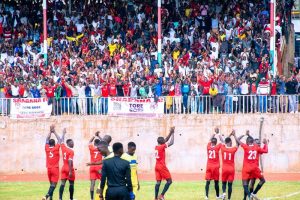
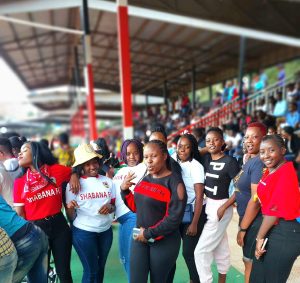
    Shabana FC patron Sam Nyamweya has reiterated his commitment to ensure Shabana FC challenges for the title in the 2023–2024 FKF Premier League seasons.

    Nyamweya, who is the former Football Kenya Federation President, said he is elated with the Kisii-based team’s promotion to the top-tier league for the first time since 2006.

    “I am thrilled to see Shabana regain their Premier League status. It is something we have worked hard to achieve, and my word of praise goes to the players and the fans, who have been very supportive to make it a reality,” said Nyamweya.

    He promised to rally behind all leaders from the region to support the team financially and morally to ensure it finishes in the top 10 positions next season.

    “Our major priority right now is to make sure they have the support of the whole Gusii community as they embark on their Premier League journey; we want to make sure they are the club that everyone in the league wants to defeat.

    “We will make sure they challenge for the title in the new season; it is possible; they have shown they can do it in the lower league, and with everyone’s support from the Gusii community, they stand a good chance to make it on their first attempt after earning promotion,” added Nyamweya.

    Shabana FC, famously known as Tore Bobe, sealed their promotion on Sunday following a 1-0  away win to Migori Youth, which put them on level on 64  points with Murang’a Seal with a match in hand.

    The solitary goal was scored by Isaac Otieno.

    Following a 1-0 away victory against Migori Youth on Sunday, Shabana FC, also known as Tore Bobe, officially cemented their promotion.

    The victory brought them even in points with Murang’a Seal with a game in hand.
    Isaac Otieno was the one who scored the goal.

    “I would like to convey my compliments to the whole technical bench as well as to all other staff members who never gave up even when it appeared they would not be promoted. This accomplishment was made possible by the management’s and the players’ unwavering dedication, said Nyamweya.

    Shabana’s next assignment will be against Darajani Gogo at Camp Toyoyo this Saturday,before welcoming MCF on the 27th at the Gusii stadium .

    The elevation of Shabana FC, the third-largest community club in the nation after Gor Mahia and AFC Leopards, reignites the rivalry in games against the two teams.

  • KPDA warns of looming shortages and price increase in pharmaceuticals

    KPDA warns of looming shortages and price increase in pharmaceuticals

    The Kenya Pharmaceutical Distributors Association (KPDA) has issued a warning about looming shortages and price increases in pharmaceuticals and other health technologies.

    According to KPDA Chairman Dr. Isaac Muruchu, unless the government, through the ministry of trade, intervenes and regulates the prices of pharmaceuticals, there is a likelihood of product shortages and an abnormal price increase in the market, which will in turn render many Kenyans unable to afford medication.

    Dr. Murichu also pointed out the increase in the number of cartels in the Kenyan market with no price control, which has left Kenyan patients at the mercy of the drug importation companies, which dictate the retail prices of medicines.

    “One way is to remove all cartels controlling prices and allow market forces to dominate. More players should be allowed in the market so that supplies can exceed demand and prices will automatically fall.

    The government also needs to come in and regulate the prices of medicines and other health technologies.

    “No government in its right sense can allow the health of its people to be controlled by cartels who want to sell lifesaving medicines at the price they deem fit for profit repatriation back into their countries.

    Equally, the government should revamp our local manufacturing pharmaceutical firms so that this country can be self-sufficient,” said Dr. Murichu in his statement.

    “KPDA remains committed to ensuring that Kenya will continue to have access to affordable, safe, and efficacious medicines through parallel importation and that the Kenya Kwanza government should support the KPDA initiative in ensuring that this happens,” added Dr. Murichu.

    KPDA has been engaged in alternative  sourcing of health technologies  and products from international markets   Since 2005.

    “In Kenya, the government does not regulate the cost of medications, hence these businesses set the price of their products based on their own evaluations. Since there is no price regulation in Kenya, they view it as a primary market, and as a result, they will even price their products to make up for losses they have suffered in other countries.”emphasized Dr Murichu

    According to Dr Mirichu this has resulted into high cost of  drugs and medicines ,as  pharmaceutical costs in Kenya are more than 500% to 700% more than they are in other nearby markets and even in other nations like the UK, Germany, the US, and India.

    “Medicines are not Luxuries; they are lifesaving commodities and should not be seen as normal commodities of trade. The stakeholders, KPDA, KAPI, and PPB agreed on the 2019 guidelines for parallel importation. The said guidelines were gazette by the former CS for health Sicily Kariuki. Up-to-date, they have never been implemented. KPDA has been more than willing to comply with the said guidelines for the establishment of a clear and transparent process.” added Dr Murichu

    The association is calling for urgent intervention and attention from the government to regulate prices of  pharmaceuticals to ensure Kenyans are protected from money minded individuals in importation and sale of medicines and drugs  in the country.

  • “Iam indebted to my father” says  Karan ahead of next week’s WRC Safari Rally

    “Iam indebted to my father” says Karan ahead of next week’s WRC Safari Rally

    Karan Patel, the champion of the Kenya National Rally Championship (KNRC), claims that his father is the reason for everything.

    The 32-year-old said that his father, Kiran Patel, had supported him at every turn.
    Patel, a trained Level 2 NDT aerospace inspector and licensed aviation engineer, reflected on how his father inspired him to take up the sport as he continued to train for the 2023 World Rally Championship (WRC) Safari Rally, which is scheduled for June 22–25 in Naivasha.

    “My dad’s invitation to take part in a chance rally event was a turning point in my professional life.

    I first mentioned my desire to rally with him when he was invited to participate in one of these gatherings as a veteran, said Patel.

    “He shockingly told me that it is something I could consider taking up if I successfully finished my degree and secured a job back home. And that’s what happened.”

    If Patel’s most recent successes are any indication, it has been a success story ever since.
    Leroy Gomez of Zambia won the Africa Rally Championship last year, but Patel still managed to win the KNRC championship overall, the Motorsport Personality of the Year Award, and the Division One championship.

    He is currently focused on improving upon his eighth-place overall showing in the 2021 World Rally at the next world championship in Naivasha.

    Through the Red Bull Tryouts Challenge, rally aficionados get a chance to participate in a unique rally experience with Karan Patel.

    Tauseef Khan, Patel’s longtime companion, will drive a Ford Fiesta Rally 2 for his KCB-sponsored squad, which has a partnership with Red Bull.

    Patel will be driven by his longtime partner Tauseef Khan in a Ford Fiesta Rally 2 that is categorized in the WRC2 category. Tauseef Khan’s team is supported by KCB and has a partnership with Red Bull.

    “My desire to succeed and excel is by far what drives me. I want to maintain my position as the top for as long as I can so that I may later use it to develop new potential. Making my family happy is very important.

    I work hard to make the most of the resources my family has invested in me in order to increase my prospects of becoming a professional rally athlete. My family has invested a lot of money to get me to the level that I am racing at now.

    Making my family happy is very important.

    I work hard to maximize the funds invested in me so that my chances of becoming a professional rally athlete remain greater than normal. My family has invested a lot to get me to the level where I am racing now.

    According to Patel, he participated in a variety of sports as a youngster, including swimming, tennis, hockey, and rugby. I used to compete for my school in a variety of sports.

    KBC Channel 1 will televise the championships starting  22nd June through 25th of this month with the event set to be flagged off by President William Ruto.

  • Majority of domestic workers  don’t access  social protection

    Majority of domestic workers don’t access social protection

    The Ministry of Public Service Gender and Affirmative Action estimates that just 6% of domestic workers globally have access to full social protection.

    The State Department’s Permanent Secretary for Gender and Affirmative Action, Veronicah Nduvah, observes that 94% of domestic workers do not have full social protection.

    These figures were released on Domestic Workers Day this year, which was observed under the theme “safe and decent work for domestic workers.”

    Eveline Senerwa, another domestic worker, has had difficulties in performing her job duties.

    Kudheiha addressed the injustice and mistreatment that domestic workers experience at the celebration of domestic workers day in Nairobi and urged for the ratification of the International Labor Organization conventions 189 and 190, which establish the fundamental rights of domestic workers.

    This was reiterated on Friday when Kenya joined the world in marking this year’s international day of the Africa Child.

  • Refugee registration key in international protection

    Refugee registration key in international protection

    The importance of refugee registration as a tool for international protection was reiterated by attendees of the third global consultation on the health of refugees and migrants, which took place from June 13 to 15 in Rabat, Morocco.

    During the meeting  the significance of refugee registration for maintaining the integrity of refugee health and social protection systems in the “Rabat Declaration” agreed at the Consultation.

    Multiple United Nations General Assembly resolutions as well as various recommendations from the Executive Committee of the United Nations High Commissioner for Refugees (UNHCR) emphasized  the need of refugee registration and census.

    Political considerations should never be viewed as a barrier to properly registering those who require international protection, such as refugees and migrants, in conformity with international norms.

    The 3rd Global Consultation on the Health of Refugees and Migrants, the first of its kind in an Arab and African country, was hosted by the Ministry of Health and Social Protection and sponsored by the World Health Organization (WHO), the Office of the High Commissioner for Refugees, the International Organization for Migration, and the Office of the High Commissioner for Refugees.

  • International recognition of Morocco’s role in inter-Libyan dialogue

    International recognition of Morocco’s role in inter-Libyan dialogue

    The role played by Morocco in bringing the inter-Libyan dialogue to a successful conclusion within the framework of the “6+6” Joint Commission has been universally praised by regional and international organizations, the diplomatic corps of numerous nations, and numerous media outlets. They have praised the Kingdom’s active commitment to a political transition in this country through the electoral process.

    Stéphane Dujarric, the spokesperson for the Secretary-General at the UN, thanked Morocco for helping the Libyan parties gathered in Bouznika to reach an agreement on the electoral regulations.

    In his daily press conference, the spokesperson said, “We thank Morocco for facilitating the efforts” of the “6+6” Joint Commission members charged with creating the voting rules in Libya.

    The “6+6” Libyan Joint Commission conference, which took place in Bouznika from May 22 to June 6, reached an agreement on the rules regulating the presidential and parliamentary elections planned for the end of the year, and the United Nations Support Mission in Libya (UNSMIL) congratulated Morocco for hosting it.

    The Mission thanked Morocco for hosting the 6+6 Commission and conveyed its appreciation for their efforts in a statement.

    The African Union (AU) welcomed Morocco in a similar manner. Chairman of the AU Commission Moussa Faki Mahamat tweeted, “I congratulate the Kingdom of Morocco on its facilitation.”

    Ahmed Abou El Gheit, the secretary general of the League of Arab States, also welcomed Morocco’s efforts and expressed his hope that they would “encourage the Libyan parties, following the compromises announced, to overcome the obstacles that remain.”

    The General Secretariat of the Organization of Islamic Cooperation (OIC), in a similar vein, praised the Kingdom for its contribution to the achievement of these concessions.

    The General Secretariat of the Arab Maghreb Union (AMU), which praised Morocco’s efforts on behalf of the Libyan brothers as well as the strategy used by the Kingdom to give them the proper space for consultation and dialogue “far from any foreign pressure,” expressed the same degree of satisfaction.

    The “6+6” Joint Commission’s compromise on the laws governing the election of the Head of State and lawmakers was welcomed by the Cooperation Council for the Arab States of the Gulf (GCC) Ministerial Council, who described it as a “positive and constructive” step in the right direction.

    Several foreign missions accredited to Morocco hailed the country for their dedication as well. The British and Irish embassies expressed their appreciation for the Kingdom’s hosting of the “6+6” Joint Commission in tweets. They also praised the diplomatic efforts of Morocco for their part in settling this dispute.

    The Croatian embassy, for its part, welcomed Morocco’s initiatives to support the “6+6” Joint Commission dialogue and find a solution in the hopes of resolving the political crisis in Libya, highlighting “the Kingdom’s strong and positive commitment to a peaceful political transition in Libya, through the electoral process.”

    The embassies of Switzerland and the Netherlands in Rabat also praised Morocco’s “very positive” support for the orderly political transition in Libya in tweets.

    Saudi Arabia praised “the efforts of the brotherly Kingdom of Morocco to make the dialogue succeed and reach a compromise, with a view to achieving a political settlement in Libya”. The Saudi Ministry of Foreign Affairs published the statement.

    Iraq greatly praised Morocco’s efforts in facilitating a productive debate and reaching a settlement about the election legislation in Libya while giving political parties the chance to play a significant role in the electoral process.

    The Mauritanian government applauded the “great efforts made by the Kingdom to reconcile the views of the various Libyan parties in order to reach this important agreement, which paves the way for the establishment of the necessary conditions for the completion of the Libyan electoral process in the best circumstances and in a consensual and participatory manner,” through its Ministry of Foreign Affairs.

    Egypt likewise lauded the work of the “6+6” Joint Commission in a statement released by the Ministry of Foreign Affairs, praising the Kingdom for hosting the commission’s activities.

    The UAE Ministry of Foreign Affairs praised “the efforts of the brotherly Kingdom of Morocco to make the dialogue successful and reach significant compromises aimed at achieving a lasting peace” in a statement that was identical.

    Jordan praised the Kingdom of Morocco for its contribution to the successful negotiation and agreement between the Libyan parties over the scheduling of the presidential and parliamentary elections.

    The “6+6” Joint Commission, which was charged by the Libyan House of Representatives and High Council of State with establishing the legislation regulating presidential and legislative elections in Libya, came to an agreement in the Moroccan city of Bouznika, which was warmly welcomed by the Jordanian Ministry of Foreign Affairs.

    The same was true for Yemen, where the Ministry of Foreign Affairs applauded the concessions made by the “6+6” Joint Commission following two weeks of discussions in Morocco over the rules regulating the presidential and parliamentary elections planned for the end of the year.

    The “6+6” Joint Commission was tasked by the Libyan House of Representatives and Council of State with drafting laws governing the presidential and parliamentary elections scheduled for the end of the current year. After roughly two weeks of meetings in Bouznika, the members of the Joint Commission came to a significant consensus, which was praised by the Kingdom of Bahrain.

    Through its Ministry of Foreign Affairs, the State of Qatar thanked Morocco on Sunday for helping to facilitate communication and consultation between the Libyan parties and for its efforts in hosting the negotiations.

    Additionally, a number of foreign media outlets emphasized the significance of Morocco’s contribution to the Libyan conversation. These included the Italian media, who deemed this action “crucial” in the endeavor to end the Libyan conflict, and the Argentine news outlet Alternate Press Agency, which lauded the Kingdom’s tenacious efforts in an analysis by Argentine political analyst Adalberto Agozina.

    The “6+6” Joint Commission said on Tuesday night that its members had reached an agreement on the legislation regulating the presidential and parliamentary elections slated for the end of the year following two weeks of negotiations in Morocco.

    The Bouznika meeting is a continuation of the series of gatherings the Kingdom has hosted, bringing together the various Libyan parties in order to deepen discussion on strategies for ending the nation’s crisis, using a strategy that creates the ideal environment for productive consultation and discussion.

  • Kipyegon rewarded 5 million and a mansion  by President Ruto  upon her  return

    Kipyegon rewarded 5 million and a mansion by President Ruto upon her return

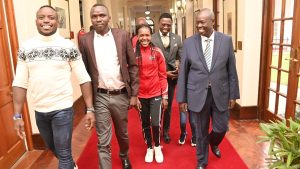
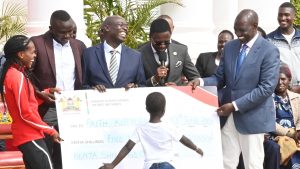
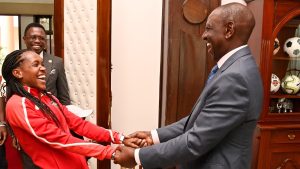
    Double World Record Breaker Faith Kipyegon has been rewarded with Ksh 5 million and a 3-bedroom house worth Ksh 6 million from President William Ruto at the Nairobi Statehouse upon her return home on Tuesday.

    President Ruto congratulated Kipyegon for her achievement, reiterating the government’s commitment to supporting excelling sportsmen and women and improving sports facilities.

    At the same time, President Ruto announced a new government reward scheme where any world record breaker will receive Ksh 5 million.

    “In our new plan to appreciate our gifted achievers in sports and the creative arts, a world record breaker will be rewarded with Ksh5 million and be considered for a diplomatic passport and other national honors,” “said President Ruto.

    At the same time, President Ruto rewarded 100-meter Commonwealth champion Ferdinand Omanyala with Ksh 2 million following his success in sprints.

    Kipyegon broke two world records in a span of 8 days running in 3:49.11 in the Florence Diamond League to smash Genzebe Dibaba’s previous world record of 3:50.07 set in 2015, before shattering 2020 Letesnetbet Gidey’s  5000M world record of 14:06.62 setting  a new world record of 14:5.20 in last Friday’s Paris Diamond League.

    The double Olympic and World champion over 1500 meters couldn’t hold her emotions as she promised to buy a car for her father. “I can finally buy my father a car,” said the 29-year-old mother of one daughter.

    Speaking during the brief ceremony, Sports CS Ababu Namwamba hailed Kipyegon, adding that his ministry will prioritize and recognize the role played by sportsmen and women in marketing Kenya abroad.

    “Kenya’s number one export to the world is our sportsmen and women; they brand Kenya in a manner that nothing else does.

    Faith breaking two world records in a week has put Kenya in the global spotlight, and we must find a way as a country to honor and appreciate that.

    We did not have guidelines on how to deal with national honors for our sportsmen and women when they excelled; now we do, and it will be clear through this revised new scheme of rewarding” sai Namwamba

    Other athletes who flanked Kipyegon at the statehouse ceremony included world 3000 msc  record holder Beatrice Chepkoech, Commonwealth champion over 800m Mary Moraa, 2017 world marathon champion Geofrey Kirui, and two-time world cross country champion Geofrey Kamworor.

  • The Safari Rally journey

    The East African Coronation Rally, which later became the Safari Rally, was founded in 1953 as a driving celebration to honor Queen Elizabeth II of England’s coronation. Queen Elizabeth II was on vacation in Kenya in 1952 when she learned of the passing of her father, King George VI.

    Early in 1952, Eric Cecil, his cousin Neil Vincent, and their friend Eric Tromp were having a drink together and talking about motorsport when the idea for the Safari Rally came to them.

    DP-Marwaha-and-Vic-Preston-Senior Ford’s first Safari victory in 1955 in a Zephyr

    The Rolund Mountain Trial and a racing track at Langa Langa in Nakuru were two unusual hill climbs that were part of the race’s early iterations.

    The first safari traveled 5,160 kilometers in difficult conditions since Kenya was experiencing the state of emergency.

    The East African Standard newspaper and Shell Oil contributed 500 pounds each to the inaugural coronation rally’s sponsorship total of 1000 pounds, which at the time was a significant sum of money.

    Joginder-singh  with his brother  Jaswant Singh after winning 1965 Safari Rally 

    The legendary driver Joginder Singh made history when he and his brother Jaswant Singh won the 1965 Safari Rally in a Volvo PV44 and again in 1974, this time in Colt Lancer versions.

    In the 1960s, Tanzanian Bert Shankland, who was driving a Peugeot, won the East African Safari Rally.

    In 1972, Hannu Mikola and Gunnar Palm, driving a Ford Escort RS1600, became the first foreign competitors to ever win the Safari Rally.

    Many drivers entered the early championship, but owing to its challenging conditions, only a select handful was able to finish.


    Bert-shankland competing in the East African Safari Rally in 1960″s 

    In the WRC era, Shekhar Mehta and Mike Doughty won four of their five Safari Rally championships.

    Before 1972, when Hannu Mikola and Gunnar Palm in a Ford Escort RS1600 from Europe won, European and later Asian drivers had been competing for all 19 years without success.

    When Shekha Mehta, a young phenomenon, stopped Mikola in a Datsun/Nissan, their third triumph following Edgar Hermann and Hans Schuller in 1970/71 in a Datsun 1600SSS, the FIA, then FISA, included the Safari in the World Rally Championship (WRC).

    After that, European manufacturers predominated the safari rally, starting with the VW Beetle in the 1950s, followed by Ford, Mercedes, and Peugeot in the 1960s.

    Driving a Toyota Celica GT4 Turbo, Ian Duncan and Ian Muroe became the final Kenyans to triumph at the 1994 WRC Safari Rally.

    Hannu Mikola and Gunnar Palm became the first overseas drivers to win the Safari Rally in history driving a Ford Escort RS1600 in 1972

    After Tanzania withdrew because its political ties to Kenya were deteriorating, the Safari was renamed the Kenya Safari Rally in 1974. In a Colt Lancer, Joginder won both that year and in 1976.
    Vic Preston Junior, whose father Vic Preston Senior won the rally in, was the first local driver that Europeans used to enhance their vehicles and provide them with one-off, total assistance as they prepared to conquer Africa completely.

    He accomplished the same exploits again in 1978 and 1981. Before anything happened, he would always outrun the best.

    Shekhar Mehta and Mike Doughty in action.

    Factory and European drivers continued to have a mixed record, with victories in 1975, 1977, and 1978 before Mehta produced four straight wins (1979–82).

    Kenyan drivers were then forced to finish in second place for the following 12 years until Duncan’s victory in a works Toyota Celica in 1994, which was significant as it was the last victory by Kenyan drivers.

    From 2002 to 2020, the Safari Rally was not included on the WRC schedule. This changed after the Kenya Motorsport Federation and the Kenyan government implemented the required security upgrades and complied with FIA regulations.

    The 1999 WRC was won by Phineas Kimathi and Abdul Sidi.

    Onkar Rai competing in 2021 WRC  Safari Rally

    By publishing Gazette Notice Number 181 on November 1, 2017, the Kenyan government sanctioned the WRC Safari Rally Project to bring the safari back to the WRC by 2020.

    Kenya formally requested the opportunity to compete in the World Rally Championship again since 2002 in 2018, and the WRC Promoter accepted that request.

    On June 21, in Paris, France, and in the presence of FIA President Jean Todt, the Promoter’s Agreement was signed by Peter Kaberia, Principal Secretary in the Ministry of Sports, Culture and Heritage, and Oliver Ciesla, Managing Director of WRC Promoter.

    Since its resumption Kenya has hosted succeful editions of the WRC Safari Rally under the new format in Naivasha with Sébastien Ogier Julien Ingrassia of Toyota Gazoo winnng the WRC main category and Kenyan Onkar Rai and Drew Sturrock winning the WRC 3 in 2021.

    Kalle Rovanperra of Toyata Gazoo competing in the  2022 WRC Safari Rally

    Kalle Ronavanperra of Toyota Gazoo racing team emerged champion in 2022,while Rai Amanraaj navigated by Panesar Gurdeep in icon Škoda Fabia being the best palced kenya in Rally2 .