Author: BBC News

  • China’s second typhoon in a week makes landfall

    China’s second typhoon in a week makes landfall

    A powerful typhoon has made landfall in China, the second to hit the country in a week, with nearly two million people evacuated from areas in the path of the storm.

    Typhoon Bavi, which spans 1,000km (620 miles) at its widest point roughly the width of France first came ashore in the coastal city of Taizhou on Saturday evening before making a second landfall in Wenzhou around midnight (17:00 GMT).

    After pummelling a chain of remote Japanese islands, it brought heavy rainfall to Taiwan as it brushed past its northern tip.

    Earlier landslides triggered by the storm killed at least 17 people in the Philippines.
    Getty Images
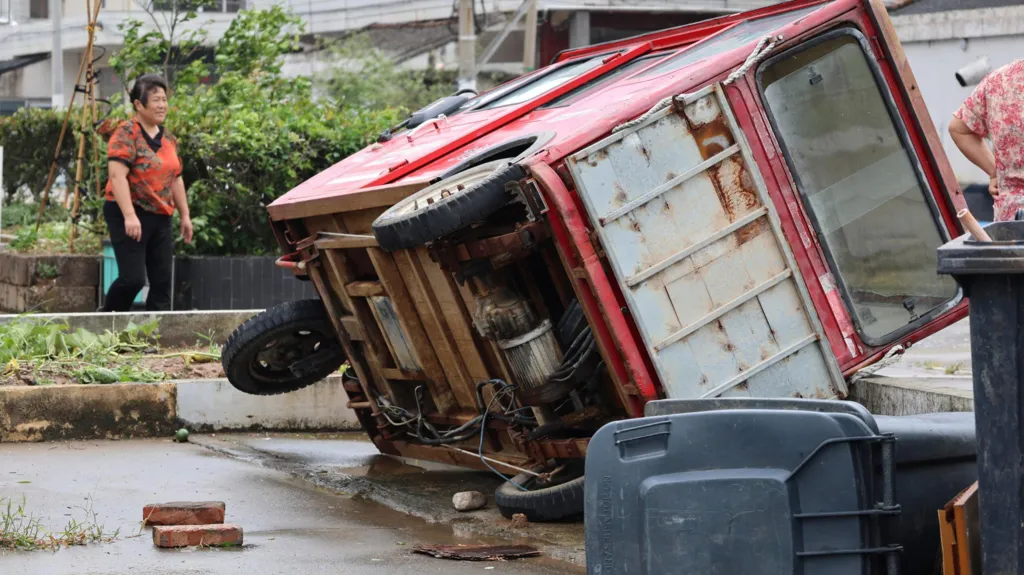
    A vehicle knocked over by winds in China’s eastern Zhejiang province on 12 July

    Though it has weakened to a severe tropical storm, it still presents a risk because of the huge volume of moisture within its rain bands.

    The storm is expected to gradually diminish in its intensity as it moves north-west.

    On Sunday morning, the centre of the typhoon reached Hangzhou City in Zhejiang province, Chinese state media reported.

    Forecasters said the typhoon would move to eastern Anhui on Monday, and to the northern Yellow Sea from the Shandong Peninsula on Tuesday.

    More than 1.7 million people were evacuated in Zhejiang and thousands more in neighbouring provinces, state media said. Schools, work and outdoor activities have been suspended in Zhejiang, while 400 flights and dozens of train services have been cancelled.

    The city of Wenzhou, home to around 10 million people, is close to the path of the storm, with authorities evacuating hundreds of thousands of residents.

    “We could hear roof tiles and tree branches falling,” Li Liangxing, a resident of the city told Reuters, adding “of course we were scared.”

    Beijing had ordered the evacuation of 100,000 people to “avoid risk”, officials said.

    Bavi began as a super typhoon, battering Guam and the Northern Mariana Islands last Monday with wind speeds of 290km/h (180mph).

    As it made its way through the Pacific, weakening to 144 km/h winds, it struck the Sakishima islands, part of Japan’s Ryukyu island chain between the country’s main islands and Taiwan. At least five people were injured and thousands were without power.

    Taiwan itself did not receive a direct hit but thousands of people were forced to leave their homes and there was a danger of landslides after heavy rain. Neither country has reported any deaths.

    Taiwanese authorities had warned that Bavi could bring up to 1m (39 inches) of rainfall.

    Dozens of flights have been cancelled while schools have suspended classes across the region. Supermarket shelves have been wiped clean as residents stock up on supplies.

    Parts of southern China are still reeling from the devastation brought by Typhoon Maysak earlier this week.

    Maysak left at least 39 people dead and killed large numbers of livestock, resulting in massive agriculture loss. It also spurred two rare tornadoes in the central Hubei province.

  • US launches fresh strikes as Iran closes Strait of Hormuz

    US launches fresh strikes as Iran closes Strait of Hormuz

    The US said it launched a fresh wave of strikes on Iran after Tehran struck a ship passing through the Strait of Hormuz.

    Iran’s Islamic Revolutionary Guard Corps (IRGC) said it closed the waterway until further notice and warned of a severe response to US “aggression”, according to state media.

    Within hours of the US strikes, the IRGC said they had hit a US base in Jordan, while the United Arab Emirates, Qatar, Kuwait and Bahrain were all responding to missiles and drones from Iran.

    It comes after incidents earlier this week in which three commercial tankers were attacked, prompting an exchange of strikes with the US.

    US Central Command (Centcom) said it launched a third round of strikes this week after the IRGC “blatantly attacked” a Cyprus-flagged vessel in the Strait of Hormuz.

    Centcom said the MV GFS Galaxy was “unable to continue its journey” as a result of significant damage to the engine room. One civilian crew member was missing, it said.

    It said US strikes hit 140 Iranian military targets, including missile and drone sites, communication networks, and coastal surveillance locations.

    The UK’s Maritime Trade Operations (UKMTO) said it had been informed by military authorities that the crew of the vessel were forced to abandon ship and were in a lifeboat.

    “Iran was provided yet another opportunity to demonstrate adherence to the Memorandum of Understanding after being held accountable for earlier attacks on commercial vessels but has again failed,” Centcom wrote in a statement shared to X.

    The statement was shared by US Secretary of Defense Pete Hegseth, who wrote: “Iran made a poor choice. Now they pay.”

    The IRGC said the US had targeted “a number of coastal bases and telecommunications towers on the southern coast”.

    In response, Iran said its “first phase” of retaliation included strikes on the Prince Hassan Air Base in Jordan, saying it had destroyed the base’s command and control centre and MQ9 drone hangars.

    Earlier on Sunday, state media said Iran had closed the Strait of Hormuz until further notice after firing a naval cruise missile at a vessel that was attempting to sail along an unapproved route.

    The Guards said the vessel was “hit by warning shots and stopped” after ignoring repeated instructions, according to a statement carried by state news agency.

    It also warned that any US “aggression” as a result of the closure would be responded to with “severity” and new bases in the region would be targeted.

    Iran’s parliamentary speaker Mohammad Bagher Ghalibaf, who is also the country’s chief negotiator with the US, wrote on X that the “era of one-sided deals is OVER”.

    He went on: “We told you: keep your word or pay the price. Reality is knocking.”

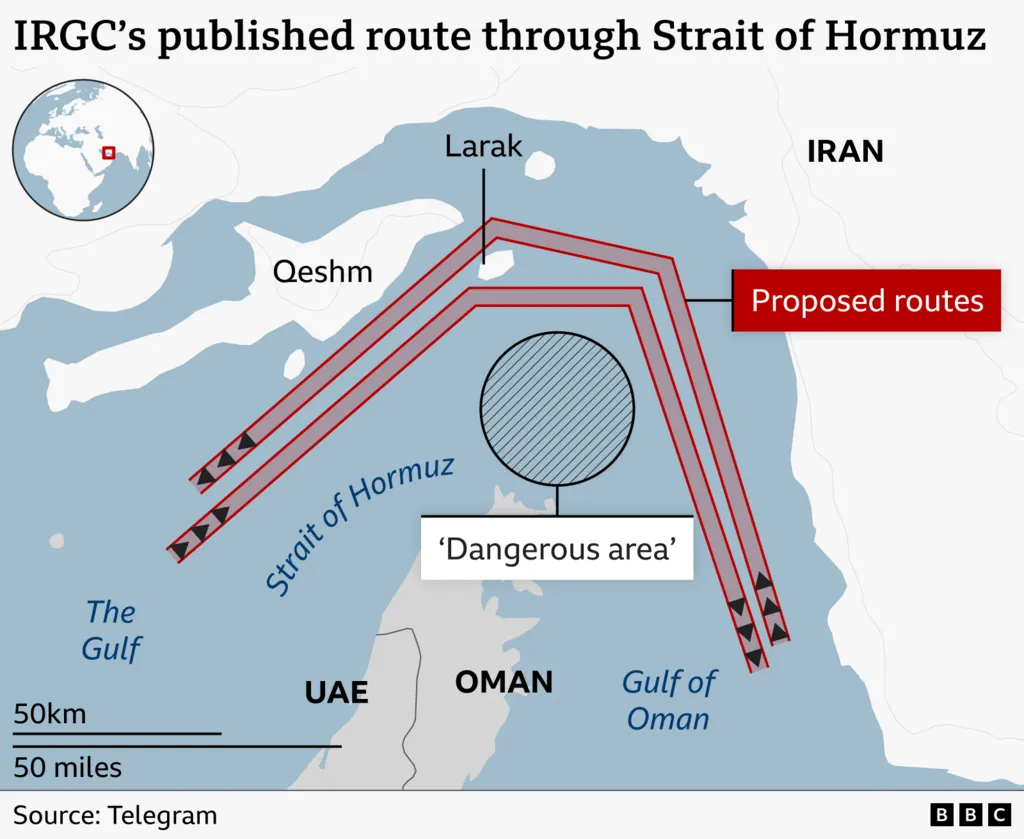
    The IRGC has said ships must use their proposed route through the Strait of Hormuz

    Earlier this week, three commercial tankers were attacked as they tried to cross a US-recommended route through Omani waters. Iran has repeatedly said the only “safe” route is a separate route through its waters.

    The incident prompted a series of US strikes in which 17 people were killed and 115 injured, according to Iranian officials. Iran responded with strikes on US allies in the Gulf.

    The exchange raised tensions, with US President Donald Trump declaring the Iranian attacks mean the ceasefire is over. Iran’s Foreign Minister Abbas Araghchi has accused the US of violating the deal.

    However, the US leader said talks would still continue and mediators were trying to revive the process. US media has reported that Iran told American officials the attacks on tankers were a mistake and blamed a rogue internal group.

    American officials say they have conveyed through mediators the demand that Iran publicly state that the Strait of Hormuz, a vital international shipping route, is open and pledge to stop firing on commercial ships.

    The closure follows a call for revenge from Iranian Supreme Leader Ayatollah Mojtaba Khamenei, in his first public statement since taking leadership.

    His father and predecessor, Ali Khamenei, was killed in an air strike on 28 February, on the first day of the US-Israeli war against Iran. He was buried in his home city of Mashhad on Friday.

    Reading a statement on state television, the new ayatollah said that vengeance was the “will of the nation”.

    “We pledge to avenge the blood of the martyred leader and all the martyrs of these two wars from the criminal and disgraced killers,” he was quoted as saying.

    “The matter depends neither on my personal existence nor on that of other officials. Whether we are present or not, it will come to pass.”

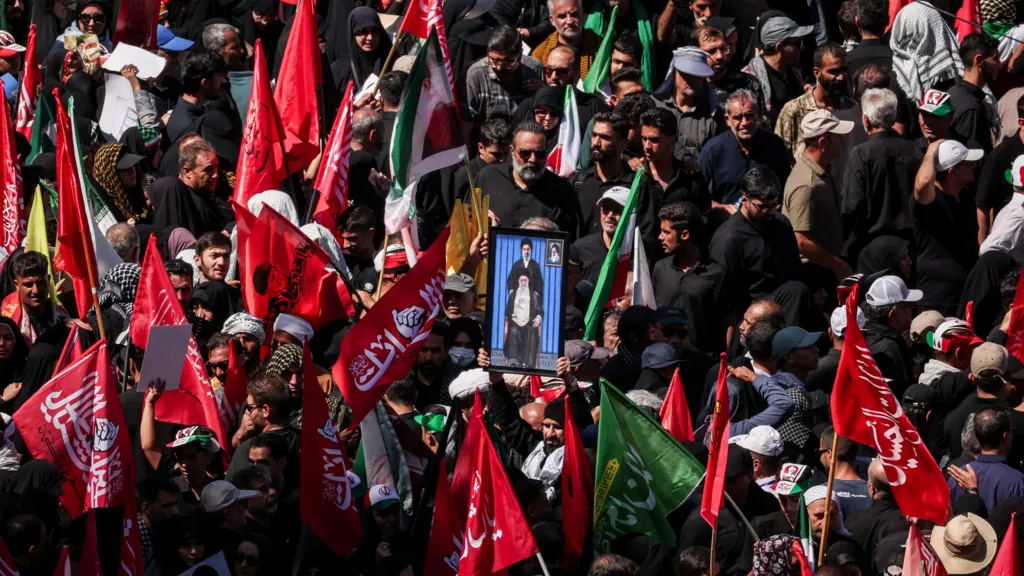
    Calls for the assassination of Donald Trump were heard at funeral ceremonies for Ayatollah Ali Khamenei in Mashhad

    Many Iranians taking part in funeral ceremonies over the past few days carried placards calling for the killing of US President Donald Trump, who on Saturday warned that any such plans would see the US “decimate and destroy all areas” of Iran in response.

    The Wall Street Journal and other US media reported this week that Israel had shared intelligence with Washington that Iran had recently devised a plan to assassinate the US president.

    However, Trump denied that Tehran had made a fresh plan or that Israel was the source of any intelligence. He told the New York Post in an interview that he had been “No. 1 [on Iran’s kill list] for a long time”.

  • Equatorial Guinea government resigns after failing to meet targets

    Equatorial Guinea government resigns after failing to meet targets

    Equatorial Guinea’s government has resigned after failing to meet its objectives, Vice-President Teodoro Nguema Obiang Mangue said.

    Obiang, who is also the son of President Teodoro Obiang Nguema Mbasogo, said the prime minister had presented the resignation of all members of the government because it had barely reached 10% of its targets.

    He did not specify the targets but a statement by the ruling party said the president had observed that the government fostered corruption and failed to diversify the economy.

    President Obiang is the world’s longest-serving leader who has ruled the oil-rich West African country since 1979 with a strong grip, while naming family members to key government roles.

    The president appointed the outgoing government in 2024, with Manuel Osa Nsue Nsua as prime minister.

    On Tuesday, the vice-president said the resignation was in line with “the principle that responsibility in public management must be accompanied by results”.

    “The degree of execution achieved is clearly insufficient in relation to the expectations and commitments undertaken,” he posted on X.

    In a statement on Facebook, the ruling Democratic ‌Party ⁠of Equatorial Guinea (PDGE) said the president was dissatisfied with the management of the outgoing government. A new government is expected to be appointed.

    The statement further cited the misuse of state resources for personal interests and stagnation in the implementation of development projects.

    The president also noted that the government had not implemented policies to diversify the economy especially in the agricultural sector, which would cut reliance on imported goods that can be produced locally.

    Equatorial Guinea’s economy is heavily reliant on petroleum, with oil and gas accounting for most of its exports and revenues.

    In spite of its oil wealth, much of its 1.8m population has not benefitted, as poverty remains rampant. In recent years, the economy has been on a decline amid reduced production and demand for oil.

  • Search for Ebola patient, six, after armed men storm DR Congo hospital

    Search for Ebola patient, six, after armed men storm DR Congo hospital

    Authorities in eastern Democratic Republic of Congo are searching for a six-year-old Ebola patient and her mother after armed men stormed the hospital where they were being treated.

    The child was taken from Wanamahika Hospital, in the city of Butembo, by “very angry” men with knives, local health official Dr Lubambo Maboko Gaston said in a statement.

    It is unclear whether the men were known to the child, but suspicion and fear surrounding Ebola treatment centres have been rife during the current outbreak.

    In an interview with the Reuters news agency, Gaston urged the child and her mother to go to a health centre, as they risked “worsening their health” and “infecting their relatives”.

    Ebola treatment facilities have come under attack multiple times during the ongoing outbreak, in which almost 200 deaths and 840 cases have been confirmed.

    Last month, police in the town of Mongbwalu fired shots in the air after angry crowds attempted to reclaim the bodies of loved ones who had died at a health facility.

    Days before, crowds set fire to isolation tents in hospital in Rwampara – a town 85km (53 miles) south-east of Mongbwalu – after they were prevented from taking the body of a man thought to have died from Ebola.

    The body of a dead Ebola victim is highly infectious and can lead to the virus spreading further when prepared for burial.

    “People are not properly informed or sensitised about what is happening. For a certain segment of the population, especially in remote areas, Ebola is an invention by outsiders – it does not exist,” local politician Luc Malembe Malembe told the BBC last month.

    “They believe it is the NGOs and hospitals creating this to make money, and this is tragic.”

    The outbreak has been caused by a rare species of Ebola known as Bundibugyo. There is currently no vaccine for this species and the World Health Organisation has said it could take months for a jab to be ready.

    Cases are currently concentrated in the provinces of Ituri, South Kivu and North Kivu, where the six-year-old girl was taken from the hospital on Monday.

    Ituri remains the main centre of transmission.

    The WHO has warned that conflict in eastern DR Congo is making it more difficult to tackle the Ebola outbreak. The M23 rebel group is in control of large parts of both North and South Kivu.

  • US and Iran exchange strikes in Gulf in latest test of ceasefire

    US and Iran exchange strikes in Gulf in latest test of ceasefire

    The shaky ceasefire between the US and Iran has been tested further, with American forces targeting Iranian drones and radar sites, and Iran firing missiles at US bases in the Gulf.

    The US military said the attacks were in response to four Iranian “one-way attack drones” launched towards the Strait of Hormuz, which it said “posed an immediate threat to regional maritime traffic”. The drones were shot down, US Central Command (Centcom) said.

    Tehran called the US strikes a “flagrant” violation of the ceasefire agreement between the two countries.

    Iran retaliated by firing ballistic missiles at two US air bases in Kuwait, and US Navy facilities in Bahrain, Iran’s Irib news agency reported.

    Bahrain and Kuwait both condemned the attacks, saying the drone and missile fire had been successfully repelled.

    Centcom said initial assessments showed that of the seven Iranian missiles fired at the two Gulf states, six were intercepted and one did not reach its target.

    The United Arab Emirates and Qatar also denounced the Iranian attacks on their Gulf neighbours.

    The Iranian foreign ministry said in a statement that the US strikes on radar installations in Sirik and at Qeshm island were a “flagrant” violation of the ceasefire and “an attack on the national sovereignty and territorial integrity of the Islamic Republic of Iran”, according to news agencies.

    “The US attack demonstrates this country’s complete disregard for the principles of international law and the United Nations Charter,” the statement added.

    Iran’s Islamic Revolution Guard Corps (IRGC) said it had hit “enemy bases” as retaliation to the American strikes.

    There have been several such exchanges of fire, threatening the ceasefire that has been in place since April.

    However, even with the conflict between the two nations continuing, the US has granted visas to Iran’s World Cup football team, ahead of their first match in Los Angeles on 15 June.

    It is the first time the competition will see a host nation receive the team of a country it is at war with.

    The attacks occurred as ceasefire negotiations between the US and Iran stalled, with a deal to end the war failing to advance, and US media reporting that President Donald Trump had requested changes to the terms of an agreement.

    On Monday, Iran’s foreign ministry spokesman said the US was “constantly changing its views and putting forward new or contradictory demands”.

    The US and Israel launched wide-ranging strikes on Iran on 28 February, sparking conflict across the Middle East.

    Iran responded by attacking Israel and US-allied states in the Gulf, and effectively closing the Strait of Hormuz, through which around 20% of the world’s oil and liquefied natural gas travels.

    That oil comes not only from Iran, but also Gulf states such as Iraq, Kuwait, Qatar, Saudi Arabia and the UAE.

    The closing of the strait sent oil prices soaring globally.

    Shortly after a ceasefire was agreed in early April, the US established a blockade of Iranian ports, which Trump said would remain “in full force and effect until an agreement is reached, certified, and signed”.

  • Peabo Bryson, ‘Beauty and the Beast’’ singer, dead at 75

    Peabo Bryson, ‘Beauty and the Beast’’ singer, dead at 75

    R&B singer Peabo Bryson, best known for his voice on Disney classics like ‘A Whole New World and ‘Beauty and the Beast’, has died aged 75.

    He died surrounded by family and loved ones, his family said in a statement.

    A cause of death has not been released publicly, but Bryson suffered a stroke over the weekend and had been receiving medical care.

    The veteran R&B singer was the voice behind hits that spanned from the 1970s to 2010s, including ‘Feel the Fire’, ‘I’m So Into You’, ‘Can You Stop the Rain’, ‘If Ever You’re In My Arms Again’ and ‘Reaching for the Sky’.

    “For more than five decades, Peabo’s extraordinary voice served as the soundtrack to some of life’s most cherished moments,” his family said in the statement.

    “His music carried generations through joyful celebrations, great love stories and enduring moments of comfort and inspiration, creating a legacy that will forever live in the hearts of those who loved him and the countless lives he touched through song,” they continued.

    Bryson won two Grammy Awards – in 1992 and 1993 – for two duet performances that went on to define a generation of Disney films: Beauty and the Beast with Celine Dion in the title track of the film with the same name, and A Whole New World with Regina Belle in the film Aladdin.

    “While our hearts are broken, we find comfort in knowing how deeply Peabo was loved and how many lives were touched by his voice and his generous spirit,” his family shared. “His legacy and music will live on for generations to come.”

    Bryson recently performed in a concert with Jeffrey Osborne in the US state of Georgia in May.

    He was set to perform several shows for his Golden Touch tour later this year, in celebration of his five decades in the music industry.

    Back in April, Bryson celebrated his 75th birthday and shared photos of his celebration with his family and friends on social media.

  • Trump unhurt and suspect in custody after shots fired at White House correspondents’ dinner

    Trump unhurt and suspect in custody after shots fired at White House correspondents’ dinner

    The United States of America (USA) President Donald Trump was Saturday rushed to safety from the White House Correspondents’ Dinner after gunshots were heard at the venue.

    According to US media reports, the incident occurred at the Washington Hilton hotel, where the annual dinner was underway.

    The President and First Lady Melania Trump appeared to be part way through a conversation at the Washington Hilton when he was interrupted by a commotion at the White House table.

    According to BBC, loud bangs could be heard and then various secret service members escorted the president away from the venue as they called out “stay down, stay down”.

    The president, first lady and all other protectees are safe, the Secret Service said later, after seven to eight gunshots were fired.

    The suspect was arrested. An officer was shot at close range, but his bullet-proof vest saved him.

    Speaking to the press after the incident, US attorney for Washington, Jeanine Pirro noted that the suspect is facing two counts for using firearm during crime of violence and assault on federal officers using dangerous weapon.

    She says the suspect will be arraigned before a federal court on Monday.

    This is the third shooting or attempted shooting that has taken place around Donald Trump in just the last few years.

    What we know about the suspected attacker

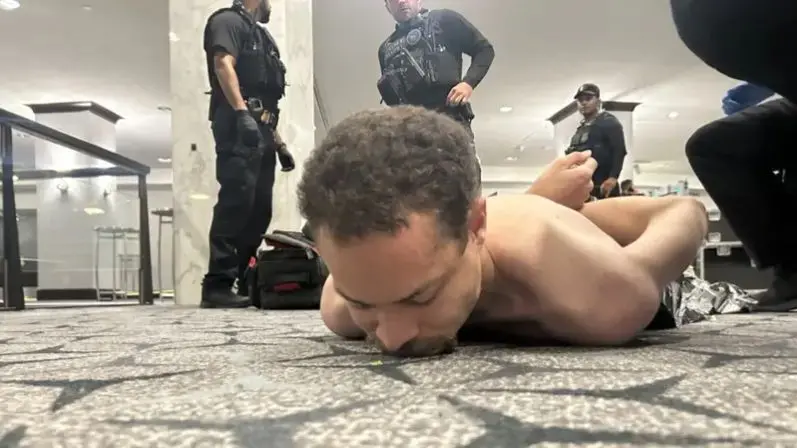
    The alleged gunman who fired shots at the White House Correspondents’ Dinner a few hours ago has been named as Cole Tomas Allen, according to US media.

    Photo of the suspect in custody, shared by Donald Trump

    The 31-year-old is reportedly from Torrance, California  in the south-western suburbs of Los Angeles.

    CBS News, the BBC’s US partner, says Allen worked as a tutor in Torrance after graduating from the highly regarded California Institute of Technology.

    Police say he was a guest at the Washington Hilton hotel, where the dinner was taking place, and was carrying multiple weapons – including guns and knives.

    Allen is receiving hospital treatment following the incident. He is expected to be formally charged on Monday.

    “I can’t imagine there’s any profession that’s more dangerous,” Trump said in the briefing room.

  • Seven dead in major Russian attack on Ukraine

    Seven dead in major Russian attack on Ukraine

    At least seven people were killed in Russian strikes across Ukraine overnight, including five in the central city of Dnipro, where officials said an apartment building was hit.

    Ukrainian President Volodymyr Zelensky said the latest attack lasted “practically all night”, while rescue workers were still searching for survivors under rubble in Dnipro on Saturday morning.

    British jets were scrambled from Romania during the heavy attack when Russian drones were detected near the border, though the UK Ministry of Defence rejected a report it had shot some down.

    Meanwhile, Ukraine carried out some of its longest-distance drone strikes deep inside Russian territory.

    In Yekaterinburg, almost 1,000 miles (1,600km) from Ukraine’s border, the governor said six people were injured when a building was struck – while in nearby Chelyabinsk, a local leader said drones targeting an industrial facility were intercepted.

    Russian missiles and drones also targeted the northern city of Chernihiv, where officials said two people were killed, as well as Odesa and Kharkiv.

    Ukrainian authorities said they repelled the vast majority of the more than 600 Russian drones, which appears to have been the largest attack in several days.

    Russia’s Ministry of Defence said it had shot down 127 drones over more than a dozen regions.

    The department also said it had taken control of Bochkove, a village in the Kharkiv region, on Saturday morning, according to state-linked news agency Tass.

    The settlement is close to Ukraine’s northern border with Russia, where invading forces have made repeated attempts to push further south towards the city of Kharkiv.

    Ukrainian authorities have not commented on Russia’s claim to have gained control of the village, nor has BBC News been able to independently verify it.

    Elsewhere, Romania’s defence ministry said it was investigating “the fall of an object” on its territory close to the Ukrainian border during the Russian attack.

    It also clarified a previous statement which appeared to suggest that British jets based in the country had shot down Russian drones, which would have been the first incident of its kind.

    With peace talks between Russia and Ukraine at an impasse, Ukraine continues to seek international backing for its military efforts.

  • Nigerian army rescues 31 held after Easter church attack

    Nigerian army rescues 31 held after Easter church attack

    Thirty-one civilians held hostage following a Sunday morning church attack in north-west Nigeria have been rescued, the army has said.

    Five others were killed as gunmen targeted Easter celebrations at a church in Ariko, Kaduna state, according to a statement from the security forces. A local church official had earlier put the number of dead at seven.

    The army said soldiers engaged the attackers in a “fierce firefight”, forcing them to flee and leave the hostages and the bodies of the dead victims behind.

    Attacks and kidnappings for ransom are common occurrences in northern Nigeria, as the country grapples with security threats from jihadist groups and armed gangs, locally known as bandits.

    Although the army said it responded swiftly to Sunday’s attack, local media report that residents said the gunmen operated for a long time without facing resistance.

    As a result of the firefight, officials said the “fleeing terrorists” had “significant casualties, as evidenced by blood trails along their escape routes”.

    Troops had also been deployed to hunt the insurgents and reinforce security.

    The army has urged residents to share information that can support operations against groups fuelling insecurity across the country.

    In a separate incident, Nigeria’s military killed 65 bandits following an offensive in Zamfara state, the AFP news agency reported on Sunday, days after a large group of bandits abducted residents from villages ‌in the state.

    Police had confirmed on Saturday that there had been a mass abduction in villages in the state earlier in the week and a manhunt had been launched.

    Late last year, the administration of US President Donald Trump raised concerns about the treatment of Christians in Nigeria – and urged the government to do more to improve security and strengthen protection for Christian communities.

    Trump had previously claimed there was a “Christian genocide” underway in Nigeria – an allegation strongly rejected by Nigeria’s government, which said Muslims, Christians and people of no faith were victims of attacks.

    In February, US troops were deployed to Nigeria to train its forces and help them with intelligence in their fight against Islamist militants and other armed groups.

  • Sudan drone attack on key hospital killed 64 people during Eid, WHO says

    Sudan drone attack on key hospital killed 64 people during Eid, WHO says

    Sudan’s army has denied it carried out a deadly attack on a major hospital on Friday night in a city in the west of the country held by its rivals, the paramilitary Rapid Support Forces (RSF).

    The head of the World Health Organization (WHO) said 64 people – including 13 children, two nurses and a doctor – had died in the strike on el-Daein Teaching Hospital and 89 others had been wounded.

    “Enough blood has been spilled,” Tedros Adhanom Ghebreyesus posted on X, urging the warring parties to end the conflict, which started nearly three years ago.

    The RSF said an army drone had hit the hospital in el-Daein, the capital of East Darfur state, on the day Muslims were marking the festival of Eid.

    Sudan was plunged into a civil war in April 2023 when a vicious struggle for power broke out between the military and the RSF, who had once been allies after coming to power in a coup in 2021.

    More than 150,000 people have since died in the conflict and about 12 million have fled their homes – nearly a third of the country’s population – in what the United Nations has called the world’s largest humanitarian crisis.

    Dr Tedros, who said el-Daein Teaching Hospital was no longer able to function following Friday night’s attack, condemned the frequent targeting of medical facilities.

    “Over the nearly three-year conflict, WHO has confirmed that 2,036 people have been killed in 213 attacks on health care, including Friday night’s strike,” the WHO chief said in his tweet.

    “The time has come to de-escalate the conflict in Sudan and ensure the protection of civilians, health workers, and humanitarians,” he said.

    “Health care should never be a target. Peace is the best medicine.”

    In a statement, the RSF said the strike had completely destroyed the hospital’s top floor, caused extensive damage to the accident and emergency department and destroyed vital medical equipment.

    In response, the military said it was surprised by the accusation it was behind the attack, adding that it abided by “international norms and laws”.

    The Emergency Lawyers group has called for an independent and transparent investigation and for those responsible to be brought to justice.

    The local rights organisation, which has documented atrocities by both the army and the RSF throughout the war, said the hospital in el-Daein was a vital health facility relied upon by thousands of civilians in the city and surrounding villages.